Spanish women’s football has spent years asking itself where the next champions will come from. This week, Liga F has decided to answer with a tournament.
It is called the Liga Futura Moeve and it is the first girls’ under-12 tournament jointly organised by the professional league and its main sponsor. The inaugural edition takes place from 12 to 14 June 2026 at the Ciudad Deportiva José Ramón Cisneros Palacios, Sevilla FC’s training ground. The academies of twelve Liga F clubs are taking part: 144 players in the under-12 age group and 28 matches spread across three days.
The project was officially unveiled on 1 June at the Moeve auditorium, with the president of Liga F, Beatriz Álvarez; the chief executive of Moeve, Maarten Wetselaar; and the president of the Spanish National Sports Council, José Manuel Rodríguez Uribes. The event included the group-stage draw and the presentation of the tournament’s official ball.
Álvarez also offered a statistic that explains why the professional competition has decided to look downwards: as she pointed out during the presentation, 70% of Liga F players come up through the academy system.
The groups
The twelve teams have been drawn into three groups of four:
Group A: Deportivo Abanca, FC Badalona Women, Madrid CFF and Atlético de Madrid.
Group B: Costa Adeje Tenerife, Levante UD, FC Barcelona and Sevilla FC.
Group C: Athletic Club, RCD Espanyol, DUX Logroño and Real Sociedad.
The list leaves out four Liga F Moeve clubs: Real Madrid, Granada CF, SD Eibar and Alhama CF ElPozo. The organisers have not publicly explained the criteria used to determine participation in this first edition.
How it works
The group stage is played between Friday and Saturday: a first round of matches on the morning of the 12th, a second in the afternoon and a third on Saturday morning.
The winners and runners-up of each group advance to the quarter-finals along with the two best third-placed teams. The teams that drop out of the title race carry on competing in the Silver Phase, with its own semi-finals and its own final. At these ages, playing is part of the prize too; the format is designed so that the experience does not end too soon for anyone.
Matches consist of two halves of 12 minutes, except for the semi-finals and final of the Final Phase and the final of the Silver Phase, which are extended to two halves of 15.
The tournament is decided on Sunday 14 June. The Final Phase final kicks off at 12:00 and the trophy ceremony is scheduled for 12:40. As well as the champions’ title, three individual awards will be handed out: MVP, top scorer and best goalkeeper (fewest goals conceded).
Fixtures and Kick-off Times
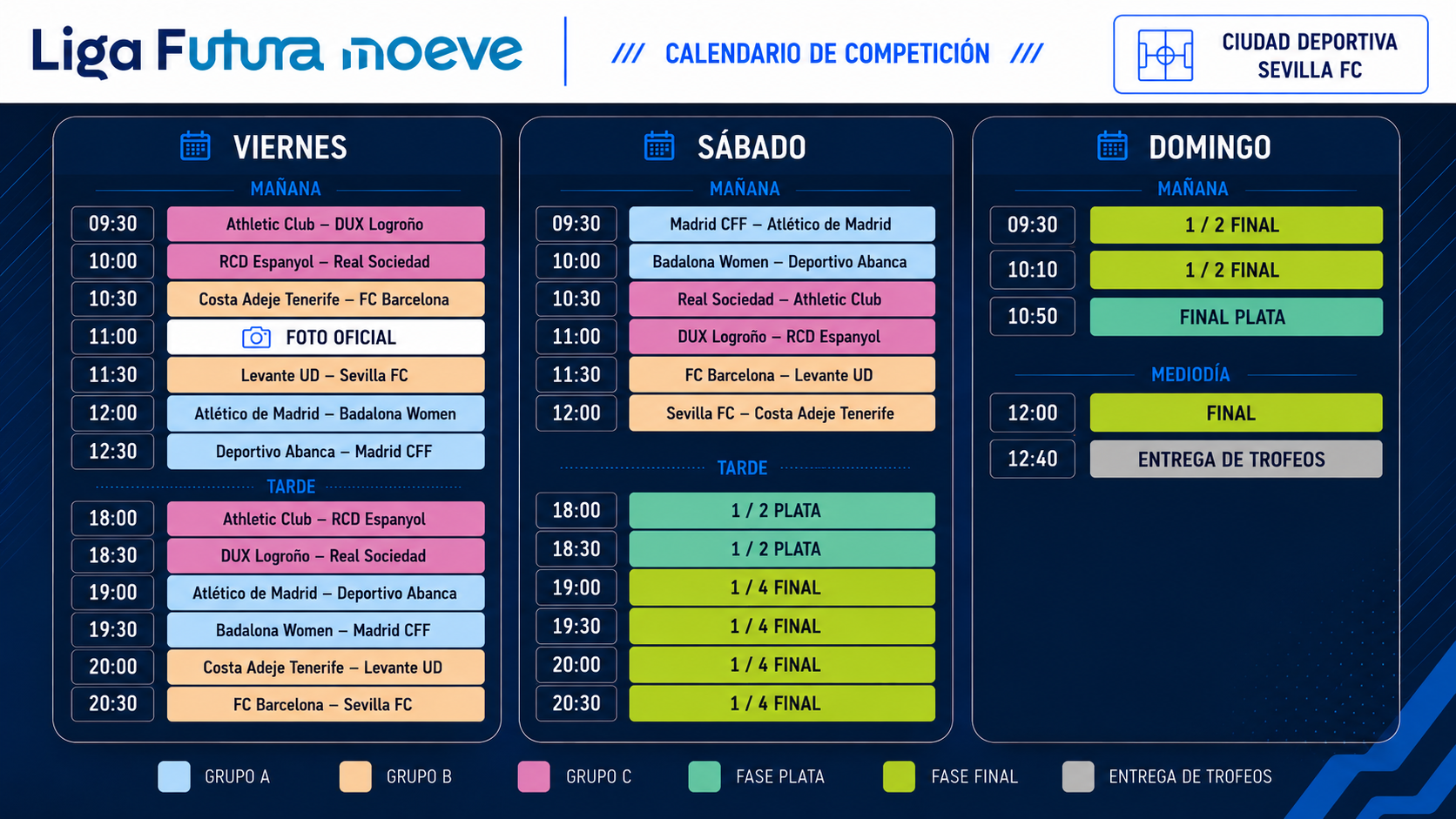
Below you can consult the full tournament schedule, transcribing the official fixtures:
Friday 12 June (Group Stage)
| Time | Match / Event | Phase / Group |
|---|---|---|
| 09:30 | Athletic Club – DUX Logroño | Group C |
| 10:00 | RCD Espanyol – Real Sociedad | Group C |
| 10:30 | Costa Adeje Tenerife – FC Barcelona | Group B |
| 11:00 | Official Photo | — |
| 11:30 | Levante UD – Sevilla FC | Group B |
| 12:00 | Atlético de Madrid – Badalona Women | Group A |
| 12:30 | Deportivo Abanca – Madrid CFF | Group A |
| Afternoon | ||
| 18:00 | Athletic Club – RCD Espanyol | Group C |
| 18:30 | DUX Logroño – Real Sociedad | Group C |
| 19:00 | Atlético de Madrid – Deportivo Abanca | Group A |
| 19:30 | Badalona Women – Madrid CFF | Group A |
| 20:00 | Costa Adeje Tenerife – Levante UD | Group B |
| 20:30 | FC Barcelona – Sevilla FC | Group B |
Saturday 13 June (Groups and Knockout Rounds)
| Time | Match / Event | Phase / Group |
|---|---|---|
| 09:30 | Madrid CFF – Atlético de Madrid | Group A |
| 10:00 | Badalona Women – Deportivo Abanca | Group A |
| 10:30 | Real Sociedad – Athletic Club | Group C |
| 11:00 | DUX Logroño – RCD Espanyol | Group C |
| 11:30 | FC Barcelona – Levante UD | Group B |
| 12:00 | Sevilla FC – Costa Adeje Tenerife | Group B |
| Afternoon | ||
| 18:00 | Silver Semi-final (1st) | Silver Phase |
| 18:30 | Silver Semi-final (2nd) | Silver Phase |
| 19:00 | Quarter-final 1 | Final Phase |
| 19:30 | Quarter-final 2 | Final Phase |
| 20:00 | Quarter-final 3 | Final Phase |
| 20:30 | Quarter-final 4 | Final Phase |
Sunday 14 June (Final Phases)
| Time | Match / Event | Phase |
|---|---|---|
| 09:30 | Semi-final 1 | Final Phase |
| 10:10 | Semi-final 2 | Final Phase |
| 10:50 | Silver Final | Silver Phase |
| 12:00 | Grand Final | Final Phase |
| 12:40 | Trophy Ceremony | — |
Official Tournament Infographic
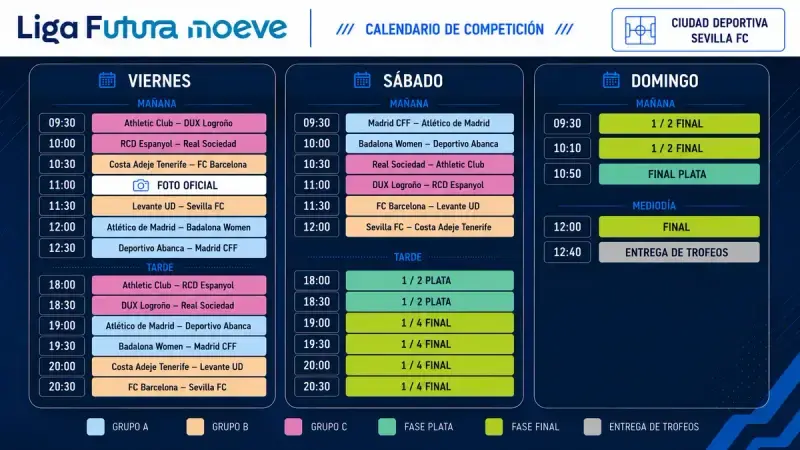 You can download the original infographic by clicking on this link.
Why it matters
It would be easy to dismiss all this as a publicity exercise with little girls. It would be a miscalculation.
The treasure of Spanish football lies at its grassroots. The 2023 world champions did not appear out of nowhere: they grew up in clubs, schools and academies that for years worked with less spotlight, fewer resources and less attention than they deserved.
The Liga Futura will not, on its own, solve the problems of grassroots football. It does not create teams in the places where they still do not exist, it does not correct the inequality of resources between academies, and it does not guarantee that a girl will be able to keep playing when her circumstances change. But it does add something that was missing for far too long: structure, visibility and institutional recognition.
Imagine being eleven years old. Imagine wearing the badge of a professional club in a tournament designed expressly for you; measuring yourself against other academies, playing a final phase in front of people who have come to the ground to watch you. Not as the warm-up act for someone else’s show. Not as a side activity. As a footballer.
And there is a coincidence of dates we do not want to let pass. The tournament begins on 12 June, the same day that “Pioneras. Solo querían jugar”, the film inspired by the women who stood up to the prejudices of the 1970s in order to play football, arrives in cinemas.
More than half a century separates those women from these girls. The former had to fight for football to recognise their right to be there. The latter already have a tournament designed expressly for them.
Between the two lies everything this sport has conquered, and everything that is still missing.
To me, that distance seems like the best reason in the world to be here, writing this.