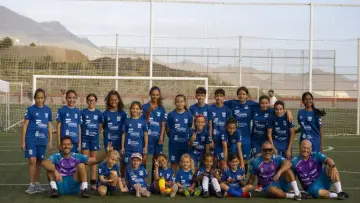
When the match that crowned them champions ended, the players of Real Betis’s under-12 girls’ team broke into a run.
It was not a European final, and there were no thousands of people in the stands. It was the conclusion of a grassroots league in Seville. For them, though, the celebration was exactly that size. “When the whistle went, we ran off in sheer emotion; we celebrated as if we’d won the Champions League final,” recalls one of the players.
They had won the 4ª Andaluza Alevín, Group 7 (Seville), a competition made up of boys’ teams. And they had not done it by surviving to the final day or taking advantage of a rival’s slip: they won all 26 matches they played. Twenty-six wins, no draws, no defeats, 200 goals for and 34 against. Seventy-eight points out of seventy-eight.
The numbers make the season exceptional. The voices of its protagonists explain how it was built.📊 Los datos de nuestro #RBBAlevínFem en la 4ª Andaluza Alevín Grupo 7 (Sevilla):
— Real Betis Féminas (@RealBetisFem) June 17, 2026
🏆 Campeonas de liga | 78 puntos
✅ 26 victorias
🤝 0 empates
❌ 0 derrotas
⚽ 200 goles a favor
🥅 34 goles en contra#BetisFéminas pic.twitter.com/AgkJ60SQIB
Dreaming before knowing whether it was possible
The team began the season without yet knowing its true level. It was a new group: the players did not know how they would work together or what tempo they would find against boys’ sides. The competition could turn into a learning experience, a physical challenge or a very hard season.
During pre-season the first sign appeared. The Betis girls faced teams from higher categories and found they could compete with them. “This year we’ve been in the fourth tier and we played a third-tier team and beat them, so we said: if we can handle this, we can handle our own league,” says one of the players. Those results gave no points, but they changed the way the group looked at itself.
Laura Martín, one of the under-12 coaches alongside Ana Bejarano —with Alejandro Domínguez as fitness coach—, introduced from the start an idea as ambitious as it is delicate to handle when working with children: they could dream of being champions, but the dream could not replace the work. “Let’s dream of winning the league,” she told them on day one. And, at the same time: “I get them to dream match by match and day by day.” First the dream; then the daily work to deserve it.
Winning also means learning
A perfect season can look simple when seen from the final table. It was not.
The players remember competitive rivals, demanding matches and games in which the physical difference became visible. “Physically is where the difference showed most in some matches,” they admit. “There were very competitive teams and it cost us a lot; we had to make a huge effort.” Winning a boys’ league was not only about having more talent on the ball: they also had to adapt to the contact, sustain the effort and find solutions when a match did not follow the script.
The team itself had to correct course as it went. “We were a bit frantic chasing goals, and in the end we started to pass it around and that’s when the goals came,” describes one of the players. The scene explains the season better than the 200 goals in the stats: the learning was not only in winning, but in understanding why they won.
A dressing room with no emotional substitutes
When the players explain what made the team special, they do not begin with goals or results. They begin with togetherness. They describe themselves as a family. “We have no envy among us; we’re a family,” they say. “When one of us is sad or things aren’t going her way, we help her.”
In grassroots football, that part of a player’s development matters as much as any technical drill. A perfect season does not mean everyone always played well or that no one had a bad spell. It means the group knew how to carry on when that happened. The unity of the dressing room is not an ornament added after the wins: it is one of the reasons that explain them.
They did not need protecting
The most immediate conclusion from a season like this would be to say that girls can also beat boys. But that reading falls short.
These players did not need 26 matches to prove that girls can play football. Nor should an exceptional team be used to argue that physical differences do not exist or that any girls’ side would sweep a boys’ competition. What the Betis season shows is something more specific and, for that reason, more valuable: when they were given training, continuity and a sufficiently demanding competition, the players responded. They did not need the level to be lowered to protect them. They needed a space in which their level could grow.
Playing against boys’ teams forced them to compete in different contexts and to live with a physical difficulty that appeared in some games. The title does not erase those differences. It shows that they should not always be used in advance to limit opportunities. Before it started, no one could guarantee they would win. That was exactly the point: they got to find out by playing.
Not the first time
It is worth saying, so as not to inflate the story: what Betis did is extraordinary, but it is not unprecedented. The Levante under-12 girls’ team has won a boys’ league two seasons running, and back in 2018 the Madrid CFF under-12s were champions of a boys’ competition with more than 150 goals for.
Far from taking anything away from Betis, that context makes it bigger: this is not an isolated miracle that happens once and never again, but a current that is repeating in more and more places. “Women’s football is growing little by little and we have made history, and as unbeaten champions too,” sums up one of the players. The second part is theirs. The first belongs to everyone.
The table does not discriminate
Betis’s under-12 girls finished the season without dropping a single point. The table did not need to explain that they were girls. It added no bonus for competing against boys’ teams, nor did it lower the value of their defeats, because they never happened. It only recorded what took place on the pitch: twenty-six matches, twenty-six wins.
There is one line, almost in passing, that sums it all up. A girl says it, and it ought to be framed in every debate about whether women’s football deserves a space of its own: “I’ve always played with boys, and when I’ve played with girls we’ve won every match against the boys.” They did not go out to teach anyone a lesson. They went out to play, to improve and to win their league. They managed it all twenty-six times.
Data and quotes from Real Betis (@RealBetisFem, 18 June 2026): champions of the 4ª Andaluza Alevín, Group 7 (Seville), with 26 wins in 26 matches, 78 points, 200 goals for and 34 against. Precedents: Levante UD (official club statement) and Madrid CFF (2018). Coaching staff (Laura Martín, Ana Bejarano, Alejandro Domínguez) per the club’s official website.