In 2024, a survey by Adecco asked more than 1,100 girls and boys aged 4 to 16 what they wanted to be when they grew up. The girls answered: teacher, first. Footballer, second.
The figure does not come from Liga F or the RFEF. It is what girls themselves said when asked how they imagined their future.
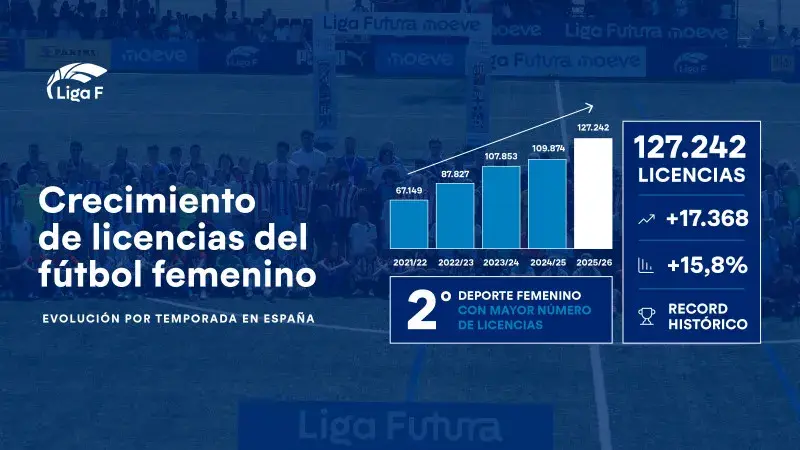
Liga F published its registration figures for the 2025/26 season today: 127,242 licences, 15.8% more than the previous year and almost double the total from 2021, before professionalisation. The league has an obvious interest in linking that growth to the professional competition. But the growth is real: in four years, Spanish women’s football has added more than 60,000 registered players. From 67,149 to 127,242. Nearly doubled in the time it takes a generation to go from under-10s to under-16s.
This is not just a statistical uptick. It is a change of scale.
The context missing from the press release
The number looks even more striking when viewed from outside the official statement.
Football is the federation with the most registered players in Spain overall, yet women still make up approximately one in ten of its members. Across all federated sport in Spain, women account for 25.5% of licences — three in every four still belong to men.
There is another figure Liga F’s release does not mention: women’s basketball closed the season with 163,770 registered players, more than football. The sport that holds itself up as Spain’s biggest has not yet led among women.
None of this makes the growth less significant. It puts it in its proper place.
Growing is not just about getting them through the door
The other angle the press release does not address is retention.
Celebrating new registrations is straightforward. The harder question is how many of those 127,242 players will renew their licence two, three or five years from now. Because between inspiration and continuity there is a chain of concrete conditions — as we detail in our guide to registering a girl in football — that cannot be taken for granted: a nearby club, a place in the right age group, training schedules that fit around school, facilities that are not whatever is left over, and an environment that takes the women’s team seriously rather than treating it as an add-on.
A system built for 67,000 players does not automatically become one capable of supporting 127,000. Demand can grow much faster than available pitches, qualified coaches or regional competitions with adequate infrastructure. And adolescence remains one of the most critical moments for dropout from sport — that problem does not disappear simply because more girls are joining.
The next key indicator should not only measure how many start. It should also measure how many stay.
What does explain the number
Professionalisation matters in this growth, but it does not explain everything. Over these four years Spain also won a World Cup, Barcelona consolidated one of the best clubs in Europe, and an entire generation grew up watching Spanish women footballers on television, in newspapers and in stadiums. Visibility opens a door that was previously closed: it is hard to picture yourself somewhere that never appears in front of you.
That is what the Adecco figure really shows. Girls are not saying they want to be footballers because a professional league exists. They say it because they now have someone to look at.
Liga F is right to celebrate the number. That is also their job. Ours is to remember that behind each licence is a girl who found a reason to play, and that reason cannot depend solely on professionalisation working at the very top.
127,000 licences. Nearly double the figure from four years ago. And an eight-year-old girl somewhere in Spain who, when asked what she wants to be when she grows up, says footballer.
That is a real change. The challenge now is making sure the structures are ready to receive it.