Here at FemGol we thought one of the most useful ways to help girls who want to play football was a simple one: make life easy for their parents. A clear, step-by-step guide so that any family would know how to sign their daughter up with a team. Age categories, paperwork, deadlines, advice. Something practical.
We hit the same wall that any parent who tries will hit: that information does not exist. Or rather, it half exists, scattered about and almost always designed for something else. Search for “how to sign my daughter up for football” and you find the academies of the big clubs, the odd stray forum and little more. The complete guide, the definitive one, we could not finish. And it turns out that this impossibility is, in itself, the story that deserved telling.
The little we can tell you (and it holds for any sport)
Let us start with what we do know, even if it is not exclusive to football or to women’s football.
Before looking for a club, talk to her. Ask her whether she wants to compete seriously or just have fun with her friends, whether she would rather play close to home or does not mind travelling. The decision is hers as much as yours. When you find somewhere, let her try it before committing: almost every club allows a trial training session, and the best sign is the simplest one — did she come out happy? From there on, the usual: do not pressure her, respect coaches and referees, understand that at these ages you are shaping a person before a footballer, and that enjoyment is what makes her want to come back.
This is good advice. But it is the same advice we would give the father of a boy. And what we discovered along the way is that, for a girl, the problem starts much earlier and is of a different nature.
The best advice we can give you
If you take a single idea from this article, let it be this one: ring your town hall.
It sounds unglamorous, but it is what genuinely works. Municipal sports services know the fabric of local clubs better than any search engine: they know which teams exist, which have a girls’ or mixed section and who to speak to. The regional federation is the other door: it can point you towards the clubs and competitions in your area. And, above all, do not underestimate a direct call to the club in your town with the simplest question of all: “Do you have a girls’ team, or a mixed one?”
What to ask in that first call
You do not need to know all the age categories yet, or understand how the federation works. Start with five simple questions:
- Do you have a girls’ or mixed team for her age?
- Can she come along to one or two trial training sessions?
- How much do registration, the licence and the kit cost?
- Where and on which days does the team train?
- If you have no places, do you know of a nearby club we could call?
It may seem like very little. But getting a clear answer to those five questions already stops many families from giving up before they have begun.
What this attempt at a guide taught us
Excellent training programmes do exist. In Galicia, to look no further, Celta and Deportivo offer schools using the methodology of their academies. They are not all alike: some let girls start from scratch; others complement the work of those already playing for a club; others are designed to refine or scout talent. They do valuable and necessary work.
But they do not, by themselves, solve the problem we are talking about. An academy tied to a professional club can bring football closer to many girls, but it is no substitute for the neighbourhood or village team: that simple, nearby, affordable place where a girl can train two evenings a week and play at the weekend with her friends without the whole family having to reorganise its life.
Celta’s own map of schools makes the difference plain. Their offering stretches across eight Galician localities and all their groups are open to girls and boys. Yet the girls-only formats are concentrated at a single site, at A Madroa, in Vigo. A girl may find a school relatively close to home; gathering a group of girls who play together remains far harder.
The real issue lies in the other lane, the one belonging to the majority. Because most girls do not want to turn professional: they want exactly the same as any boy. To train two evenings a week and play at the weekend with their friends. And there appears the crack that features in no brochure.
In many towns, a boy has one or two teams nearby with room for children his age. He takes it for granted that playing football is something that is simply there, next to home, waiting for him. A girl, too often, has to adapt to whatever there is: starting in a mixed team if it is the only option, travelling to another municipality as she grows, or waiting until enough players come together to form a team. The rules, moreover, vary by regional federation. In the Comunitat Valenciana, for instance, the current regulations allow mixed teams up to under-14 level; after that, only approved exceptions are permitted.
And here is what we truly learned. The first gap in women’s football is not the one in wages or in half-empty stadiums. It is this one, the most silent: a boy learns, without anyone telling him, that playing football is normal; a girl learns, also without anyone telling her, that for her it is an exception that must be sought, negotiated and earned. Some are raised in normality and others in rarity. And it happens years before anyone talks about professionalising anything.
It can be done differently
That things are this way does not mean they have to be. The United States proves it. Footballing tradition there is far thinner than in Europe — football was never their national game — and yet their women’s national team has been among the best in the world for decades, far ahead of the men’s. One of the underlying reasons lies not in an academy system of century-old clubs, but in a structure that embeds sport in schools and universities and has been required by law for more than half a century to offer girls the same opportunities. Less inherited passion and more structure. When girls are given somewhere to play from a young age, the talent appears, along with a far broader base. We told the story when we analysed the American model.
There is no need to copy it wholesale. It is enough to grasp the lesson: the base is everything, and the base is not the big clubs — it is the small ones. A team in every town where a girl can play without it being a feat.
What has changed
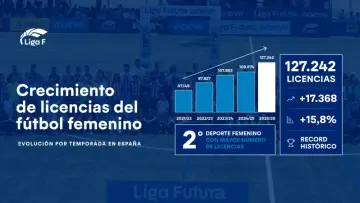
We do not want to sign off on a note of complaint, because that would be unfair to the moment. The girl who today asks her parents to play football has something the girls before her did not: someone to want to be like. There is no need to go back to the pioneers who played in borrowed shirts to find role models. Just switch on the television: several matches from every round of Liga F are shown free-to-air, the national team fills stadiums, and Liga F itself has launched an under-12 tournament with twelve of its clubs.
So this was the guide. Not the one we wanted to write, but perhaps a more useful one: if your daughter wants to play football, ring your town hall, ask without fear and do not give up at the first attempt. And if there is no team for her in your town, know that the problem is not yours, nor hers. It belongs to all of us. And, more slowly than it should, it is being fixed.