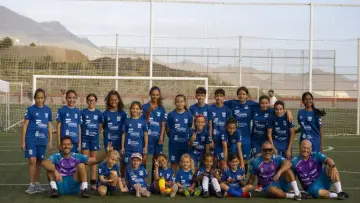
The news, on its own, was already hard to believe. In May, the club Fútbol Base Bonrepòs i Mirambell, in the Valencian district of l’Horta Nord, celebrated its youth team’s league title and promotion with a dinner at the El Barranc municipal sports centre. The celebration was attended by players — several of them minors — parents and members of the coaching staff. After the dinner, according to reports by elDiario.es and À Punt, an erotic show featuring a stripper was added to the evening, on public premises and with alcohol present. Some parents, opposed to what was happening, left the venue as soon as the show began.
The media do not agree on the exact date of the party — some reports place it on 16 May, others on the 22nd — but they do agree on the essentials: there was an erotic show, there was alcohol, there were minors, and it took place on municipal premises.
What followed was swift. The town council described what had happened as “incompatible with the use of municipal facilities and with educational and sporting values”, and the mayor, Raquel Ramiro, referred the matter to the Juvenile Prosecutor’s Office. The club’s board denied having authorised the performance, branded it “absolutely incompatible with the values that must govern any activity involving minors” and opened an internal investigation, as reported by Telecinco. Days later came the resignations: the president and part of the board stepped down, and the coach is no longer with the club, as confirmed by À Punt. A caretaker committee now runs the organisation, which must call elections. If no candidates come forward, Bonrepòs i Mirambell could be left without grassroots football.
So far, the incident. But the incident is not the story.
What was already there
When elDiario.es looked inside the club in the wake of the scandal, it found something older than a party: an accumulated resentment within the organisation’s women’s teams. Coaches and players described to the outlet a climate of sustained contempt: being told that they “play badly”, that they are “all lesbians” and — the phrase no newsroom will forget in a hurry — that “what they need is a good shag”. They also denounced the systematic denial of resources for the women’s teams.
For those coaches and players, the stripper was not a bolt from a clear blue sky. It was the final drop in a glass that had been filling for a long time. According to the same outlet, some families have stopped taking their children to training, and players from the youth team itself said they had lost confidence in their coaches.
That is the part of the story that concerns us. Because the erotic show lasted one night; the climate that made it conceivable had been there for years.
The uncomfortable lesson
It is tempting to read this case as a grotesque anecdote from a small town. That would be a mistake. Spanish grassroots football has thousands of clubs like Bonrepòs i Mirambell’s: modest structures, sustained by volunteers, where footballers and people are formed at the same time. In the vast majority, admirable work is done. That is precisely why it matters to point out what failed here: not a one-off booking of a stripper, but a culture in which someone thought it normal to suggest it, others to carry it out and part of those around them to tolerate it — the same culture which, according to the published complaints, had spent years treating the club’s girls and women as second-class footballers.
The author of this article has played amateur football and knows the mechanism from the inside. One day, after a good match, someone shouts in the dressing room: “If we win the league, we’re off to…!” Everyone laughs. Nobody stops it. The joke is repeated, becomes a promise, and the promise, months later, becomes someone booking a show for a dinner with minors. At no point in that chain, in all likelihood, was there any intention to do harm. And that is precisely the problem: the absence of bad intent is not a mitigating circumstance; it is the diagnosis. The most damaging things in grassroots sport are rarely done by villains. They are done by ordinary people who did not stop to think, because nobody around them taught them to.
The education of those boys and girls does not happen only at home or at school. It also happens at Tuesday training, at the post-match drinks, in what the adults celebrate in front of them and in how they celebrate it. All of us around them are responsible, and it is a responsibility that admits no spectators: either it is exercised actively, or it is delegated to inertia. Where inertia leads, we have already seen.
The sociologist Beatriz Bonete summed it up in Artículo 14 with a sentence that stings: with celebrations like these, “parents are teaching that women’s bodies are part of male leisure”. The lads of that youth team had just won a league. The lesson they received that night had nothing to do with football.
The treasure of Spanish football lies in its grassroots: that is where the world champions came from, and that is where the next ones will come from. But the grassroots do not form players through training sessions alone; they form them through what adults do in front of boys and girls. The pioneers of the seventies played against a society that told them football was not for them. Half a century later, the fact that the players of a grassroots club have to listen to what the women of Bonrepòs have denounced is a reminder that that battle did not end: it changed pitches.
The prosecutor’s office will determine the legal responsibilities. The others — those of the dressing room next door, of the dugouts, of the stands — are not settled in the courts. They are settled by not looking the other way.