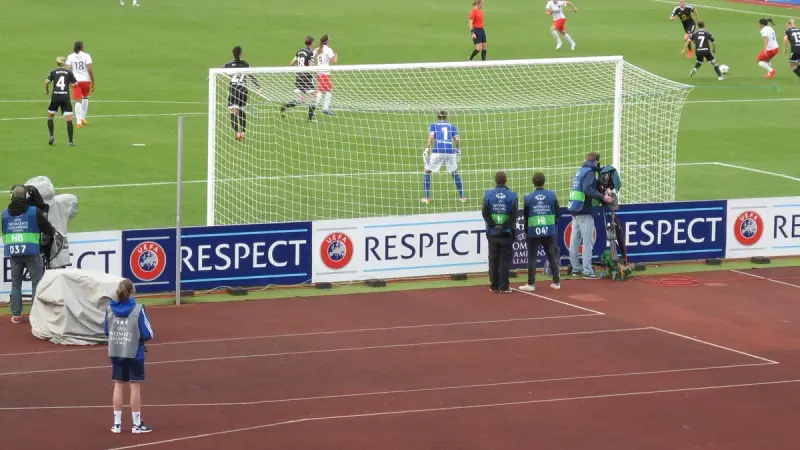
The first Women’s Club World Cup may go ahead without Europe’s biggest clubs. It does not yet have a host either.
European Football Clubs, the body that speaks for the continent’s clubs, has told FIFA its members will not play in 2028 unless the two sides first build the joint venture they have already agreed on — the company that would run the commercial side of FIFA’s global club competitions.
The letter went to FIFA secretary general Mattias Grafström on 31 July, signed by EFC chief executive Charlie Marshall. The Guardian revealed its contents two weeks later.
The demand is precise, and it comes with a deadline. The venture has to be up and running — and hold exclusive authority over all commercial and operational matters — before the women’s tournament’s television rights go to market. If it is not, EFC withdraws its support and its clubs stay away.
None of this is a novel request. EFC has run a company of exactly that kind with UEFA since 2025 — UC3, covering the men’s and women’s European club competitions.
Nor was the ultimatum confined to the women’s game. The letter warns that its clubs will not take part in “any future edition” of the tournament, naming the 2028 and 2029 competitions, women’s and men’s, in particular. But the deadline it sets is the women’s one.
A second warning runs through it, less widely picked up and with a longer reach. It argues that the conduct of the FIFA president, Gianni Infantino, could amount to a “substantial breach” of the memorandum of understanding that governs the relationship between the two bodies, and even grounds for tearing it up. That memorandum, which runs until 30 December 2030, is precisely where the clubs accept the international match calendar and the rules obliging them to release players for their national teams.
Three days in July
The letter landed in the middle of the worst institutional crisis of Infantino’s FIFA.
On 28 July, FIFA unveiled FIFA Forward Enterprise: a subsidiary, controlled by FIFA, that would pull together its commercial rights — television, sponsorship, ticketing, licensing — along with part of the job of staging its tournaments.
It was built on an initial valuation of 20 billion dollars, and the plan was to raise up to 4.2 billion by selling minority stakes that carried no control.
On 30 July, UEFA’s 55 member associations voted unanimously to stay out of every FIFA competition for as long as the proposal was alive. Concacaf, speaking for its 41 associations, rejected it too.
The EFC letter went out on 31 July. Hours later, Infantino pulled the plan.
The sequence matters. EFC did not bring FIFA Forward Enterprise down on its own; it joined a revolt that was already running, and it arrived with a demand of its own.
That demand was not simply that the plan be scrapped. The clubs wanted the joint venture built. Which is why their ultimatum survived the scrapping.
Scrapping it settled nothing
FIFA apologised to its Council members and its member associations for shutting them out of the process that produced FIFA Forward Enterprise.
On 6 August UEFA replied that an apology was not enough. Its associations had set two conditions — the proposal withdrawn, and binding guarantees that nothing like it would be attempted again — and only one of them had been met.
So the European threat to stay out of FIFA competitions still stands.
So does the clubs’. FIFA is understood to have answered EFC’s letter by promising a meeting soon to keep the joint venture on track, though The Guardian does not present that as confirmed. Neither side has announced a deal.
None of which amounts to a confirmed boycott of the 2028 tournament. What exists is a live ultimatum, and it will be settled by a commercial negotiation that has to close before the rights go on sale.
Europe holds six of the nineteen places
The first Women’s Club World Cup runs across January and February 2028, with nineteen clubs, at a neutral venue FIFA has yet to name.
Thirteen go straight into the group stage: five from UEFA, two each from the AFC, CAF, Concacaf and CONMEBOL.
The other six — one per confederation, the OFC included — play a preliminary round, and the three that come through make up a sixteen-team group stage: four groups of four, top two advancing.
So Europe has six clubs in the tournament. Five are guaranteed a place in the groups; the sixth has to earn one.
FIFA has not published how those places will be handed out. But EFC’s threat binds its members, and a tournament built to gather the best clubs in the world does not amount to much without the European ones.
More than 140 women’s clubs are EFC members
EFC is not a new organisation. It is the old European Club Association, renamed on 7 October 2025.
It represents more than 800 clubs across 55 countries and territories, and it is chaired by Nasser Al-Khelaïfi, the president of Paris Saint-Germain. At the renaming it counted 139 women’s clubs; its current directory puts the number above 140.
That is the figure to hold on to, and so is its limit. This threat is not coming from somewhere outside women’s football: the clubs that stand to be shut out of the first Women’s Club World Cup belong to the organisation threatening to pull them. But belonging and deciding are not the same thing. The association more than tripled in size in a few years by opening its doors, and of those 800-odd members only a minority hold full voting rights.
Both levers are women’s tournaments
Two fronts are open against FIFA, and each has picked its own pressure point.
The European associations are threatening to withhold their national teams. The first competition that touches is the Under-20 Women’s World Cup in Poland, which kicks off on 5 September with six European teams qualified: the hosts, Spain, France, England, Italy and Portugal.
So far nobody has acted on it. France was the first association to confirm it would travel, New Zealand followed, and the Polish federation says no team has notified it of a withdrawal and that preparations are on schedule.
The European clubs are threatening to withhold their teams, and the deadline they have picked is the 2028 Women’s Club World Cup.
There is no need to read intent into that. It is the calendar. The Under-20 World Cup is the next tournament FIFA stages, and the Women’s Club World Cup, played in January 2028, is the first whose rights come up for sale.
Nobody had to choose women’s football. It is just what comes next.
That does not make it less serious. It makes it more exact.
For years the case against women’s football was that it did not bring in enough money to belong in the big negotiations. It belongs in them now. And what you find out once you are inside is that being part of the accounts that matter also means being the thing put up as security when two parties fall out over a business that is not decided on the pitch.
Still unknown
Whether FIFA and UEFA settle before 5 September, and whether any European association actually acts on the threat.
How Europe’s five direct places and its preliminary-round place will be allocated. FIFA has not said.
What the new competition’s broadcast and commercial rights are worth. Neither FIFA nor the clubs have named a figure — and that figure is the whole argument.
And where it will be played. Seventeen months out, there is still no host.