They say women’s football doesn’t interest them.
They write it in posts about women’s football. They repeat it under videos of women’s football. They devote entire paragraphs to explaining why they would never waste three minutes watching a women’s match.
It doesn’t interest them, but they’re always there.
I’ve spent months collecting these comments. Not out of masochism, but because if you’re going to build something, it helps to know exactly what you’re building against.
And what I’ve found are not sporting opinions. They are three distinct arguments that all say the same thing: this place is not yours.
The first: the one who doesn’t bother hiding it
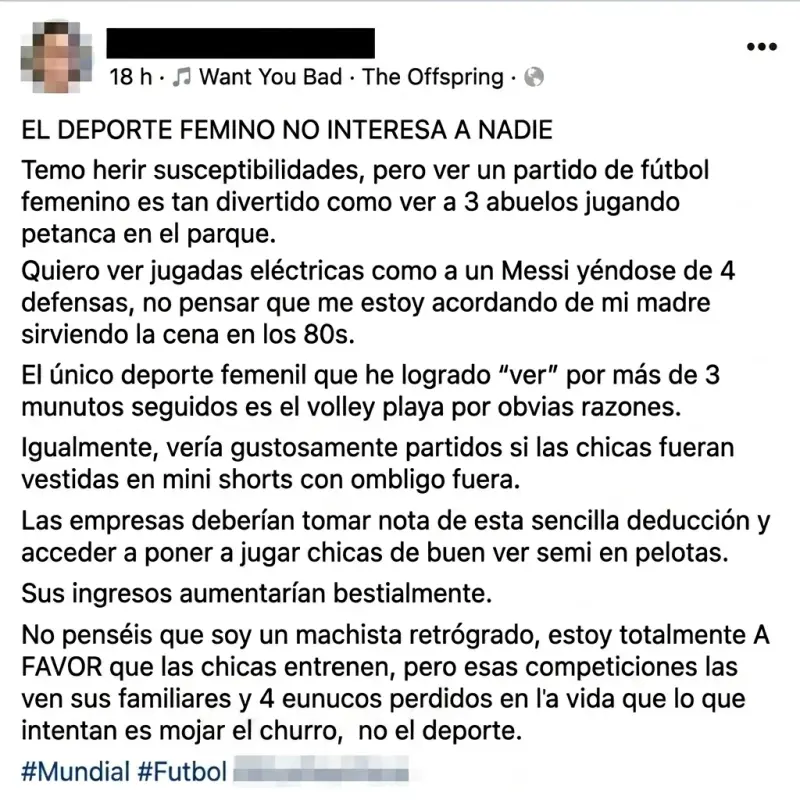
A Facebook account linked to the fitness world recently posted that watching a women’s football match was as entertaining as watching three elderly men playing pétanque. That the only women’s sport they had managed to watch for more than three minutes was beach volleyball, “for obvious reasons”. And that companies should make women play nearly naked to increase their revenue.
At the end, as an inevitable disclaimer:
“Don’t go thinking I’m some kind of sexist dinosaur.”
This is the most transparent archetype. No pretence. No argument constructed. Just an opinion posted under a real name and a profile photo.
In a way, it’s the easiest to read: the contempt is aesthetic and sexual, and there’s no interest whatsoever in concealing it.
This person is not commenting on the technical level of a competition. They are explaining the conditions under which they would be willing to tolerate women’s presence in sport: as long as women remain a product designed for their gratification.
They claim to want sporting spectacle. They propose removing the sport from the conversation.
The second: the one who turns his taste into a conspiracy
On Reddit, a user posted the following:
“Can anyone watch this rubbish? The mainstream media pressuring us to enjoy something terrible. Why are they trying to normalise a women’s sport that’s awful to watch?”
This one is more sophisticated, even if it doesn’t appear so at first glance. It has adopted the language of scepticism: the mainstream media, normalisation, external pressure.
It’s not simply that women’s football bores them. It’s that hidden forces are working to manipulate their taste.
The argument has a perverse elegance: it means they can never be wrong. If women’s football ever wins them over, they’ve been taken in by the propaganda. If it doesn’t, they’ve successfully resisted manipulation.
It is a position perfectly insulated against any evidence.
Every full stadium is propaganda. Every sponsor is a lobby. Every news story is part of an organised campaign. The genuine interest of millions of supporters simply does not exist in their version of the world.
The third: the one with credentials
Horacio Pagani has spent decades occupying prominent positions in Argentine sports media. When he speaks, he doesn’t speak from an anonymous profile. He speaks from a platform.
And he said this:
“Football is essentially masculine. They’ve had 200 years of men’s football, so women who don’t play football shouldn’t be getting involved. Feminism is all fine, we’re all equal, but football — let the lads play football.”
This is the most dangerous of the three.
Not because he is more intelligent than the others, nor because his argument is particularly sophisticated, but because his words carry institutional weight. Pagani speaks from one of those places that have spent decades deciding what matters in sport and what doesn’t, what deserves a back page and what can be dismissed as a curiosity.
The “200 years” argument deserves a moment’s attention. It is an argument of pure inertia: things should continue as they are because they have been that way for a long time.
But football was not born with a masculine identity stamped into the ball. It became masculine because for decades men had access to the pitches, the clubs, the federations, the resources and the media spaces. Because women were obstructed, or outright forbidden, from taking part.
That exclusion was then presented as something natural.
It was not nature. It was accumulated advantage.
What they have in common
The three messages come from different spaces. One appears on Facebook, another on Reddit, and the third comes from the mouth of a journalist with decades of media presence.
But they agree on something fundamental: women’s football does not deserve their attention, and the problem is women’s football.
Not one of them considers, even for a moment, that the problem might lie with them.
There is also something worth noting: this demand is only ever applied to women’s football. No one calls for a men’s competition to be scrapped because it doesn’t match the Champions League’s audiences. No one watches a Sunday league match and complains that the players can’t dribble like Lionel Messi. No one uses the Premier League’s viewing figures to argue that a local team doesn’t deserve a pitch.
Women, however, are expected to demonstrate absolute excellence before being granted so much as a minute of attention.
Why FemGol exists
No one has to enjoy women’s football. The freedom to change the channel has always been there.
But there is a difference between saying “this competition doesn’t interest me” and needing to prove that no woman should play it, watch it, or make a living from it. Those who aren’t interested can look elsewhere. Those who feel compelled to call it rubbish, mock the players, or explain how they should dress are doing something different: they are trying to establish which interests deserve respect and which do not.
FemGol was not created to convince the people who write those comments. I don’t think they’ll change their minds because they’ve read this piece, and frankly, that was never the goal.
It was created because more and more people follow women’s football with the same passion they bring to any sport, and for too long they haven’t had the space in English that passion deserves.
The match has already started. And perhaps that is precisely what bothers them so much.
_03.BxWsb19M_Z1hhudE.webp)