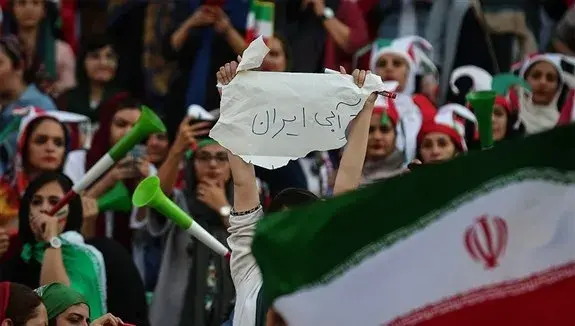
Sahar Khodayari didn’t want to play a match. She didn’t want to hold an office, or defy a competition, or unfurl a banner in the centre circle. She wanted to walk into a stadium and watch. In Iran, for decades, that was enough to turn a supporter into a problem.
Some rights are so elementary it’s almost embarrassing to have to defend them. Taking a seat in the stands. Buying a ticket. Wearing your team’s shirt. Roaring at a goal that won’t change your life but will brighten your afternoon. Not playing, not deciding, not leading: just watching. And yet there was a country, not so long ago, where a woman died trying.
In Iran, Khodayari is known as the Blue Girl, after the colours of Esteghlal, her club. In 2019 she was arrested for sneaking into the Azadi stadium dressed as a man to watch a match. Facing the threat of a prison sentence, she set herself on fire on the courthouse steps. She died a few days later. She had not stepped onto the pitch, she had not scored, she had done nothing that millions of supporters don’t do every weekend. She had only wanted to watch.
What comes before playing
We tend to tell the story of women’s football through the players: those who played when they couldn’t, who defied bans, who trained at night and won with no one watching. That story is essential. But there is another, less told — an earlier, quieter step: that of the women who weren’t asking to play, but to be there. The girl who wanted to go to the ground with her father. The supporter who knew more about football than half the stand and couldn’t show it there.
Because anyone who isn’t even allowed to watch is hardly going to be allowed to play. Watching is no minor detail: it’s a form of sporting citizenship. Whoever can go to the stadium becomes part of the collective memory, can say “I was there”. For forty years, since the 1979 Revolution, Iranian women were denied even that: entry to men’s football stadiums. It wasn’t a written law — which made it even harder to fight — but a custom enforced with arrests and abuse. Outside the stadium, outside the celebration, outside that noisy, imperfect community that forms around a match.
A permit is not the same as a right
The crack came in October 2019, weeks after Sahar’s death, when international pressure forced Tehran’s Azadi open to some 3,500 women for an Iran–Cambodia match. In December 2024, a stadium in Isfahan was filled by 45,000. It sounds like a victory, and it half is: that match was played with a women-only crowd as a punishment for the male supporters and their chants. And there’s the catch. When a woman can only enter if those in power allow it, only when the calendar suits, only in a designated section and in controlled numbers, she isn’t enjoying a right. She’s being granted a permit. And rights shouldn’t depend on permits.
The stands as a frontier
I’m telling all this from a country where none of it happens, and it’s worth saying without any condescension: here women go into stadiums, play, referee, commentate. But Iran’s forbidden stands aren’t only an Iranian matter. They’re the extreme version of something that, to varying degrees, has run through football almost everywhere: the idea that the stadium is, by default, a place for men, and that the woman who enters does so on loan.
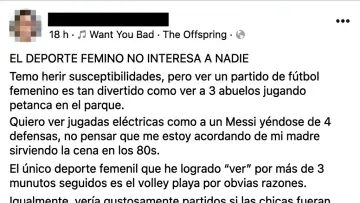
We’ve told that story here with twenty stickers and not a single girl, with albums put together as if football were a boys’ thing. The stand empty of women and the album with no female players are the same gesture: deciding, before anyone asks, who belongs in this place and who is merely visiting. A stand with no women isn’t a neutral stand: it’s an amputated one. The difference with Iran is one of degree, not of nature.
That’s why we watch
At FemGol we spend our days insisting on looking where almost no one points the camera. The other national team, the other league, the other half of the story. And sometimes, in the telling, you realise that the verb that best defines this trade isn’t to play or to win, but precisely that one: to watch. To take for granted that this deserves to be watched. Because watching is the simplest way of saying this matters: a full stand is a verdict.
Sahar Khodayari wanted to see a match. That sentence should be enough. That it cost her life forces football to answer a question far simpler than all its speeches about unity and passion: universal for whom? As long as a supporter needs permission to enter a stand, football won’t belong to everyone. Because football doesn’t begin when the referee blows the whistle. It begins when someone feels they have the right to be there.
_03.BxWsb19M_Z1hhudE.webp)