_03.BxWsb19M_1kypOd.webp)
During one of the drinks breaks in Spain–Cape Verde, ITV did something no other broadcaster did: instead of filling the gap with a pundit repeating himself, it put Emma Hayes in front of a chalkboard —X for Cape Verde, O for Spain— and let her explain why the European champions couldn’t find a way through. Spain ended up drawing nil-nil with World Cup debutants, one of the shocks of the tournament. The clip of Hayes travelled faster than any move in the match. A Sky Sports journalist settled it: she’s the best analyst at the World Cup.
It’s worth setting the scene. ITV has built its studio for this World Cup in Brooklyn, and around that desk sit Roy Keane, Gary Neville and Ian Wright —British male punditry in its most recognisable and most combative form—. In that company, the voice that makes you stop scrolling belongs to a woman who has never managed a men’s team.
The easy reading would be “woman triumphs in a man’s world”. It’s lazy and, by now, false twice over. False because Hayes is no beginner being made room for: she built the Chelsea dynasty —seven leagues, a decade of titles—, won Olympic gold at Paris 2024 in her tenth match in charge of the United States, and was the first manager to receive a Ballon d’Or from the dugout. And false, above all, because what happened on ITV is not an exception. It’s the tip of something that has been building for years.
The flow of women’s-football experts into men’s punditry goes back a good decade now. Eni Aluko was the first woman to sit as an analyst on Match of the Day, the most sacred programme on English football television, in 2014. Karen Carney led ITV’s coverage of the men’s Euro 2024, final included. At the 2022 World Cup in Qatar there was, for the first time, an all-female panel analysing a men’s match. Hayes didn’t open that door: she walked through it once it was already open, and turned out to be the one who crosses it best.
And before this sounds like a British phenomenon that doesn’t concern us, it’s worth looking closer to home. Vero Boquete —the first Spanish woman nominated for the Ballon d’Or, the first to win a Champions League— was also the first woman to commentate on a men’s tournament for Spanish television: Euro 2024 on RTVE, national-team matches included, after narrating the women’s Euros and the Women’s World Cup. The local version of Hayes exists, has a name, and has already walked the same road. With one difference worth stating plainly: Spain’s pool of former players turned analysts is younger and thinner than England’s. We’re behind, but we’re moving.
And the phenomenon has just crossed the Atlantic. For this very World Cup, TUDN —the Televisa giant— has signed Aitana Bonmatí, three-time Ballon d’Or winner and still an active player, and Jennifer Hermoso, a world champion, to analyse Spain in prime time. Two of the best players on the planet explaining men’s football to half of Latin America. Aitana herself put it with a candour worth the whole feature: “When they told me, my first thought was ‘why me?’. I’m still a player.” The right question, of course, is why not.
So far, good news. The problem —and the interesting part— shows up when you ask whether the bridge runs both ways. It doesn’t. The minds of women’s football cross over to explain the men’s game; the return trip barely exists. There’s no Guardiola, no Mourinho, no Keane sitting down to analyse the Women’s World Cup final as a peer, out of sheer interest in the game. Authority flows uphill, and in one direction only.
But the return trip does happen, in another form. Not as reciprocity, but as occupation. Eni Aluko opened an uncomfortable debate this year by pointing at Ian Wright: she argues there’s a finite number of seats in women’s-football coverage, and that every man who takes one takes it from a former player with more than enough of a CV for it. She gave the example of the 2025 women’s Euro final: between the BBC and ITV, two of six analysis slots went to men, while analysts with hundreds of international caps in their legs watched from the stands.
The reply came quickly, and from within. Laura Woods, one of the country’s most respected presenters, countered that “women’s football by women, for women” is one of the most damaging phrases she’s heard: what you genuinely want to grow, she suggested, you don’t wall off. And Wright’s defenders point out that his work in the women’s game is concentrated on the national teams, not on taking up space week in, week out.
I’m with Woods, and not because Aluko isn’t partly right: she is. The grievance she names —former players with huge CVs watching from the stands while a man takes his first steps in the job— is real, and naming it does no harm. But her solution points the wrong way. Walling women’s football off “by women, for women” is furnishing a pit more comfortably, and the pit is exactly the one it can’t climb out of: as long as it’s a separate genre —its own league, its own voices, its own audience, its own table— it will remain a niche by definition. What gets it out of there is the opposite of a fence: Keane debating the Brazil final with the same bite he brings to the one here, a top-level manager asking for the floor without it being news. Women’s football doesn’t need a better-decorated room of its own. It needs to stop being a room. It isn’t a niche. It’s football.
There is, moreover, a way to check which way the scales tip, and it’s coming soon. Next summer the Women’s World Cup is played in Brazil. And because of how the international calendar alternates —2024 the men’s, 2025 the women’s, 2026 the men’s, 2027 the women’s— that summer has no senior men’s tournament: the men’s national-team managers will be as free as Hayes is now. The question, then, asks itself: how many top-level male coaches will we see in a studio analysing the Brazil final, with their diaries just as clear? Mark the date. The answer —probably, almost none— will say nothing about the calendar. It will say who considers the other’s football worth their attention.
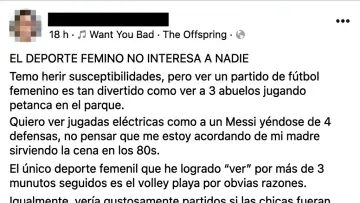
That’s why Hayes’s chalkboard matters more than it seems. Not because a woman proved she knows her stuff —that line is too late—, but because, in the middle of a hyper-technological World Cup, the most lucid reading of the match was delivered by someone that same football, for far too long, couldn’t be bothered to listen to. And because, when the scene is reversed, we’ll see who returns the visit.