Information updated as of 31 July 2026.
Deportivo ABANCA have already shown that they can survive in Liga F. Now they want to find out whether they can stop living in fear of relegation.
The Galician side finished the 2025/26 season in twelfth place, with 31 points and a comfortable enough cushion above the drop. They met their main objective, but once again showed the distance that still separates them from the clubs established in mid-table: they conceded 54 goals and were only able to string together good results for short spells.
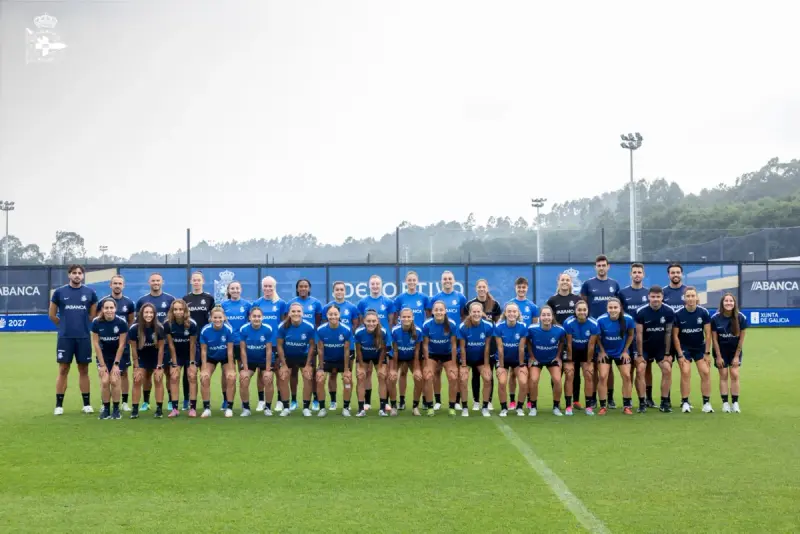
The club has responded with a thorough overhaul. Fran Alonso has left the bench, fourteen players have ended their spell, Cris Martínez has retired and nine footballers have arrived from other clubs, plus two signings registered with the B team.
This is not a simple adjustment. It is the start of a new cycle.
Alberto Rodríguez, continuity amid the change
The new coach will be Alberto Rodríguez, Fran Alonso’s assistant since January 2025.
The Arteixo-born manager knows the club, part of the dressing room and the work done over the last season, but he will take on his first experience in charge of a professional team. Deportivo have opted for an internal promotion in order to keep a degree of continuity while they transform almost the entire squad.
Rodríguez wants a team with more initiative, capable of showing personality on the ball and of reading matches without depending continually on instructions from the bench.
The club has not set a specific finishing position as a target. It has, however, expressed its intention to be more consistent, more of a protagonist and less dependent on the fight to avoid relegation.
The end of an era
Deportivo announced the departures of Paula Gutiérrez, Raquel García, Henar Muiña, Vera Martínez, Ainhoa Marín, Samara Ortiz, Yohana Gómez, Lía Muiño, Lucía Martínez, Carlota Sánchez, Bárbara Latorre, Marina Artero and Hildah Magaia.
To them is added Cris Martínez, who brought her career to an end after ten seasons tied to the Deportivo project.
Her retirement carries a special meaning. The captain had been with the team since the women’s section was revived in 2016 and had lived through its two promotions to Liga F. The new dressing room will not only have to replace footballers, but also rebuild its leadership.
Ainhoa Marín’s exit also leaves an important gap in attack. She was one of the team’s top scorers last season and had taken on a growing role in the attacking play.
The situation of Inês Pereira is also unresolved. The goalkeeper ended her loan and returned to Everton after a season in which she was one of Deportivo’s most decisive players.
Nine arrivals and only two loans
The new project combines young players with others who already know the top flight.
In goal, Andrea Tarazona has arrived from Levante. Despite being only 22, she has Liga F experience and starts as the only senior goalkeeper confirmed so far.
The defence brings in Daniela Caracas, Vega Montesinos, Sofía Domínguez and Adriana Ranera.
Caracas arrives from Espanyol after playing 24 Liga F matches and could become one of the defensive reference points from the outset. Ranera, on loan from Barcelona, was captain of the Blaugrana reserve side and has already featured for the first team.
Montesinos and Domínguez offer alternatives on both flanks. Carla Castiñeyras signs with a Dépor ABANCA B licence, although the club announced her within the first-team set-up: a bet on the future who is 17 and has already played 21 matches in the top flight with Alhama.
In midfield come Eva Alonso and Ainoa Gómez.
Eva Alonso comes from Levante and brings immediate experience. Ainoa arrives on loan from Barcelona after becoming a Primera Federación champion with the reserve side and a European Under-19 champion with Spain. Paula Hernández will be registered with Dépor ABANCA B, although she will train within the first-team set-up.
In attack, the club has brought in Lucía Pardo and has made permanent the stay of Marisa García, who last season played on loan from Real Madrid.
Pardo is one of the arrivals best prepared to deliver an immediate return. She is 26, has more than a hundred Liga F matches behind her and can operate in several attacking positions.
Marisa, aged twenty, will stay until 2028 and now belongs to Deportivo.
The deal reflects one of the summer’s changes of strategy. Only Ainoa Gómez and Adriana Ranera arrive on loan. The rest of the arrivals belong to the club and several have signed contracts of more than one season.
The players who stay
The rebuild does not start entirely from scratch.
Footballers such as Merle Barth, Paula Monteagudo, Eva Dios, Olaya Enrique, Millene Cabral and Espe Pizarro remain, along with the young players who had already begun to break into the first-team set-up.
Lucía Rivas, Redru, Paula Novo and Espe Pizarro have also renewed or extended their commitment.
Rivas and Redru will return to training alongside Ainoa Gómez after becoming European Under-19 champions. The three of them represent one of the new Deportivo’s main bets: footballers with international recognition at youth level, but still very much in the process of adapting to professional football.
The challenge will be to protect their growth without turning youth into an excuse. The team needs some of them to start delivering this very season.
A squad with more options
Deportivo appear to have gained depth and versatility.
Alberto Rodríguez will have several footballers capable of playing in more than one position. Vega Montesinos can cover the entire left flank. Sofía Domínguez can play as a full-back or a midfielder. Lucía Pardo can appear in different areas of the attack. Eva Alonso also offers solutions both in midfield and closer to the defence.
That variety will allow the shape to be changed without needing to make too many substitutions.
The unknown will be how long the team needs to build understanding. The defence has changed almost completely, the midfield brings in new pieces and the attack loses one of its main scorers.
Deportivo will have more options, but fewer settled relationships.
Where will the goals come from?
Espe Pizarro and Ainhoa Marín ended last season with six goals each. The latter is no longer here.
Pizarro will continue as one of the main attacking reference points, now joined by Lucía Pardo, Marisa García, Millene Cabral and the young players who come into the attacking line.
The team does not look likely to depend on a single scorer. The intention is to share the output among several players.
That can make them less predictable, but it also requires Pardo, Marisa and Millene to increase their numbers and Pizarro to confirm the form shown during her first season in A Coruña.
The goalkeeping question is still open
It is the main outstanding issue.
Andrea Tarazona is currently the only senior goalkeeper confirmed. Deportivo are also working with goalkeepers from their own structure, but it seems reasonable to expect another arrival before the league begins.
Inês Pereira’s possible return will depend on an agreement with Everton. The club has not hidden that it retains an interest, although the Portuguese has returned to England after finishing her loan.
The identity of the second goalkeeper will help to make sense of how responsibilities are shared. Tarazona may arrive as first choice or compete for the spot with a more experienced player.
Until that deal is resolved, the squad will not be completely closed.
Three friendlies before the league
Deportivo began pre-season on 13 July and have three fixtures confirmed:
- 7 August: Sporting de Gijón–Deportivo ABANCA, in the Trofeo Emma Cuervo.
- 13 August: Deportivo ABANCA–FC Porto, in the Trofeo Teresa Herrera.
- 16 August: Real Madrid–Deportivo ABANCA, at the Ciudad Real Madrid.
The last will be the most demanding test and will come only two weeks before the start of the competition.
The league will begin on 30 August against Sevilla at Riazor, according to the calendar published by Liga F.
The three questions of the season
The first is how long the team will take to adapt. Few clubs will face the campaign with so many changes in the squad and the coaching staff.
The second is who will take on the leadership. The retirement of Cris Martínez and the departure of several senior players force a new hierarchy to be built within the dressing room.
The third is whether Deportivo have brought in enough goals. The defence has plenty of alternatives and the midfield gathers different profiles, but the team needs to improve its attacking numbers to get closer to mid-table.
Deportivo face the season with more players of their own, several European Under-19 champions, arrivals who already know Liga F and a coach who intends to increase the team’s control of matches.
They also begin with a goalkeeping position to complete and a squad that will need time to get to know itself.
Survival will remain the first obligation. The difference is that, this time, Deportivo want it not to be the only aspiration.