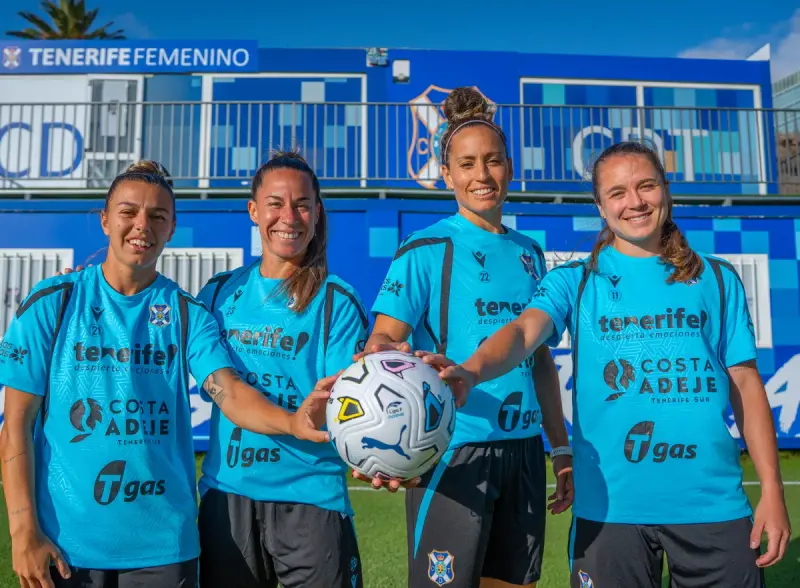
When Liverpool signed Natalia Ramos this summer, they took the player Costa Adeje Tenerife had been built around. Everything about the island club’s 2026/27 season follows from that.
Tenerife finished fourth in Liga F last season, reached the Copa de la Reina semi-finals for the first time in their history and turned the Estadio Heliodoro Rodríguez López — a 22,800-capacity ground in Santa Cruz — into one of the least inviting away trips in the Spanish top flight. It would be easy to present the new campaign as the next chapter of steady growth. It would also be incomplete.
Because the side that starts 2026/27 no longer has Natalia Ramos, Paola Hernández, Sakina Ouzraoui, Clau Blanco or Sandra Castelló. Five players who between them carried much of the team’s football, its experience and a large share of its output. The manager stays. So do the goalkeepers and the spine of the defence. What has gone is the player everything else was organised around.
The challenge, then, is not to defend fourth place. It is to build a new route back to it.
Last season: fourth place under two managers
The numbers explain the scale of 2025/26: 54 points, 49 goals scored and only 23 conceded. Tenerife finished fourth, the first side outside the European places. They also reached the Copa de la Reina semi-finals for the first time, going out to Atlético de Madrid.
There was an oddity to it. Eder Maestre left the dugout in December with the team fifth on 24 points after fourteen rounds. His exit had nothing to do with results, and it forced the club into a change of manager in the middle of a season that was already going well. Maestre closed that spell with six wins, six draws and just two defeats.
Yerai Martín inherited a reliable team and improved it without pulling it apart. From his first match, Tenerife took eight wins, six draws and two defeats in the league. Among those results: a 5-0 win over Athletic Club, four straight victories against Alhama, Badalona, Levante, Logroño and Madrid CFF, and a draw away at Atlético with ten players on the pitch. In the second half of the season only Real Madrid and Barcelona beat them.
What emerged was a team that was very hard to pull out of shape — comfortable protecting its own box, aggressive when it found space to run into, and content to play matches it was never going to dominate on the ball. It did not need many chances to compete, and it rarely gave one away.
The summer: this is not one player leaving, it is the middle of the team
The eight confirmed departures do not all carry the same weight. Jenni López barely featured for the first team before going on loan to Granada, and Bicho had a limited role for much of the season. María Estella retired after eleven years at the club; hers is a departure that matters historically and emotionally more than tactically.
The rest genuinely change the team.
Clau Blanco joins Sevilla after four seasons, 113 competitive appearances and a final campaign of three goals and four assists. Her versatility let her play as a full-back, a wing-back or the outside centre-back in a back five. Sevilla also take Sandra Castelló, an experienced midfielder who logged 1,124 minutes.
Sakina Ouzraoui leaves after two seasons and 58 appearances. The Morocco international contributed two goals, four assists and a constant ability to carry the ball forward down the flank. Paola Hernández takes roughly 1,300 minutes, three goals and one assist with her, but above all a technical profile that is hard to replace. Servette paid her release clause, reported at around €300,000.
And then there is Natalia Ramos.
The Tenerife-born midfielder played 2,664 minutes, more than any other footballer in Liga F. She scored ten goals, provided five assists and won 192 duels. She was the team’s top scorer, its main creator and the player who kept the game moving whenever a match asked for something beyond resistance. That form earned her the league’s player of the month award for April and a move to Liverpool.
Between them, Ramos, Paola, Sakina, Clau, Sandra and Bicho produced 20 of Tenerife’s 49 league goals. That is roughly 41% of the team’s scoring walking out of the door, along with fifteen assists.
That is the true measure of this summer. Tenerife do not simply need new starters. They need to replace goals, final balls, ball-carrying, leadership and knowledge of the system.
Out
- Natalia Ramos — Liverpool
- Paola Hernández — Servette
- Clau Blanco — Sevilla
- Sandra Castelló — Sevilla
- Bicho — Espanyol
- Sakina Ouzraoui — contract expired
- María Estella — retired
- Jenni López — on loan at Granada
The signings: sharing out what Ramos used to do alone
The club has not gone looking for a like-for-like replacement for Natalia Ramos, probably because one does not exist within its budget. Instead, the recruitment has spread her old responsibilities across several new arrivals.
Natalia Padilla is the signing with the highest immediate ceiling. The Poland international returns to Spain after a spell at Bayern Munich and already knows the league: on loan at Sevilla she scored eleven goals in 29 matches. She can lead the line, drift wide or attack space behind. Her pace gives Tenerife an outlet that is especially useful when they defend deep and win the ball a long way from the opposition goal.
Érika González adds quality between the lines. Before a knee injury she was one of the few bright spots at Levante, finishing the season with five goals and two assists in 18 appearances. She can play as a number ten, a winger or a second striker, and she can receive, turn and accelerate an attack. How her body holds up, and how long she needs to string matches together, will matter.
Marina Martí arrives after helping Valencia win promotion. She is a direct, quick forward who is used to attacking space — a profile that suits Yerai Martín’s ideas and one that works on either flank.
The midfield is where the rebuild is most explicit. Henar Muiña brings structure, experience and defensive reading of the game; she was a foundation and captain at Deportivo, knows the division, and can help the team hold its shape when it loses the ball. Ari Mingueza offers something else: late runs from deep, a good strike and the knack of arriving near the box. She ended last season with two goals and two assists at Granada.
Alba Pérez reinforces a defence that has lost depth, while Bárbara Martínez — known as Pola — steps up permanently from the reserves after already making nine league appearances. Her promotion is also a reminder that the club’s academy is starting to have real consequences for the first team.
In
- Natalia Padilla — from Bayern Munich
- Érika González — from Levante
- Henar Muiña — from Deportivo
- Ari Mingueza — from Granada
- Alba Pérez — from Granada
- Marina Martí — from Valencia
- Pola — promoted from the reserves
The Spanish window stays open until 18 September, so the squad could still change.
What stays
The summer has been deep, but it has not dismantled every certainty.
Yerai Martín stays, having turned a January solution into a long-term bet. So does a pair of high-level goalkeepers. Noelia Ramos ended the season with nine goals conceded and nine clean sheets in fifteen matches; Nay Cáceres conceded fourteen in the other fifteen. Rotating them did not weaken the position, and it meant both arrived at the business end of the season sharp.
The back line still has Patri Gavira, Elba Vergés, Cinta Rodríguez, Fatou Dembélé, Aleksandra Zaremba, Violeta Quiles and Aithiara Carballo — an experienced group that can defend its own box and knows the back five well. Pisco also stays, though her return will need managing after a full season out with knee problems.
Up front, Paulina Gramaglia, Carlota Suárez, Koko Ange and Iratxe Pérez all remain. Carlota was especially efficient, scoring seven goals in under a thousand minutes. Gramaglia added five and had some strong performances as a mobile focal point, while Iratxe managed four despite starting only five matches.
That continuity lowers the risk of the new signings having to carry the team from day one.
How they might play
Yerai Martín often used five at the back, four in midfield and one up front. It was not a rigid shape. Aleksandra and Aithiara pushed on from the wing-back positions, one of the wide midfielders tucked inside to play alongside Natalia Ramos, and the striker worked to pin the centre-backs and open space for runners from deep.
Without Ramos, Tenerife lose the player who occupied several of those positions within a single match. Ari Mingueza can provide the attacking presence and Henar Muiña can run the build-up, but neither offers the full set on her own. The logical answer is to share it out:
- Henar as the balancing midfielder.
- Ari making runs into the box and linking with the forwards.
- Padilla attacking the space behind.
- Érika receiving between the lines, when available.
- Marina or Koko providing width and depth.
- Gramaglia or Carlota as the furthest player forward.
The 5-4-1 remains the likely base for the hardest matches, but the range of attacking options makes a 4-2-3-1 or a 3-4-2-1 plausible whenever Tenerife have to take the initiative.
Pre-season has reinforced the sense that Yerai has no intention of abandoning his identity. Tenerife drew with Espanyol before winning on penalties, beat Sevilla and Athletic Club by a single goal and won 2-1 against Alavés. They then drew 0-0 with Atlético in the Trofeo Teide and lost the trophy in the shoot-out. Against Atlético the same team showed up again: compact, willing to press high in spells, protected without the ball, and attacking through transitions and set pieces.
Summer results matter little in themselves. The relevant signal is that Tenerife are still conceding very little while integrating a new front line.
A possible XI
Noelia Ramos; Aleksandra Zaremba, Cinta Rodríguez, Elba Vergés, Fatou Dembélé, Aithiara Carballo; Koko Ange, Henar Muiña, Ari Mingueza, Natalia Padilla; Paulina Gramaglia.
Érika González could change that shape entirely if she rediscovers her best level, and Carlota Suárez has a strong enough scoring record to be more than an impact substitute. Nay Cáceres will keep competing for the goalkeeping shirt, while Alba Pérez, Violeta Quiles, Marina Martí and Iratxe give Yerai enough alternatives to change the plan.
The player to watch: Natalia Padilla
She should not be asked to be Natalia Ramos under a different surname. Padilla is a forward, not the all-purpose organiser Tenerife have lost. What she should be asked to do is turn the team’s collective work into goals.
This side already knows how to defend, how to compete with little of the ball and how to survive long spells without controlling a match. What it needs now is someone who can punish space when it appears and turn a turnover into a chance before the opposition reorganises. Padilla has those qualities, and she already showed at Sevilla that she can clear ten league goals in a season.
The open question: who runs the game
Tenerife have enough goalkeepers, centre-backs and forwards to be competitive again. The uncertainty lies in the journey between them.
Last season, when the team needed to breathe, Natalia Ramos offered a passing option. When it needed to advance, she carried the ball. When a finish was missing, she arrived in the box. When a match turned physical, she won duels. Henar, Ari, Yerliane Moreno, Pola and the forwards will have to fill that space collectively.
If they manage it, this squad may be more varied than last season’s. If they do not, Tenerife risk becoming a team that is excellent at resisting but too reliant on transitions and set pieces to score.
The fixture list allows no settling-in period
Tenerife open away to Barcelona at the Estadi Johan Cruyff on 30 August. After that come Deportivo at the Heliodoro, Real Sociedad at Zubieta and Sevilla at home again.
Opening against the champions will settle nothing. The three rounds that follow will tell us far more: Deportivo and Sevilla should measure whether this new Tenerife can take the initiative, while the trip to Real Sociedad is a first direct comparison with one of the sides occupying the European tier they are aiming at.
Prediction
Fourth place should not be treated as the floor of this project. It was an exceptional season, and repeating it would require several signings to deliver immediately.
Tenerife still have one of the most reliable defensive structures in Liga F, two good goalkeepers, depth in attack and a manager who has already shown he knows how to use all of it. It is reasonable to place them in the group fighting to finish between fourth and seventh.
To get close to Europe they will need three things: Henar and Ari to hold the midfield, Érika to string matches together, and Natalia Padilla to become a double-digit scorer. If one of those fails, the team will still be competitive, but it will find it harder to turn tight matches into wins.
Tenerife arrive ready not to fall. The question is whether, having lost the footballer who made almost everything work, they are also ready to climb again.