Spanish sport has a condescending habit: calling everything that happens far from the centre a miracle.
The word sounds like a compliment. Sometimes it is not. A miracle needs no explanation. It appears, dazzles for an instant and disappears without leaving too many questions behind. It allows you to admire the result without pausing to study the work that made it possible.
Costa Adeje Tenerife’s season deserves better.
The Tenerife side finished Liga F in fourth place with 54 points, behind only FC Barcelona, Real Madrid and Real Sociedad. They won 14 matches, drew twelve and lost only four. They scored 49 goals and conceded 22 in 30 matchdays: only Barcelona and Real Madrid let in fewer.
They did not earn a ticket to the Champions League. Nor were they ever genuinely on the verge of it: Real Sociedad finished the season twelve points clear. But they finished ahead of Atlético de Madrid and settled with authority into territory that usually seems reserved for projects with bigger budgets, greater media exposure and a far more comfortable geographical position.
Fourth place was not an accidental invitation to the top table. It was the result of a full season’s work.
Tenerife did not always win. But they almost never lost.
A new crest on top of an older story
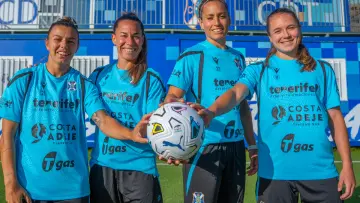
The summer of 2025 marked a profound change. UD Granadilla Tenerife, latterly known as Costa Adeje Tenerife Egatesa, reached a collaboration agreement with CD Tenerife to build a joint project.
The team adopted the blue-and-white crest and colours. The Heliodoro Rodríguez López became their stadium. The alliance, set to run until 2032, connected the island’s leading reference in women’s football with a historic institution and a much broader fan base.
The operation made sense.
Tenerife’s women’s football gained visibility, better conditions in which to compete and a recognisable stage. CD Tenerife, for their part, stopped turning their back on a project that had already proved its sporting worth.
But the full story should be told.
The team was not born when it received a historically more visible crest. Nor did it start competing when it set foot in the Heliodoro.
UD Granadilla Tenerife was founded in 2013 in Granadilla de Abona. They were promoted to the top flight in 2015 and have sustained a decade in the elite ever since. Before the new alliance, they had already built a recognisable identity, developed a structure of their own and shown that a club born from women’s football could compete against far larger institutions.
The new era may expand the project. It should not retrospectively appropriate it.
In a competition where many women’s sections are still viewed as secondary extensions of men’s institutions, Tenerife offers a more interesting story: a consolidated women’s structure that comes to the agreement with something valuable to contribute.
They do not ask permission to exist. They negotiate from the legitimacy the pitch has given them.
Distance conditions; it does not explain
Competing from an island carries obvious costs.
Every away trip begins with an aeroplane. Recruiting talent, organising the academy and building a community around the team obey a different geography from the mainland’s. Even the calendar imposes a logistical routine that other clubs never have to face.
But nor should insularity be turned into a magical explanation.
Tenerife did not finish fourth because the Heliodoro possesses supernatural properties or because their rivals arrived defeated by the journey. They finished fourth because they were an extremely difficult team to beat.
They lost only four league matches: the same number as Real Sociedad and Real Madrid. They drew twelve, more than any other team in the upper reaches. That figure contains both their greatest virtue and the limit they have yet to overcome.
Tenerife learned to stay in matches. They knew how to protect themselves when they could not dominate, to resist when the game tightened and to compete without always needing their best version. On numerous occasions, they fell short of turning that resistance into a victory.
That is where the real distance to the Champions League lies.
Not in some supposed lack of legitimacy to look upwards, but in the need to turn a few even contests into three points.
A change of coach without a change of course
Eder Maestre’s departure in December could have opened a crack.
The team had built much of its competitive identity under him and occupied a significant position in the table. A mid-season change always carries an unknown: it is not enough to change the coach’s name without disturbing the balance of a dressing room that is already working.
Yerai Martín took over the dugout in January and avoided any rupture.
From his debut he oversaw 19 official matches across the league and the Copa de la Reina: nine wins, six draws and four defeats. During that stretch, Tenerife scored 27 goals and conceded twelve. They also reached the Copa semi-finals, where Atlético de Madrid ended their run with two narrow victories.
There was no flashy transformation. There was continuity.
The team kept its defensive sobriety, strengthened its reliability at home and closed the season with a victory over Deportivo Abanca that secured fourth place. Yerai Martín’s renewal for the 2026/27 campaign offers a first answer to the question this season leaves behind: how to turn an excellent campaign into a new starting point.
Two goalkeepers and a defence that did not depend on a single name
The 22 goals conceded explain an essential part of the final standing.
Tenerife finished as the third-least-scored-against team in Liga F. Only Barcelona and Real Madrid conceded fewer. It was not a brief streak, nor a statistic propped up by a succession of miraculous saves. It was a structure.
Noelia Ramos became one of the names of the season.
She played 15 league matches, conceded nine goals, kept nine clean sheets and saved two penalties. Her performances earned her a place as goalkeeper in the Liga F team of the season.
It would be tempting to turn her into the complete explanation. It would also be unfair.
Nay Cáceres guarded the goal in the other 15 matches. Tenerife alternated goalkeepers without losing their defensive identity. The solidity did not depend solely on one footballer in a state of grace, but on mechanisms capable of repeating themselves with different pieces.
Over a long competition, that difference matters.
A team can survive for a few matchdays thanks to an extraordinary performance. To finish fourth, it needs a structure.
Tenerife had one.
Natalia Ramos and the value of coming back
The other great protagonist of the season shares a surname, a date of birth and a significant part of her story with Noelia.
Natalia Ramos completed all 30 league matches, scored ten goals and provided five assists. Those are notable figures in any context. They are even more so for a footballer who put a serious cruciate ligament injury behind her and returned to become one of the team’s attacking references.
Her season allows for a deeper story than an individual recovery.
The Ramos sisters were born in San Cristóbal de La Laguna. They grew up in Canarian football, have travelled different paths and found each other again at the club of their homeland. In a competition increasingly open to the international market, Tenerife found two of its principal references in two players formed on the island.
This is not about idealising the local footballer simply for being local.
An academy or a territory does not generate value only when it produces talent. It also does so when it can offer that talent reasons to return, to stay and to take on responsibility.
Natalia was not a decorative symbol of Canarian identity. She was the team’s top scorer from midfield.
Fourth place is not a comfortable destination
There is a danger after a season like this: confusing recognition with arrival.
Tenerife have shown they can occupy the position immediately behind the Champions League places. They have not yet shown they can climb that step.
Between their fourth place and Real Sociedad’s third there were twelve points. The gap is wide enough to rule out any complacent reading. It is also concrete enough to know where to look: Tenerife lost very little, but drew too much to catch the top three.
Next season will be more uncomfortable.
Atlético de Madrid finished only three points behind. Other clubs will overhaul their squads. The market will test Tenerife’s ability to keep talent and replace possible departures. The new crest will increase visibility, but also expectations. Yerai Martín will begin the campaign from the start and will no longer have the narrative margin of someone inheriting a situation halfway through.
Repeating the result may prove harder than achieving it for the first time.
That is where the true dimension of the project lies.
Tenerife do not need to be eternally presented as a humble team defying the logic of Spanish football. That image may be attractive, but it also locks them into a supporting role: that of the charming exception, applauded for as long as it does not threaten the established order too much.
The 2025/26 season forces a change of frame.
It was not a miracle. It was not an unexpected excursion through the upper reaches. It was not a picturesque tale born on a faraway island.
It was a serious team having a very serious season.
And from now on, surprise no longer works as an explanation.