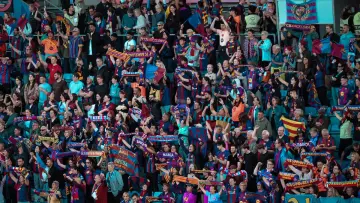
On 30 May, with the Antonio Puchades in Paterna sold out, Valencia were losing 0-1 to Villarreal from the 21st minute, watching their return to Liga F slip through their fingers. It was not relegation, but it was starting to look dangerously like a sentence: a second season in the second tier. In the 99th minute, Leyre Monente wound up from outside the box and buried the equaliser that was worth a promotion: with the tie level (0-0 in the first leg), Valencia’s superior league position would decide it. Extra time stopped being a chase and became an act of resistance. “This is the happiest day of my life,” said Monente, who dedicated the goal to her grandmother, who had died two weeks earlier, and to her team-mate Andrea Recio, who suffered a serious injury during the season.
“This team is never dead,” was Mikel Crespo’s summary. And the line works for the match, for the season and for the entire year of a club that on 11 May 2025, on the penultimate matchday, had suffered the first relegation in its history after sixteen consecutive seasons in the top flight. Some promotions are celebrated for what they win. This one was also celebrated for what it avoided.
The ones who stayed
Relegations are usually told through the players who leave. There were departures, of course: head coach Cristian Toro and the international goalkeeper Enith Salón both headed for Servette. But this promotion is better explained by the ones who stayed: the four captains — Pauleta, Yasmin Mrabet, Sara Tamarit and Marina Martí — chose to go down to Primera Federación with the crest. Around that core, the club built a new squad with thirteen signings, the academy graduate Marta Mascarell and Esther, two players established in the first team. After the fall, gathering talent was not enough: a group had to be rebuilt.
Into the dugout came Mikel Crespo (Galdakao, 1991), who knew exactly what he was signing up for: in 2021 he had already taken Alavés up to the top flight — the same Alavés who, in one of the calendar’s little winks, have gone up this year as runners-up via the direct route. “We are Valencia and we must always aim for the highest,” he said at his unveiling.
A whole season for one match
The plan worked through an accumulation of order: third in the regular season with 46 points (12 wins, 10 draws, 4 defeats), 35 goals scored and just 18 conceded, the second-best defence in the division. They were not a side that steamrollered opponents: they were a side that was hard to break down, and in a season built for an immediate return, conceding little was also a way of being in a hurry. The Puchades became a fortress and the goalkeeping position an argument in itself: Jana Xin held the team together until an injury in the semi-final second leg ruled her out of the decisive stretch, and Marina Llàcer responded by playing the whole final. Up front, Danielle Marcano’s seven league goals led the attack.
That consistency bought the advantage that ended up deciding everything. “A whole year for one match,” Crespo explained. “We knew that over seven months we had earned an edge: playing here, with a draw being enough.” First they had to survive a heart-stopping semi-final against Alba Fundación: 0-0 in Albacete and a 4-3 in the return leg, with a red card in the 43rd minute, half an hour with ten players, Jana’s injury and a stunning Mrabet strike from forty metres.
Returning to familiar ground
Valencia are not coming back to foreign territory. Their women’s team, born in 1998 at the Colegio Alemán and tied to the club since 2009, finished third in the Liga Iberdrola in 2016/17, within touching distance of the Champions League. And the promotion did not arrive alone: the club’s women’s structure has produced a historic campaign with four promotions from the first team down to the academy, including the reserves, whose squad dedicated their own promotion to Fernando Martín, their coach, who died in December. Valencia return a year after leaving, which is the timetable of those who leave intending to come back.
Coming back is not the same as staying
The story could end here, because football has a weakness for neat endings. But Valencia do not need an ending: they need a better beginning than the last one.
Next season will be a different matter. Liga F does not grant much time to learn: the margins shrink, mistakes are punished harder, and the distance between competing and going down can be measured in a handful of badly managed matchdays. The squad will need reinforcements for the step up, as Crespo himself has acknowledged. Everything suggests the coach will stay in the dugout, although his renewal has not yet been finalised. About the group’s level, however, he has no doubts: “If this team has proved anything, it is that it belongs in Liga F.”
The context adds responsibility: with Levante relegated for the first time in their history, Valencia are left as the only club from the Comunitat Valenciana in Liga F. They do not inherit the Granotas’ legacy, nor do they take their place — every club carries its own history — but they land in a competition where they will have to sustain a presence that Valencian football took for granted until very recently.
Leyre Monente’s goal bought something more than extra time. It bought time: to strengthen a squad that has already shown its character, and to decide what Valencia CF Femenino want to be once the emotion of promotion no longer protects them. The 99th minute will be remembered as the way they came back. What matters starts in the minute after.
You can follow the team’s updates and matches via their official X account @VCF_Femenino and on the Valencia CF website.