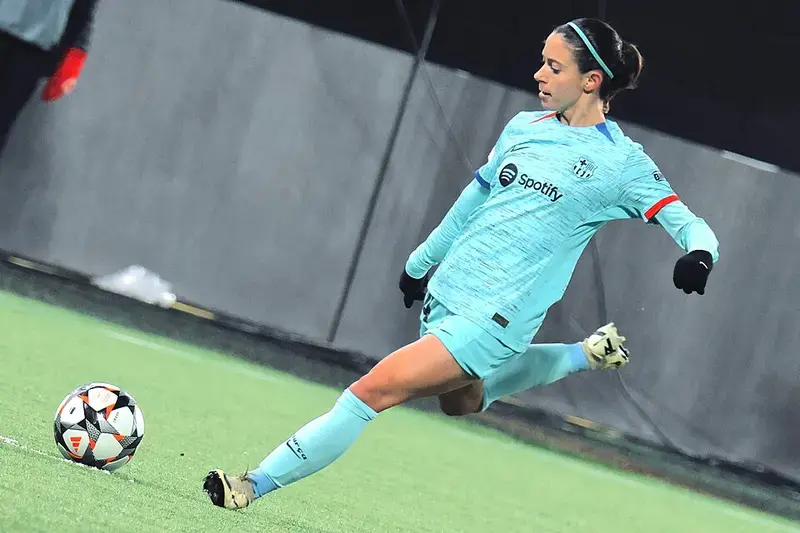
The 113th minute. Spain had spent almost two hours trying to break Germany down in the semi-finals of Euro 2025. They had dominated the ball, piled up arrivals and run again and again into Ann-Katrin Berger. The match was drifting towards penalties when Athenea del Castillo found Aitana Bonmatí on the right edge of the box.
The position did not look especially dangerous. The angle was tight and Berger was expecting the pass back. Aitana feinted, lifted her head and struck at the near post. The goalkeeper got there late. Spain reached the first European final in its history and beat Germany for the first time.
Afterwards, Aitana explained that the coaching staff had studied Berger and spotted that she sometimes left the near post too exposed. The move that looked like a flash of inspiration had begun much earlier, in an analysis room. It was not just a remarkable goal: it was an explanation of Aitana Bonmatí. Where the rest saw a closed position, she had found a way out; where the goalkeeper expected a cross, she had seen a shot. She always seems to see things an instant earlier.
Coming back from a hospital room
Less than a month before that goal, Aitana was in hospital with viral meningitis. The illness struck as Spain were finalising their preparation for the Euros. She was discharged on 29 June 2025 and rejoined gradually, with no certainty about when she could compete: she missed the opener against Portugal, came off the bench against Belgium and was already a starter in the last group match.
She finished the tournament as its best player. Spain lost the final to England on penalties and Aitana missed one of the spot-kicks —saved by Hannah Hampton. It was an unexpected image: the footballer who seemed able to solve any problem found herself facing one without an answer. The individual award sat alongside the feeling of having let the title slip.
That contradiction matters. Aitana has not become the best footballer in the world because she always wins, but because even her defeats seem to turn into study material. She analyses the match, the opponent and herself, often with a severity that borders on dissatisfaction. When she received her first Ballon d’Or in 2023 she admitted that, if she could talk to the girl she had been, she would ask her for something she still finds hard: patience.
A surname that was already a statement
Aitana Bonmatí was born on 18 January 1998. Back then, Spanish rules dictated that the father’s surname had to come before the mother’s. Her parents, Rosa Bonmatí and Vicent Conca, rejected that obligation and took part in the fight to change it. That is why she is called Aitana Bonmatí Conca: her mother’s surname first.
It is not a decorative detail. Before she could choose how to look at the world, her own name already contained a way of questioning it. Her parents, teachers of language and literature, taught her that a tradition does not become fair simply because it has lasted a long time. Years later she would do the same on and off the pitch: ask why. Why a girl had to be treated differently for wanting to play. Why footballers had to accept structures that did not match the demands of the elite. Aitana did not just inherit a surname: she inherited a discomfort with what others consider normal.
The only girl
She grew up in Sant Pere de Ribes playing among boys. She was the only girl in the team and learned early that having talent did not guarantee being accepted: she has recalled arguments, clashes and comments from adults surprised that a girl could get the better of their sons with the ball. That could have pushed her to go unnoticed. It had the opposite effect: she developed a ferocious competitiveness. She did not want to be allowed to play as a concession; she wanted to prove that the pitch did not need to make room for her because it already belonged to her as much as to anyone else.
At thirteen she joined Barcelona’s youth ranks. To get to training she made journeys on public transport with her father that could approach two hours. The women’s Masia was far from the structure that today welcomes the best young players in the world: there was no crowd waiting for her, only long trips, sparsely attended pitches and a career that did not yet guarantee becoming a profession. Aitana kept travelling.
Before football was ready
In 2015/16 she led the reserves to their first Second Division title and debuted for the first team in the Copa de la Reina; a year later she was integrated into the squad. The timing was decisive: Aitana had even considered continuing her development in the United States because the road to professionalism was unclear, and Barça’s professionalisation changed that.
She did not become a starter at once. She waited behind more experienced players, played scattered minutes and proved that her size did not limit her ability to govern midfield. In 2018/19 she established herself and played the first Champions League final in the club’s history: Lyon won 4-1 in Budapest. That defeat measured the distance to the elite, but Barça did not abandon its idea to get closer to Lyon: it took it to the extreme. Aitana grew within that transformation; the team got stronger as she learned to be more influential.
The first night Europe saw her
On 16 May 2021, Barcelona faced Chelsea in the Champions League final. Within twenty minutes they led 2-0; Aitana received in the box, attacked the gap between the centre-backs and scored the third. Barça won 4-0 and lifted their first European Cup, and UEFA named her player of the final.
It was not because she controlled the game from a safe position, but because she was everywhere: she dropped to receive when Chelsea pressed, carried the ball to beat lines and turned up in the box when the move demanded it. She did not read the final as a midfielder tasked with linking two zones, but as a footballer responsible for solving any problem. That night, Europe discovered what Barça had been seeing for years: Aitana could organise a match and break it open.
The player who doesn’t occupy a position
Tactics boards need to place her somewhere —right interior, left interior, attacking midfielder—, but on the pitch those labels do not last. She can drop to help the build-up, appear between the lines, drift to the flank to create an overload and finish in the box. She does not move on a whim: she moves because she has identified where the team needs an extra player.
Her main tool is not the pass, but the scan beforehand. Before she receives she has already looked both ways: she knows who will press her, which team-mate has set off and what space will open up. Her first touch does not only control the ball: it moves it away from danger and towards the next action. That is why she seems to play faster than she runs. She does not have Salma Paralluelo’s stride, nor does she need fifty metres to change a game: a half-turn is enough, or a touch that draws in two opponents, or a pass that forces the whole defence to readjust. The ball does not find her by chance; it finds her because she has understood where the next thing will happen.
Learning from Xavi without becoming Xavi
Her great reference point was Xavi Hernández, and the influence is not hard to see: the way she opens her body, the obsession with looking before receiving, the need to always offer a passing line. Xavi wrote the foreword to her autobiography. But to define her as a female version of Xavi would be to reduce her: Aitana has a different relationship with the box. She does not just orchestrate from outside; she attacks spaces, eliminates opponents by carrying the ball and chases goals with a forward’s persistence. In November 2024 she reached one hundred official goals for Barcelona, an extraordinary figure for a midfielder. She took her references’ positional intelligence and added an aggression that belongs to her era. She does not wait for the match to grant her importance: she goes looking for it.
Stepping away without leaving the national team
In September 2022, Aitana decided to step away from the national team temporarily. It was not a resignation or an international farewell: it was a demand. She believed things had to change for the players to perform in an environment fit for elite competition. After months of meetings with the federation, she returned to play the 2023 World Cup, judging that the conditions to come back existed.
The decision was uncomfortable: she could miss a World Cup, she could be labelled a troublemaker, she could discover that football punishes the one who questions a structure more readily than the structure being questioned. Aitana accepted the risk, not because she wanted to be away from the national team, but because she wanted being part of it to mean more than being called up. The same drive that makes her ask for the ball when the opponent presses pushed her to take responsibility off the pitch.
The World Cup that changed the scale
She arrived in Australia and New Zealand as one of the best midfielders in Europe. She returned as the best player in the world. She scored three goals, gave two assists and played all seven of Spain’s matches; she struck a brace against Switzerland in the first World Cup knockout tie Spain had ever won and steered the team to the title against England. FIFA gave her the tournament’s Golden Ball.
The World Cup confirmed something already visible at Barça: Aitana did not need a team to revolve solely around her to dominate it. She could coexist with Alexia Putellas, Jenni Hermoso, Mariona Caldentey, Patri Guijarro or Teresa Abelleira and find the exact place from which to raise the value of them all. That is one of the least visible traits of her greatness: she does not monopolise football, she accelerates it.
Winning also means having to speak
The World Cup could have ended with a clean celebration. It did not: Luis Rubiales’s non-consensual kiss on Jenni Hermoso during the medal ceremony turned the players’ success into an institutional crisis. Eleven days later, Aitana collected UEFA’s best European player award and used the stage to denounce abuses of power and to support Jenni and the women who had been through similar situations. It was not the comfortable speech expected at a gala: she had just received the biggest individual recognition of her career and understood that the moment did not belong to her alone.
Her voice did not stop there. She has criticised the lack of growth in Liga F and called for the Spanish competition to look at models like England’s. And since 2022 she has worked with UNHCR, on projects integrating refugee women and girls through sport. Her activism comes from the same place as her football: observe, identify the problem, intervene.
Three years ruling football
The 2023 Ballon d’Or was not an isolated prize: she won it again in 2024 and 2025, and added three consecutive editions of FIFA’s The Best. No woman had won three Ballons d’Or before. The continuity says more than the number. In 2022/23 she was named the Champions League’s best player after five goals and eight assists and after helping to come back from 2-0 down against Wolfsburg in the final (3-2). In 2023/24 she scored against Lyon in Bilbao and was again the best player of the final and of the European season.
In 2024/25, Barcelona lost the final to Arsenal. Even so, Aitana closed the competition with four goals and five assists and remained one of its great reference points. Being decisive even in a season that ends in defeat sums up her influence well: the best player does not always belong to the winning team; sometimes she is the one who has most transformed a competition, even when the last match reminds her that football never grants absolute control.
When the best footballer had to disappear
On 30 November 2025, in a training session with the national team, she fractured her left fibula. She had to undergo surgery and was out for more than five months: she missed the second leg of the Nations League final against Germany and left Barça without the footballer who had won the last three Ballons d’Or.
For a player built around constant intervention, the recovery imposed an unfamiliar experience: she could not correct the match, ask for the ball or speed up the process with a better read. The body set the timetable. She returned to training on 9 April 2026 and, on 3 May at Camp Nou, during the second leg of the Champions League semi-final against Bayern, she came on in the 67th minute to a standing ovation from more than 60,000 people. Twenty days later she took part from the bench in the Oslo final: she entered in the 72nd minute and lifted the fourth Champions League of her career after the 4-0 win over Lyon. She was not the protagonist. She did not need to be: after years deciding the biggest matches, coming back was already a kind of victory.
The first goal of the new era
The season’s final match carried an unexpected symbolic weight. Alexia Putellas was saying goodbye to Barcelona and the Johan Cruyff was preparing to honour its captain. In the 34th minute, Alexia was involved in the move and Aitana scored against Real Sociedad: her first goal since the injury. The pass between the two brought together five Ballons d’Or and connected two eras of the club: the footballer who had led Barça’s transformation and the team-mate who took over the centre of the game during her long absence. It was not an official changing of the guard —football rarely hands over its symbols so neatly— but it offered a powerful image: Alexia touched the ball, Aitana finished; one said goodbye and the other returned.
Self-demand as engine and as risk
Aitana has built her career on permanent dissatisfaction: she can always turn better, arrive sooner, score more, find another pass. That self-demand explains much of her success, but it raises a question: what happens when a footballer who already has three Ballons d’Or, four Champions Leagues, a World Cup and two Nations Leagues keeps assessing herself as if she still had to justify her place? Ambition lets you move forward, but it can stop you recognising the distance covered. Aitana has spoken about the importance of mental health and has worked for years with professionals to manage her competitive character. Her challenge does not seem to be reducing the demand, but stopping it from turning every achievement into something immediately insufficient.
The world that doesn’t yet exist
Aitana is under contract with Barcelona until June 2028; the 2024 renewal confirmed her as a central piece of the project. On the horizon is the 2027 World Cup in Brazil, which she will reach at 29 and after a season that forced her to stop. But her legacy will not depend on another trophy: she has already changed the way the interior role is understood and proved that a midfielder can set the rhythm, lead the press, beat opponents by carrying the ball and finish seasons with a forward’s numbers. She has also changed what is expected of a great footballer off the pitch: she does not accept that individual prestige should turn into institutional silence, nor that being grateful for what has been achieved means settling for it. She can love Barça, represent Spain and, at the same time, demand that both structures improve.
Seeing it before anyone else
In the semi-final against Germany, Berger protected the centre of her goal. It was the logical thing to do. From that position, almost any footballer would have looked for a pass back or a cross. Aitana shot at the near post because she had seen something the goalkeeper did not yet know she was showing. It was not improvisation: she had studied the movement, waited for the moment, recognised the space.
Her whole career fits inside that action. The girl who took on the boys because she would not accept that the pitch was theirs. The teenager who travelled for hours to train in Barcelona. The midfielder who waited her turn, lost a European final and came back to win four. The international who stepped away because the environment had to change. The champion who used her awards to speak about the women who had no microphone. Even her name tells the same story: before she was born, her parents saw that an unjust rule could be changed. Aitana learned the lesson. On and off the pitch, she has never simply accepted the space others had decided to grant her: she observes it, understands it and, when the moment comes, transforms it before everyone else has managed to see it.