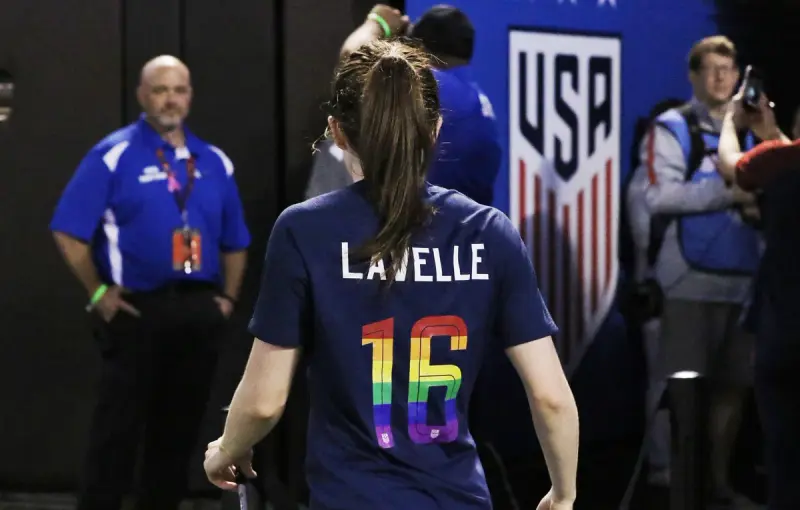
When the other children ran after the ball, Rose Lavelle waited outside the group.
She was five and playing in a mixed YMCA league. Both teams moved together, forming a crowd around the ball. Rose was too small to impose herself inside it, so she began watching from the edge.
The ball always came out eventually.
When it did, she appeared.
Her mother, Janet, would recall years later that Rose seemed to understand even then where the space was.
That childhood solution contains much of the player she would become: a midfielder who does not need to rely on physical contact to escape pressure, who changes direction before a defender can adjust her body and who finds routes where, a moment earlier, there appeared to be only opponents.
Learning to fool defenders
Rose Lavelle was born in Cincinnati, Ohio, on 14 May 1995. She is the daughter of Marty and Janet Lavelle and grew up with her sisters Nora and Mary and her brother John.
Starting football was her decision. She scored in her first match and tried to suppress her smile, as though celebrating too much might reveal how much she had enjoyed the feeling.
At eight, she met Neil Bradford, an English coach whom she has always credited with making her fall in love with the game.
Bradford did not ask her to compensate for her size by becoming stronger. He taught her to protect herself in another way.
They worked on ball control, changes of direction and keeping her head up while carrying the ball. Rose began calling those skills her “tricks” because they allowed her to fool opponents.
By 11, she was already appearing in videos Bradford used during his coaching courses. In one recording, she performed control exercises with different parts of her body before attempting a bicycle kick in her back garden.
Lavelle weighed around 36 kilograms when she started high school. Some parents asked whether she was really the same age as the other players. By the end of the match, the question was usually different: how could someone so small be so difficult to stop?
The footballer others were slow to see
At Mount Notre Dame High School in Cincinnati, Lavelle became the team’s all-time leading scorer. She then enrolled at the University of Wisconsin.
There, she studied Sociology, was selected to the All-Big Ten first team four times and became the first player to win the conference’s Midfielder of the Year award in consecutive seasons.
She was also the first Wisconsin player to receive three consecutive All-America honours.
Her progress at university earned her a place in the United States under-20 team. She was named the best player at the 2014 Concacaf Women’s Under-20 Championship and played every minute of the USA’s four matches at that year’s Under-20 World Cup.
In January 2017, the Boston Breakers selected her with the first overall pick in the NWSL draft. Two months later, she made her senior international debut against England.
Her career appeared to be progressing without interruption until injuries began to stop it.
In June 2017, she suffered the first of three separate hamstring tears. She returned, was injured again and, when she believed her recovery was complete, a scan revealed a third tear.
The effects remained after the pain had gone. Upon returning, she avoided carrying the ball, released it too early and preferred to give it to team-mates she considered more important.
Megan Rapinoe insisted that such caution did not help the team. To make a difference, Rose had to start taking risks again.
The goal that introduced her to the world
Lavelle arrived at the 2019 World Cup as a player well known within US soccer but still unfamiliar to much of the international audience.
She left France as one of the tournament’s leading figures.
She started six of the USA’s seven matches and scored three goals. Her ball-carrying offered the team another way to advance, alongside the power on the wings and the direct play of its forwards.
Rose received between the lines, drew in an opponent and accelerated with a series of quick steps that made it difficult to predict when she would change direction. Her left foot could release a team-mate or carry her directly towards the penalty area.
The move that came to define her World Cup began near the centre circle.
The USA led the Netherlands 1-0 in the final when Lavelle received the ball with open ground ahead of her. She drove towards the penalty area, waited for the defenders to retreat and struck with her left foot from outside the box.
The ball found the bottom corner. It was 2-0.
Lavelle finished the tournament as a world champion and received the Bronze Ball as its third-best player.
The goal did not create that footballer. It simply allowed the world to see her on the largest stage.
Her changes of direction and ability to recognise space before it opened had been developing for much longer.
A career shaped by interruptions
In August 2020, Lavelle left the United States to join Manchester City. She made 26 appearances and scored five goals during her only season in England.
She also won the FA Cup. Lavelle started the delayed 2019/20 final at Wembley, where City defeated Everton 3-1 after extra time.
In 2021, she returned to the NWSL with OL Reign. A year later, she started all 17 league matches she played, scored five goals and helped the team win the NWSL Shield.
That continuity was broken again in 2023. A knee problem limited her to four regular-season appearances and meant she arrived at the World Cup in Australia and New Zealand with her minutes restricted.
Lavelle returned in time for the NWSL play-offs. OL Reign reached the final and she scored their only goal, but Gotham FC won 2-1.
Two months later, Gotham signed her as a free agent.
The player who scored in both finals
Lavelle’s first season with Gotham began with another injury but ended with seven regular-season goals, her best return in the NWSL. That summer, she won Olympic gold with the United States in Paris.
A persistent ankle problem required surgery in January 2025. She did not return to competition until June.
Five months later, Gotham reached the NWSL final.
The match against Washington Spirit remained level until the 80th minute, when Lavelle received the ball near the edge of the penalty area and scored the only goal with her left foot.
She had scored in the 2023 final and did so again in 2025, this time to become a champion. Lavelle was named the match’s Most Valuable Player and became the only footballer to have scored in two NWSL Championship matches and a World Cup final.
Her season ended with the first U.S. Soccer Female Player of the Year award of her career.
She received it after spending almost half the year learning to trust her body again.
A future Gotham are trying to secure
Lavelle remains a Gotham player during the 2026 season. As of 13 August, she has 122 caps, 29 goals and 29 assists for the United States, according to U.S. Soccer’s official figures.
Her contract expires at the end of the year.
Since 1 July, she has appeared on the official list of players eligible for 2027 free agency. She can negotiate her next contract with Gotham or any other club, although she remains under contract until the end of the season.
Gotham president of soccer operations Yael Averbuch West has acknowledged that the club are working every day to retain her. She also summed up the competition they face: every team would want to sign Rose Lavelle.
For now, no next destination has been confirmed.
Whoever secures her next contract will be signing a world champion, an Olympic champion and a player who has scored in two NWSL finals.
They will also be signing the same footballer who first began to understand the game when she was too small to join the crowd and discovered that, if she waited, the ball would eventually find her in the space she had chosen.