Below the house where Teresa Abelleira grew up, there was a football pitch.
She played there with her brother Tomás, her father Milo, her cousin and her friends. The ball also followed the siblings to the beaches of Covelo and A Lanzada, where they could spend hours trying to keep it off the ground.
Abelleira summarises it without much ceremony: “I always say I come from street football.”
That pitch in A Caeira was her first place of learning. The second was the futsal court.
Between them, a midfielder began to emerge who does not need to carry the ball far to move play forward, who shapes her body to continue the move and who often knows where her next pass is going before the ball reaches her.
The only girl at AJ Lérez
Teresa Abelleira Dueñas was born in Pontevedra on 9 January 2000. Her father, Milo Abelleira, built a long coaching career with clubs including Pontevedra, Celta B, Ourense and Cultural Leonesa. Her brother was also a footballer and played for Pontevedra and Compostela, among others.
Teresa grew up accompanying them to matches and training sessions. Her father offered advice when she asked for it, but the family never turned football into an obligation.
She joined AJ Lérez at five. She was the only girl in the team and continued playing with boys until, a decade later, the opportunity to join Deportivo appeared.
For three of those years, she combined 11-a-side football with futsal at Poio Pescamar. She won a Spanish under-16 title with the Pontevedra club.
That period is not a minor detail in her biography. Abelleira herself explained how it influenced her game: the smaller spaces meant she had to decide earlier and be more precise.
Her role models also help explain her. As a child, she watched Andrea Pirlo and Vero Boquete, the outstanding Galician footballer of the previous generation. She met Vero at one of her camps in Santiago and grew up watching a player who had been forced to leave Spain to develop her professional career.
Deportivo grew with her
In 2016, Teresa accepted an offer from a Deportivo side that had just created its women’s team. She was 16.
Much of that first squad came from the Galician under-16 team. It was not a side built around established footballers, but a project that had to grow at the same time as its players.
Manu Sánchez, her coach throughout her four seasons in A Coruña, mainly used her as an attacking midfielder. What caught his attention was not a dribble or a shot, but the way she interpreted every reception.
At 16, Abelleira’s first thought was already to combine with a team-mate. She understood the game like a far more experienced footballer and assumed responsibilities that did not match her age.
Six months after she arrived, in January 2017, Teresa and Raquel Béjar signed the first professional contracts awarded by Deportivo to players from their women’s team. They were also the first women registered as professionals by a Galician club.
The distinction matters. They were not the first Galician women to be paid for playing football: Irene González had already earned money from the game during the 1920s. What those contracts represented was the beginning of a new stage within the structure of a professional club.
Deportivo needed three seasons to earn promotion. They went unbeaten in 2018/19, recording 25 wins and one draw before overcoming Alhama and Femarguín in the play-offs.
Their first season in the top flight confirmed that the team had not arrived merely to survive. Deportivo led the table for several matchdays and were fourth when the pandemic brought the competition to an early end.
Learning the less natural part of her game
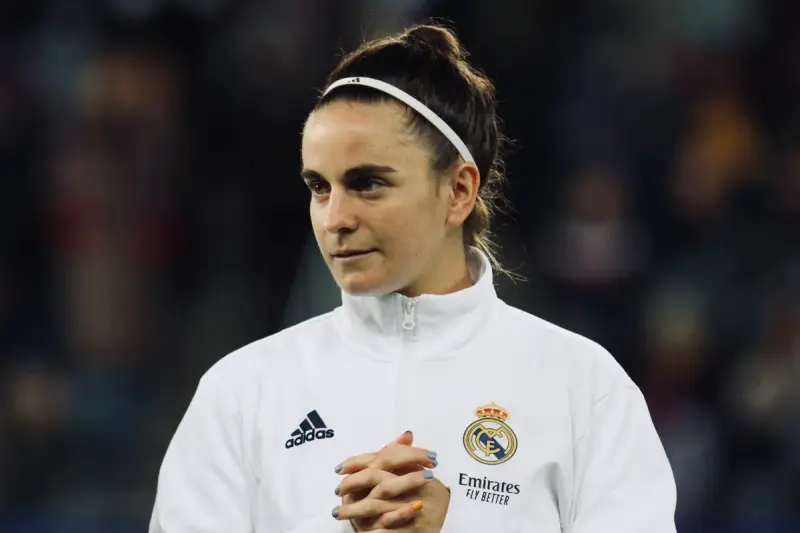
In the summer of 2020, Abelleira left A Coruña to join Real Madrid for the first official season of their women’s team.
The adjustment was not immediate. Teresa had spent her entire career in Galicia, was joining a project with greater competition for places and still needed to develop one part of her game.
She could play as an attacking midfielder or a holding midfielder, but her talent was most evident on the ball. At the time, she acknowledged that defending was more difficult for her. At Madrid, she added physical work, video analysis and a better understanding of the spaces she needed to occupy when her team were out of possession.
She did not stop being an associative midfielder. She learnt how to protect what she organised.
That development expanded her possibilities. She could appear near the penalty area, play further forward in midfield or drop deeper to start attacks in front of the defence. Her body orientation, ability to turn under pressure and range of passing allowed her to accelerate the game without having to run with the ball.
She ended her Real Madrid spell after six seasons, 170 appearances and 13 goals, according to the club’s official figures.
From entering through an injury to playing the entire World Cup
Her development can also be traced through the Spain national team.
Abelleira finished as a Women’s Under-17 Euro runner-up in 2016. Two years later, she won the Women’s Under-19 Euro, scored the only goal of the semi-final against Denmark from outside the box and was selected in UEFA’s team of the tournament.
She made her senior international debut on 27 November 2020. She replaced Aitana Bonmatí in the 60th minute of a 10-0 victory over Moldova.
Her place was still not secure when Women’s Euro 2022 arrived. Jorge Vilda left her out at the final cut, but Salma Paralluelo’s injury reopened a place in the squad. Teresa joined the team and ended the tournament as a starter in the quarter-final against England.
A year later, she no longer needed a late withdrawal.
She started all seven of Spain’s matches at the World Cup in Australia and New Zealand. She occupied a deeper position than she had for much of her career and became the player connecting the build-up with the midfielders ahead of her.
She also scored one of Spain’s goals at the tournament. Against Zambia, she received the ball outside the penalty area and sent it into the top corner with a strike that brought together two qualities present since her earliest years: little time to decide and the precision to execute.
Her statistics describe her influence better than the goal. Abelleira completed 461 passes and created 24 chances, more than any other player at the tournament, according to FIFA’s figures.
Spain went on to lift their first World Cup. Teresa later added the 2024 Women’s Nations League and competed at the Paris Olympics.
The injury that interrupted her career
On 25 February 2025, during a Spain training session at Wembley, Teresa suffered a rupture of the anterior cruciate ligament and external meniscus in her left knee.
The injury ruled her out for the rest of the season and Women’s Euro 2025. Her recovery lasted for more than a year.
In March 2026, she returned to training with her Real Madrid team-mates after 393 days, but did not make another competitive appearance before her contract ended. The club announced her departure on 12 June.
As of 13 August 2026, her next destination has not been officially announced. Offers and interest have been reported from Spain, England, Italy, Germany and the United States, but none of those possibilities has yet become a confirmed signing.
That uncertainty explains why Teresa Abelleira’s name is being discussed again. It does not explain who she is.
Her next club will change the final line of her career record. The rest began to be written much earlier: on the pitch below her home, in the confined spaces of futsal and in the 16-year-old footballer whose first thought when receiving the ball was already where to find a team-mate.