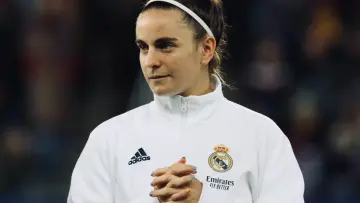
Some midfielders catch the eye with the final pass, with their ball-striking or with a run that breaks lines. Irune Dorado belongs to another family. Hers is less noisy, but no less important: the kind of player who stops a move from falling apart.
One of the most striking things about her game happens even before she receives the ball. Dorado is constantly looking left and right, whether she has possession or not. She scans the pitch, measures distances, locates opponents, looks for teammates and prepares the next action before the ball reaches her feet. She plays as if she had a radar switched on.
Sometimes all it takes is a first touch in the right direction. At others, it is protecting the ball when she receives with her back to play. It can also be arriving first to a second ball, correcting after a turnover or choosing the pass that changes the side from which her team can build. Her football does not always demand the immediate spotlight, but it helps explain why Spain can settle in the opposition half and why Real Madrid have been bringing her closer to the first team before her career has even really begun.
Irune Dorado Alosete was born in Pozuelo de Alarcón on 22 March 2008. She is a midfielder, plays for Real Madrid B and belongs to a Spanish generation that has grown used to competing in finals from a very early age. With Spain under-17s, she was European champion in 2024 and a World Cup runner-up that same year. With the under-19s, she won the 2025 European Championship, a tournament in which she scored in extra time in the semi-final against Italy and was included in UEFA’s Team of the Tournament, before returning in 2026 with a side trying to extend a dominance that is difficult to normalise.
But her story cannot be understood only through medals. It is better understood through function.
Dorado is a central midfielder who plays with her body before she plays with her foot. She receives on the half-turn, protects the ball well, turns when she can and secures possession when she has to. She does not need to carry the ball too much to move the play forward. Often she does it with her first touch, with the direction of her pass or with the exact pause needed to draw pressure and free a teammate.
That trait is especially valuable in teams that want to dominate possession. In a Spain under-19 side full of attacking talent, Dorado brings a different layer: continuity, balance and security. She is not just a player who accompanies possession, but a footballer who helps that possession make sense. If the game speeds up, she can organise it. If the team drops deeper, she can anticipate. If the opposition press tightens, she can hide the ball long enough to find a way out.
Her development at Real Madrid has also been marked by that maturity. She spent time in Atlético Madrid’s academy before joining Real Madrid’s development structure and moving through the levels until she began working with the first team. Her Liga F debut came against Espanyol at the Alfredo Di Stéfano, when she was still 16. Relevo reported that, when Alberto Toril called her over while she was warming up, she answered with a “me?” before coming on in the 68th minute of a 5-0 win. The surprise did not last long: once on the pitch, she left one of those images that explain the jump from academy football to the elite, a teenager stepping into a professional match but playing as if she understood exactly what the context required.
Since then, her name has appeared naturally in conversations about the future of Real Madrid’s midfield. That naturalness matters. Not every young player who debuts early is ready to be read beyond precocity. With Dorado, her age is surprising, but the profile sustains the interest.
She is not a highlights-only footballer. Nor is she an attacking midfielder disguised as a No. 8, or a ball-winner limited to destruction. Her value lies in the mix. She has the defensive reading to jump at the right time, the aggression to compete, the calm to retain possession and the judgement to choose. In youth football, where many players stand out because they move faster than the rest, Dorado stands out for something different: she seems to play half a second earlier.
That half-second does not appear by chance. It comes from looking earlier, from orienting herself earlier, from knowing what is around her before the ball forces her to decide. It is what allows her to receive under pressure without losing the ball. What turns a recovery into an advantage. What avoids a rushed pass. What allows a central midfielder not only to take part in the game, but to govern it.
Spain are once again looking toward an under-19 final with several players expected to have a future at the top level. Some will be more visible. Others will have gestures that are easier to summarise. Irune Dorado, by contrast, represents the kind of player who grows the more you watch the whole match.
Because there are midfielders who appear when their team gets there. And there are others who explain how it got there.