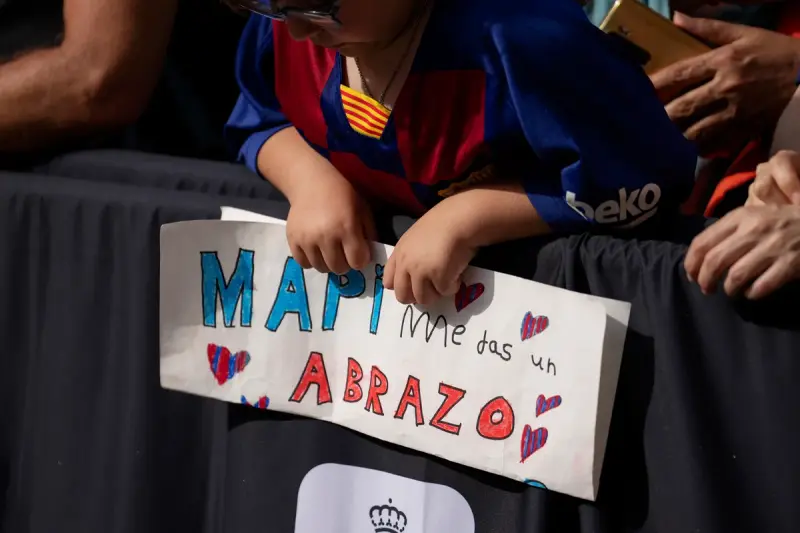
From La Almozara to the first paid transfer in Spanish women’s football. From a Barça that aspired to conquer Europe to the side that dominated it. From turning down a World Cup to returning to the national team three years later. Mapi León has built her career defending two things: the ball and her right to decide who she wanted to be.
Mapi León leaves FC Barcelona at 31, after nine seasons, more than 300 matches and 27 titles. She departs with four Champions Leagues to her name and as one of the footballers who helped turn a good European team into a global benchmark.
The numbers measure the scale of her time at Barcelona, but they explain little about her.
They do not tell us that she arrived in 2017 as the first Spanish footballer for whom two clubs agreed a transfer fee. Nor that for years she was the player who took the first risk in every attack, the one tasked with receiving the ball when the opponent pressed and the simple pass seemed to hide. Still less do they explain why she was willing to miss a World Cup, why she ended up an LGBTI reference point without ever setting out to be one, or why her character has stirred admiration, rejection and controversy in almost equal measure.
To understand Mapi León it is not enough to look at what she won. You have to look at what she was never willing to give up.
The girl who played where there were no girls
María Pilar León Cebrián was born in Zaragoza on 13 June 1995 and grew up in La Almozara. Football turned up in a childhood spent trying out different sports, and in which playing almost always meant doing so among boys.
She herself has recalled that she could barely find girls to share the ball with. Tagging along with her brother to futsal let her meet another and feel that the space could belong to her too. It sounds like a small anecdote, but it holds an important part of her story: before opening a path for others, Mapi needed to find someone who showed her she was not alone.
She started at Prainsa Zaragoza and made her First Division debut at 16. She then spent time at Espanyol and, in 2014, joined Atlético de Madrid. There she won the 2016 Copa de la Reina and the 2017 league title, completed her transformation from left-back into centre-back and caught the eye of a Barça that wanted to stop chasing Europe and start conquering it.
Barcelona paid Atlético around €50,000. It was the first time two Spanish clubs had paid a transfer fee for a home-grown female footballer.
Today the figure looks modest within a market that is beginning to move millions. Back then it was a statement: a player’s talent also had a price, her contract had value, and signing her took more than waiting for her to become a free agent.
Mapi understood at once what it meant. Years later she recalled her reaction: “They’ve paid for me. I’d better deliver.”
She delivered.
The centre-back who starts the attacks
Mapi León did not become one of the best centre-backs of her generation by clearing more balls than the rest. She did it because she learned to defend within teams that played far from their own goal, and because she turned her left foot into the start of almost everything.
She is aggressive in anticipation, quick to recover in open space and especially uncomfortable to face in a duel. But her main difference shows when she wins the ball back. She does not treat it as a dangerous object to be cleared away from the box, but as a responsibility.
At Barça she understood that a clearance could solve one second and create a problem ten seconds later. You had to control it, lift your head and find the midfielder, the full-back or the forward appearing between the lines. You had to accept that losing the ball near your own goal could cost a goal, but that refusing to play it changed the whole team’s identity.
In an interview with Panenka she admitted that bringing the ball out from the back and taking risks was precisely what she liked most. The long hoof, by contrast, made her uncomfortable.
That explains why her influence does not always show up in the highlights. For years Mapi has been the footballer who let Barça settle high up the pitch. The one who found the pass that took out the first line of pressure. The one who switched the play. The one who struck a free-kick, took a corner or carried the ball forward when no one came to press her.
In the 2023 Champions League final against Wolfsburg she was the Barça player who touched the ball most. That statistic describes her role better than any spectacular tackle: even in the most important match, the game had to go through her.
Her fellow professionals named her in the 2022 FIFA FIFPRO World 11. It was not a recognition based on popularity or goals, but the vote of those who had to play against her.
The body as a way of telling her story
Before she imagined making a living from football, Mapi León drew. Art is still part of her life and her body has become part of the canvas.
She has tattooed herself, trained in a studio and spoken on many occasions about the possibility of taking it up when her career ends. Some tattoos hold an intimate meaning; others simply answer the need to create something.
On her neck there is a phrase: Looks can be deceiving.
It may look like a line designed to build a persona, but it fits the contradiction that follows her. On the pitch she radiates toughness, tension and defiance. Off it, what often appears is laughter, restlessness, curiosity and a way of expressing herself that rarely passes through the usual filters of a professional footballer.
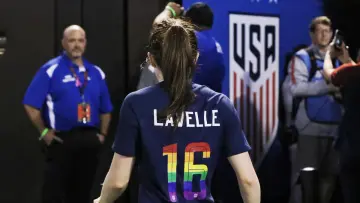
Her visibility as a gay woman also grew out of that naturalness. In 2018 she spoke publicly about her sexual orientation and began to receive messages from people thanking her for doing so. She insisted she did not want to become an icon or craft a message. She wanted to be honest.
But visibility does not depend solely on the intentions of the person offering it. For many girls and young women, seeing a footballer from the national team and Barça speak openly about her life had a value that went beyond Mapi. Not because they all needed to be like her, but because she proved they could reach the elite without hiding a part of themselves.
She did not invent a cause. She simply stopped hiding within a sport used to asking for silence.
The World Cup she chose not to attend
The hardest decision of her career did not happen on a pitch.
In September 2022, Mapi was one of fifteen players who told the Royal Spanish Football Federation that their situation with the national team was affecting their emotional state and their health. They asked for changes to working conditions, to preparation and to the structure around the team.
The RFEF publicly presented the conflict as a resignation. The players were singled out and the group began to fracture. Some returned before the 2023 World Cup. Mapi did not.
She knew what she was losing. Spain could compete for the title and she was at the best moment of her career. In the end, the national team became world champions without one of the best centre-backs Spain has produced.
Mapi could have had a World Cup medal. She chose not to act as if the reasons that had driven her away had disappeared.
“My values come first,” she explained later.
In September 2023 she was included, along with other players, in a squad called up amid the conflict that followed Luis Rubiales’s kiss on Jenni Hermoso. She turned up under the threat of possible sanctions, but left the camp with Patri Guijarro after stating that this was not the right way to return and that she was not in a fit state to do so.
She did not return with Spain until October 2025. More than three years had passed, the federation had changed part of its structure and Sonia Bermúdez had just taken over as head coach. Mapi came back moved, describing herself as a calmer, more serene person. She spoke of a rebirth.
The same stubbornness that kept her out was what allowed her to come back when she decided she could.
Learning to be on the outside
In December 2023 she suffered a tear of the lateral meniscus in her right knee during training. She needed surgery and missed almost the entire season.
For a player used to constantly intervening, the injury meant learning to watch. Barça kept winning while she worked away from the pitch. Her team-mates won the 2024 Champions League and Mapi reached the final after months of recovery, without the on-field prominence she had had in the previous ones.
She came back the following campaign and regained her place. She was no longer only the centre-back who had accompanied the team’s growth, but a veteran able to read what each match demanded and to pass on a competitive culture to the younger players.
Her final season in Barcelona ended with another league, another cup, another Supercopa and the club’s fourth Champions League. The same team that in 2019 had lost its first European final to Lyon said goodbye to her after beating the French side and completing another historic season.
Between one final and the other came the transformation of Barça. Mapi was inside almost all of it.
A stain the profile must not hide
An honest portrait cannot skip the episode that took place in February 2025 during a derby against Espanyol.
The blue-and-whites reported that Mapi had made a gesture that violated the privacy of Daniela Caracas during a tussle in the box. Barça’s defender denied having intentionally touched her opponent’s intimate parts and rejected the interpretation that spread about what happened. She also condemned the abuse Caracas began to receive on social media.
The RFEF Disciplinary Committee opened proceedings of its own accord and sanctioned Mapi with two matches for conduct contrary to good sporting order. Her appeals were dismissed and the Sports Administrative Court (TAD) later confirmed the sanction. In upholding the punishment, the TAD stressed that what had happened could not be considered accidental contact, but an intentional gesture made with play stopped.
There is no need to distort what happened in order to defend a player, nor to use it to sum up her entire career. There was a serious accusation, conflicting versions, a disciplinary ruling and a sanction. It is all part of the profile.
Mapi has argued for years that each person must take responsibility for who they are. That responsibility also includes living with the moments when her actions have been called into question.
Leaving while she could still stay
Mapi is not leaving Barça in search of one last contract after fading from the team. She departs as a starter in a European champion side, at 31 and still able to compete at the highest level.
Her next destination had not been officially announced at the time of writing, although various reports place London City Lionesses as the club best placed to sign her. It would be her first experience outside Spain and the start of a very different chapter: another language, another league and a project that wants to grow with footballers capable of changing its standing.
In Barcelona she leaves behind more than 300 official matches and a mark that does not fit into the statistics. She arrived when paying €50,000 for a Spanish footballer was news. She leaves at a time when the big European clubs compete for centre-backs, transfers are multiplying and girls can recognise a defender by her name, her number and the way she strikes the ball.
Mapi León was not always right. Nor has she tried to be comfortable. Her career contains triumphs, refusals, convictions, contradictions and mistakes. That is precisely why it deserves to be told as the story of a person and not the manufacture of a perfect symbol.
For nine years she defended Barcelona’s goal by moving forward. Off the pitch she did something similar: she decided that protecting herself did not necessarily mean staying quiet, hiding or keeping still.
Sometimes, to defend also means not to step aside.