There is a very elegant way of not actually looking at someone: to say that they are going to be. Going to be a star, going to be the best, going to be the future. It sounds like praise, and almost always is. But the future is a comfortable place: it never quite arrives, so it never demands anything. While a player is going to be, we can carry on never noticing what she already is.
With Vicky López, that trick has stopped working.
On Tuesday, in a cold stadium in Reykjavík, the Madrid-born forward scored twice, opened the scoring in the fifth minute after a threaded pass from Alexia, and pushed Spain towards their fourth consecutive World Cup before the opposition had strung three passes together. It was not a breakthrough or a surprise or a jewel being unearthed. It was a starter for the world champions doing her job. And doing it better than almost anyone.
A career written in records
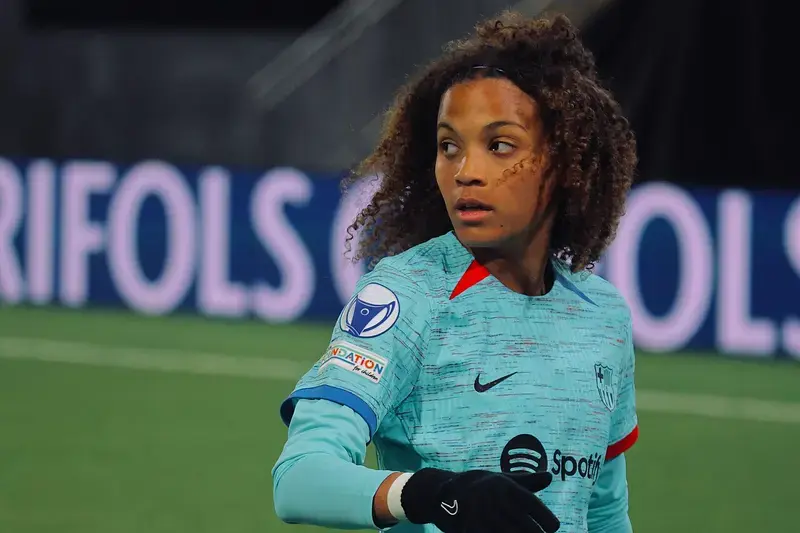
It is worth remembering where she comes from, because the CV makes your head spin. Vicky López Serrano Félix (Madrid, 26 July 2006) came through Madrid CFF, where she made her Liga F debut at 15 years and 71 days, the youngest ever to do so. Barça took her in 2022, in theory for the reserves, in practice never to let her go: today she is under contract until 2028.
Since then, her biography has been a list of “the youngest to”. The youngest Barça player to feature in the Champions League, at 16 years and 148 days. The youngest goalscorer in a Clásico for the club —men’s football included, ahead of Ansu Fati— at 17 years and 116 days. The youngest to debut for the senior national team, at 17 and 212, in February 2024. And, last summer, the youngest Spain goalscorer at a European Championship: 18 years and 342 days against Portugal, a record she took off Alexia Putellas, who is not exactly just anyone to take a record from.
That day at Euro 2025 she came into the starting eleven in place of Aitana Bonmatí. It is worth reading slowly: a teenager replaced the then two-time Ballon d’Or winner at a continental tournament, played eighty minutes, and Alexia said afterwards that she had moved “as if she had been playing here for ten years”. She won back ten balls —more than any other player— and barely lost her composure. Precocious maturity, they called it. We would call it, quite simply, being good.
It is not what she promises, it is what she delivers
The prodigy narrative has a trap: it puts the spotlight on age and leaves quality in the background, as if the astonishing thing were the when and not the what. But Vicky López’s numbers stand up without the crutch of her date of birth. This 2025/26 season she has ten goals and nine assists in Liga F. Those are not the figures of a young prospect: they are the figures of a decisive footballer, the kind who settle matches in both senses of the verb.
Her honours list, at 19, is dizzying: four leagues, three Copas de la Reina, four Super Cups and three Champions Leagues with Barça; two Nations Leagues with Spain —she scored in the 2025 final against Germany— and a U-17 World Cup. There are players who retire with less and nobody questions their career.
She moves the ball, she links play, she reads space, she breaks lines. She plays as an attacking midfielder and as a winger with the same ease, and in both roles she turns up where it hurts most. They call her the Golden Girl, and in September 2025 they put a trophy to the nickname: she won the first ever women’s Kopa Trophy, France Football’s award for the best Under-21 footballer in the world. The nickname is lovely, but it falls short in one respect: it suggests something still to be polished, gold in the rough. What we saw in Reykjavík was not a golden promise waiting to ripen. It was an already decisive footballer. One who, on top of that, at 19, still has an enormous amount of room to grow.
Let’s change the tense
The usual thing will happen. Tomorrow someone will once again announce that Vicky López is going to be the best in the world, and they will say it with affection, with good reason even, because at this rate she will be. But let’s hold on to what matters, which is what is in front of us and not what we are promised.
This national team is changing generations without easing off, winning 1-6 away from home with a 19-year-old leading the way while some of its legends waited their turn on the bench. Vicky López is not the future of anything. She is one of the best players in the present of Spanish football, and the present, by definition, is already here.
So let’s put it on the record, in the only tense that does her justice: Vicky López is brilliant. The rest are just chapters.
Records and career details for Vicky López via FC Barcelona and RFEF as primary sources; Olympics.com and DAZN as further reading. Our match report on Iceland-Spain, here.