The 2027 Women’s World Cup will be played in Brazil, from 24 June to 25 July. Thirty-two teams, 64 matches, eight cities — and the first edition ever staged in South America.
Spain have already qualified. They arrive as the first nation to hold both world titles at once: the women’s won in 2023 and the men’s won in July 2026.
Here is what is known about the tournament so far, and what is not.
Where is the 2027 Women’s World Cup being played?
In eight Brazilian cities. All eight stadiums hosted matches at the 2014 men’s World Cup.
| City | Stadium |
|---|---|
| Rio de Janeiro | Maracanã |
| Brasília | Nacional Mané Garrincha |
| Belo Horizonte | Mineirão |
| Fortaleza | Castelão |
| Porto Alegre | Beira-Rio |
| São Paulo | Arena Itaquera |
| Salvador | Fonte Nova |
| Recife | Arena Pernambuco |
Capacities are left out here: FIFA has not yet announced what capacity each match will be played at, and it need not be the stadium’s usual one. Brazil’s bid already planned substantial reductions at several venues.
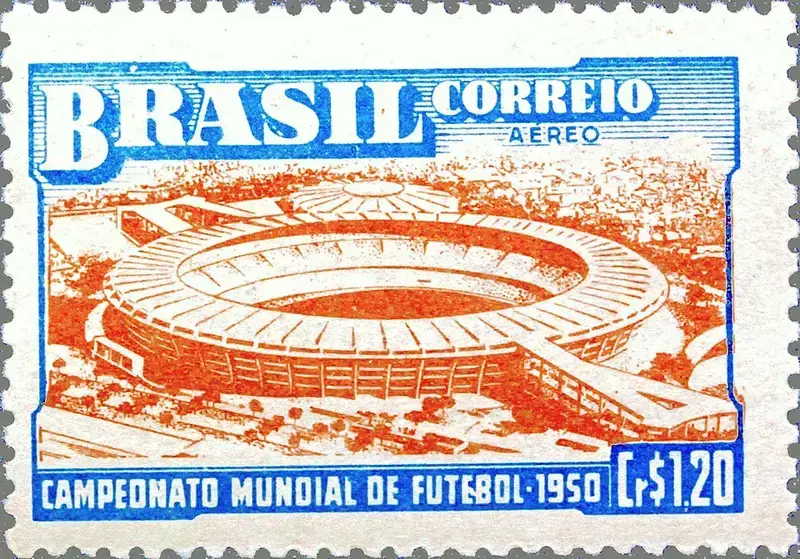
The final will be played at the Maracanã, which will also stage the opening match. Each of the eight cities will host six group matches and at least one knockout game: São Paulo will have the most, with ten; Rio de Janeiro and Fortaleza nine; Belo Horizonte eight; and Brasília, Porto Alegre, Recife and Salvador seven each.
When does it start and when does it finish?
The tournament begins on 24 June 2027 and ends with the final on 25 July. A month and a day, 64 matches.
FIFA published the full schedule on 20 August 2026, and the stages break down like this:
| Stage | Dates |
|---|---|
| Group stage | 24 June–8 July |
| Round of 16 | 10–13 July |
| Quarter-finals | 16–17 July |
| Semi-finals | 20–21 July |
| Third-place play-off | 24 July |
| Final | 25 July |
What that schedule says about each host city, and the two possible routes for Brazil, is in the piece on the World Cup schedule.
The field still has to be filled, and that calendar is this one:
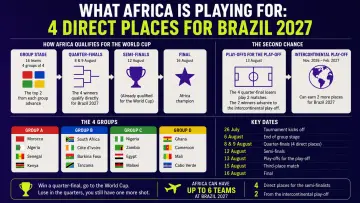
- 26 July – 16 August 2026: the Women’s Africa Cup of Nations, which hands out four direct places.
- 7 – 13 October 2026: first round of the European play-offs.
- 26 November – 5 December 2026: second European round, the one that awards the tickets.
- 27 November – 5 December 2026: Concacaf W Championship, in Texas, with four places.
- 24 November – 5 December 2026 and February-March 2027: the two stages of the inter-confederation play-off.
The last qualifier will be known between February and March 2027, three or four months before kick-off.
Which teams have already qualified?
Eighteen of the thirty-two. Four confederations have completed their allocation.
South America (3 of 3). Brazil as hosts, from the day FIFA awarded them the tournament in May 2024. Colombia and Argentina qualified on 5 June 2026, finishing first and second in the Nations League.
Asia (6 of 6). Australia, China, South Korea and Japan through the Asian Cup quarter-finals in March 2026. The Philippines and North Korea days later, through the play-off between the beaten sides.
Oceania (1 of 1). New Zealand, in April 2026, in the confederation’s first qualifying tournament of its own.
Europe (4 of 11). Germany on 5 June; Denmark, France and Spain on the 9th. The four sides that topped their league-phase group.
Africa (4 of 4). Morocco, Algeria, Cameroon and Malawi, for reaching the Women’s Africa Cup of Nations semi-finals in August 2026.
Concacaf: none yet. Their four places are decided between late November and 5 December.
How are the remaining places decided?
Fourteen are left. The full allocation for the tournament, confederation by confederation, runs: Europe 11, Africa 4, Concacaf 4, South America 3, Asia 6, Oceania 1, plus three more through an inter-confederation play-off.
The seven remaining European places come from two-legged play-offs involving 32 teams across two rounds between October and December. They produce eight winners, not seven: the seven ranked highest in the league phase go to the World Cup, and the eighth plays for its place in the inter-confederation play-off. That is the route left to England, the European champions, who did not win their group.
The four Concacaf places work the same way, through the semi-finals of an eight-team tournament in Texas between late November and 5 December.
The inter-confederation play-off hands out the last three places among ten teams, in two stages and at a single venue. Six play the first stage between November and December 2026 — two from Asia, two from Africa, one from Oceania and one from South America — and only two go through. Between February and March 2027 they are joined by four who enter directly: two from Concacaf, one from Europe and one from South America. Six teams, three ties, three places.
Seven already have their spot in that play-off: Uzbekistan, Chinese Taipei, Ghana, South Africa, Venezuela, Ecuador and Papua New Guinea. The six in the first stage were drawn on 20 August 2026 in Zurich: it is not a bracket but a three-matchday mini-league between 24 November and 5 December, with the top two overall going through.
What about Spain?
Spain qualified on 9 June 2026, with a 1-6 win in Reykjavík on the final matchday. They finished top of their group on fifteen points, level with England and ahead on the head-to-head.
It will be the first time they defend a world title. They have never done it, because they had never won one before 2023.
They also arrive in a new era: Sonia Bermúdez has been in charge since the summer of 2025, and Aitana Bonmatí returned to play in May after five months out with a fractured fibula. The build-up already has its first dates: two friendlies in the United States in October.
What is not known yet
The draw has no date. FIFA has only said it will be held during 2026. Any specific date you read elsewhere is speculation.
Nobody knows who plays where. The schedule for all 64 matches is now published, with a venue and a date for each, but without a draw there are no groups: only Brazil know which cities they will visit in the first round. Kick-off times have not been set either.
Tickets are not on sale. All that exists is a registration of interest on FIFA’s website. There are no prices, no sales phases and no announced opening date. Treat with suspicion any site presenting its offers today as official tournament tickets.
Where to watch it
In Spain it goes to RTVE, free to air, through rights acquired via the European Broadcasting Union for eighteen European territories. The deal provides for at least one match a day on member channels and live coverage of every game, as well as television, radio and digital coverage. RTVE has not yet set out how it will share the matches across its channels.
In the United States and Canada it goes to Netflix, which bought the 2027 and 2031 tournaments. In Brazil, Globo and CazéTV.
And after Brazil
2027 will be the last 32-team Women’s World Cup. FIFA agreed in 2025 to expand to 48 teams from 2031: twelve groups of four and 104 matches instead of 64.
Brazil 2027 therefore closes a format.
In the meantime, 2026 is not empty: there are two Women’s World Cups this year, the Under-20 in Poland and the Under-17 in Morocco.