

The 2026 Women’s Africa Cup of Nations will be the biggest edition yet. Sixteen teams will compete for the first time, four more than in 2024, and the tournament doubles as Africa’s qualifying event for the 2027 Women’s World Cup in Brazil.
Morocco are hosting WAFCON for a third consecutive edition. The opening match is on 26 July and the final on 16 August, with 34 games packed into three weeks. There are two first-time qualifiers, four former champions and two prizes to chase: the African title and a place on the road to Brazil.
This is FemGol’s guide to the tournament. All kick-off times are local in Morocco — and the same as British Summer Time.
When and where is WAFCON 2026?
The group stage runs from 26 July to 6 August 2026. The knockout rounds begin on 8 August, with the final scheduled for Sunday 16 August.
CAF initially announced a tournament window of 25 July to 16 August, but the governing body’s official match schedule puts the first game on Sunday 26 July. Rabat will host Groups A and C, while Groups B and D will be based in Casablanca.
Five stadiums will be used:
- Rabat Olympic Stadium.
- Moulay El Hassan Stadium, Rabat.
- Al Madina Stadium, Rabat.
- Moulay Rachid Stadium, Casablanca.
- Larbi Zaouli Stadium, Casablanca.
How World Cup qualification works
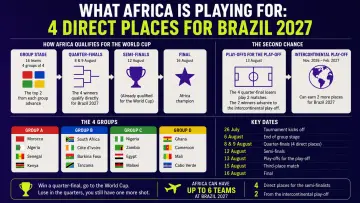
Four teams will leave Morocco with a guaranteed place at Brazil 2027. Qualification is immediate for every WAFCON semi-finalist, which gives the quarter-finals an importance beyond the continental trophy.
Losing in the last eight does not end a team’s World Cup campaign. The four defeated quarter-finalists will meet in two play-off matches on 13 August; the winners will claim Africa’s two places in FIFA’s inter-confederation Play-Off Tournament.
That means Africa can ultimately send as many as six teams to Brazil, but only four places are direct. The other two sides must still navigate the global play-offs. FIFA’s CAF qualifying guide explains the wider route to the finals.
There is also a record financial reward. CAF has announced prize money of US$1 million for the champions.
The tournament format
The 16 entrants are split into four groups of four. Each team plays three matches and the top two in every group advance to the quarter-finals. There is no route through as a best third-placed side.
The quarter-final bracket is already set:
- Group A winner vs Group B runner-up.
- Group B winner vs Group A runner-up.
- Group C winner vs Group D runner-up.
- Group D winner vs Group C runner-up.
From there, WAFCON becomes a straight knockout competition — with the extra World Cup play-offs for the four beaten quarter-finalists.
WAFCON 2026 groups
| Group | Teams | Base |
|---|---|---|
| A | Morocco, Algeria, Senegal, Kenya | Rabat |
| B | South Africa, Ivory Coast, Burkina Faso, Tanzania | Casablanca |
| C | Nigeria, Zambia, Egypt, Malawi | Rabat |
| D | Ghana, Cameroon, Mali, Cape Verde | Casablanca |
Group A: Morocco carry the pressure
Morocco have reached the last two finals and now play another tournament on home soil. They are clear favourites to win Group A, but that status brings expectation rather than comfort. Algeria provide a North African derby, Senegal arrive at a third consecutive WAFCON and Kenya return to the finals for the first time since 2016.
For the Atlas Lionesses, the group stage is less about announcing themselves than proving that two runner-up finishes have permanently changed their level.
Group B: the 2022 champions and three returning teams
South Africa are the benchmark. Banyana Banyana won WAFCON in 2022 and have since competed at another World Cup. Behind them, the group is built around returns: Ivory Coast are back after a 12-year absence, Burkina Faso make their second appearance after debuting in 2022, and Tanzania reach the finals for a third time, after 2010 and 2024.
South Africa should control the group. The more open question is which of the other three teams can turn a long-awaited return into a quarter-final place.
Group C: no room for a slow start
Nigeria have won a record ten titles and arrive as defending champions. Zambia finished third in 2022 and possess a generation hardened by Olympic and World Cup football. Egypt are back on the continental stage, while debutants Malawi bring Tabitha and Temwa Chawinga — two forwards capable of changing the shape of a match on their own.
It is the strongest group on paper and the one most likely to punish a single poor performance.
Group D: old pedigree, present urgency
Ghana and Cameroon both have World Cup history; Ghana finished third last time out, while Cameroon missed the tournament altogether. Mali are returning to the finals and Cape Verde are making their debut. The draw gives all four a genuine opening: none must face Nigeria, Morocco, South Africa or Zambia before the quarter-finals.
That opportunity comes with pressure. For Ghana and Cameroon in particular, reputation will count for very little if recent decline follows them into Casablanca.
Complete group-stage fixtures
| Date | Kick-off | Fixture | Group |
|---|---|---|---|
| 26 July | 18:00 | Algeria vs Senegal | A |
| 26 July | 21:00 | Morocco vs Kenya | A |
| 27 July | 18:00 | South Africa vs Tanzania | B |
| 27 July | 21:00 | Ivory Coast vs Burkina Faso | B |
| 28 July | 18:00 | Zambia vs Egypt | C |
| 28 July | 21:00 | Nigeria vs Malawi | C |
| 29 July | 18:00 | Ghana vs Cape Verde | D |
| 29 July | 21:00 | Cameroon vs Mali | D |
| 30 July | 18:00 | Senegal vs Kenya | A |
| 30 July | 21:00 | Morocco vs Algeria | A |
| 31 July | 18:00 | South Africa vs Ivory Coast | B |
| 31 July | 21:00 | Burkina Faso vs Tanzania | B |
| 1 August | 18:00 | Egypt vs Malawi | C |
| 1 August | 21:00 | Nigeria vs Zambia | C |
| 2 August | 18:00 | Ghana vs Cameroon | D |
| 2 August | 21:00 | Mali vs Cape Verde | D |
| 3 August | 21:00 | Senegal vs Morocco | A |
| 3 August | 21:00 | Kenya vs Algeria | A |
| 4 August | 21:00 | Burkina Faso vs South Africa | B |
| 4 August | 21:00 | Tanzania vs Ivory Coast | B |
| 5 August | 21:00 | Egypt vs Nigeria | C |
| 5 August | 21:00 | Malawi vs Zambia | C |
| 6 August | 21:00 | Mali vs Ghana | D |
| 6 August | 21:00 | Cape Verde vs Cameroon | D |
The two matches in each group’s final round kick off simultaneously. Morocco and the United Kingdom are both on UTC+1 during the tournament, so the listed times are also the UK times.
Knockout-stage dates
- 8 and 9 August: the four quarter-finals, two on each day.
- 12 August: semi-finals.
- 13 August: two World Cup qualifying play-offs between the beaten quarter-finalists.
- 15 August: third-place match.
- 16 August: final in Rabat, kicking off at 20:00.
For weeks there was a discrepancy in CAF’s own material: the official PDF placed all four quarter-finals on 8 August, while the news release accompanying the schedule split them across 8 and 9 August. The release is the one that holds: two ties on each day.
WAFCON 2026 favourites
Nigeria remain the starting point for any title discussion. The Super Falcons are defending champions and have won ten of the 13 editions recognised by CAF. Their 2024 triumph required them to eliminate Zambia in the quarter-finals, come from behind against South Africa in the semi-finals and then overturn a two-goal deficit against Morocco in the final.
Morocco are no longer an emerging outsider. Successive runner-up finishes, home advantage and growing investment have changed the terms of the conversation. Anything short of another serious title challenge will now feel like regression.
South Africa still carry the authority of their 2022 title, although this tournament will test whether they remain the continent’s leading challenger to Nigeria and Morocco. Zambia, with their pace and big-tournament experience, complete the clearest top tier.
The chasing group is varied. Ghana finished third last time out and Cameroon missed the edition altogether. Algeria reached the quarter-finals for the first time in 2024. Malawi have never been here before, yet the presence of the Chawinga sisters makes them far more dangerous than the word “debutants” suggests.
Why this edition is different
WAFCON expanded from 12 to 16 teams after the qualifying competition had finished. CAF filled the four additional places by selecting the highest-ranked eliminated teams in the FIFA Women’s World Ranking: Cameroon, Ivory Coast, Mali and Egypt. The governing body approved the expansion in November 2025.
The larger field brings Cape Verde and Malawi to WAFCON for the first time. It also creates a cleaner group-stage equation than in many expanded tournaments: finish in the top two or go home.
The dates are another part of the story. WAFCON was originally due to run from 17 March to 3 April, but CAF postponed it just 12 days before kick-off, citing “unforeseen circumstances”. The new window begins exactly one week after the men’s World Cup final, forcing national teams and clubs to rebuild travel plans, camps and player-release arrangements at short notice.
How to watch WAFCON 2026
CAF published its list of international rights holders on 24 July, and for the first time the tournament is live in the United Kingdom on Channel 4. Elsewhere in Europe, DAZN holds the rights in Germany and surrounding territories, alongside Ziggo; beIN Sports covers the MENA region and CANAL+ French-speaking sub-Saharan Africa. Ireland is not named in CAF’s list.
Where no local broadcaster has been announced, CAF’s official platforms and its YouTube channel, CAF TV, are the place to check. FemGol will update this section as coverage is confirmed. Availability on an official stream in one territory does not necessarily mean the same feed will be accessible elsewhere without geoblocking.
Eight stories to read before kick-off
The fixture list tells us who plays whom. These stories from The Other National Team explain something of what the teams are carrying into Morocco:
- Morocco: the Atlas Lionesses chase their ticket to Brazil at home.
- Algeria learned how not to lose; now they chase a first World Cup.
- Senegal do not roar yet, but they have stopped asking permission.
- South Africa: Banyana Banyana, a team built on resilience.
- Ivory Coast and the 10–0 that could never be the end.
- Egypt: the national team Sahar El Hawary built out of her own pocket.
- Ghana reached the World Cup first; now they are trying to return.
- Cape Verde built another national team in eight years.
WAFCON 2026 FAQ
What does WAFCON stand for?
WAFCON is short for the Women’s Africa Cup of Nations, CAF’s senior continental championship for women’s national teams.
When does WAFCON 2026 begin and end?
The opening match is on 26 July 2026. The final will be played on 16 August.
How many teams are taking part?
Sixteen teams will compete, up from 12 in the previous edition. They are divided into four groups of four.
How many African teams will qualify for the 2027 Women’s World Cup?
Four will qualify directly by reaching the WAFCON semi-finals. Two more will represent Africa in the inter-confederation Play-Off Tournament, where ten teams will compete for the final three World Cup places.