THE OTHER NATIONAL TEAM · MOROCCO
During the men’s World Cup, FemGol will trace the history of some of the women’s national teams from the countries taking to the pitch. Because a country’s football doesn’t fit in a single team.
Today Morocco face Brazil. The Group C match in East Rutherford is the kind that justifies a World Cup: the side that won the planet over in Qatar 2022, the first African team to reach a semi-final, against the five-time World Cup winners. Some will treat it as a final brought forward.
But Morocco are also playing another match. In a few weeks, the Atlas Lionesses will host the 2026 Africa Cup of Nations at home. And this time the trophy will not be the only prize: the four semi-finalists will earn a direct place at the 2027 Women’s World Cup in Brazil. Two more African sides will go through to the inter-confederation play-offs.
Morocco do not have their ticket yet. But once again it is within touching distance.
The team that opened a door
Morocco made history in 2023 by becoming the first Arab side to play at a Women’s World Cup. And they did not simply turn up: they reached the round of 16 on their debut in Australia and New Zealand.
The opening had been brutal. Germany, among the favourites, beat them 6-0 in the first match. For many sides, that would have set the tone for the whole adventure. Morocco did the opposite. On matchday two they beat South Korea 1-0 through Ibtissam Jraidi, the country’s first ever goal at a Women’s World Cup. And on matchday three, another 1-0 win, this time over Colombia, took them into the knockout rounds.
That match against South Korea also produced an image that travelled around the world: Nouhaila Benzina became the first footballer to play a Women’s World Cup match wearing a hijab. In the last 16, France proved too much (4-0) and the journey ended. But the message had been sent: you could get there, and you could get there from a corner of the map the tournament had never visited.
What did not exist, and now does
It was not a spontaneous leap. CAF itself credits the team’s transformation to the structural drive of the Royal Moroccan Football Federation. The team that debuted in 2023 was led by Frenchman Reynald Pedros. Soon after, in October of that year, Jorge Vilda arrived — the coach who had won the 2023 World Cup with Spain amid the upheaval of the Rubiales affair.
Vilda remains in charge of a project that no longer wants to be a tournament’s charming footnote. Morocco have kept investing in infrastructure and player development, and head into the next Africa Cup of Nations with a mix of experienced players and emerging youngsters.
Two finals, twice so close
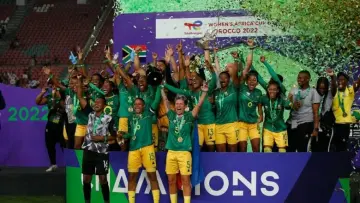
The clearest measure of that growth is the Women’s Africa Cup of Nations. In 2022, as hosts, Morocco reached the final and lost 2-1 to South Africa. That edition did open the door to their first World Cup: the four semi-finalists earned direct qualification for Australia and New Zealand 2023.
The story repeated itself, almost identically, at the next edition. WAFCON 2024 was played in July 2025, again on Moroccan soil, and again the Atlas Lionesses reached the final. Facing them stood Nigeria, the continent’s great power. Morocco went 2-0 up through Ghizlane Chebbak and Sanaâ Mssoudy and came within touching distance of their first ever title. But Nigeria fought back to win 3-2, with an 88th-minute strike from Jennifer Echegini, and claimed a tenth African crown.
Two finals in a row, two defeats, both at home. The trophy has yet to arrive.
The tournament that decides the ticket
The calendar has handed them an immediate third chance, and once more in front of their own supporters. Morocco will stage WAFCON for a third consecutive edition. The tournament had originally been set for 17 March to 3 April 2026, but CAF rescheduled it: it will now be played from 25 July to 16 August.
The Atlas Lionesses share Group A with Algeria, Senegal and Kenya. If they reach the quarter-finals and win that tie, they will be in Brazil 2027. A semi-final place would not only bring closer the title that has twice slipped away: it would also secure their return to the World Cup.
For a side that a decade ago barely registered on the map, the challenge is no longer to show up. It is to finish the job.
Brazil is on the other side
There is a symmetry the calendar has drawn without meaning to. Tonight, Morocco’s men face Brazil in one of the great matches of the World Cup group stage. The women, meanwhile, are preparing their own road to that same country.
One reached the summit in Qatar and is looking to prove it was no exception. The other built its place almost in silence, match by match, final by final, until what began as a feat became a habit.
Today every camera will point at the men’s Brazil–Morocco. Fair enough: it is a wonderful fixture. But it is worth remembering that there is another Moroccan side with Brazil on the horizon.
It is not in yet. This time it will have to earn it at home.