THE OTHER NATIONAL TEAM · ALGERIA
During the men’s World Cup, FemGol will trace the history of some of the women’s national teams from the countries taking to the pitch. Because a country’s football doesn’t fit in a single team.
Algeria are already out of the World Cup.
Switzerland defeated them 2-0 in Vancouver and brought an end to a campaign in which the men’s national team had managed to survive the group stage. After losing to Argentina, they came from behind against Jordan and drew 3-3 with Austria to advance as one of the best third-placed teams. Their return to the World Cup knockout rounds, twelve years after reaching the last 16 in Brazil, ended at the first hurdle.
That same weekend, the women’s national team began their training camp for the Women’s Africa Cup of Nations.
They are not preparing to return to a World Cup. They are preparing to reach one for the first time.
Algeria have never played at the Women’s World Cup, but they approach this opportunity after the best year in their history. They reached the quarter-finals of the continental competition for the first time, went through the entire tournament without conceding a goal and then eliminated Cameroon to qualify again.
They have already learned how to compete against some of Africa’s strongest teams.
Now they need to learn how to cross the threshold.
An entire tournament without conceding
The 2024 Women’s Africa Cup of Nations was held in Morocco in July 2025. Algeria arrived after missing the previous two editions and facing a barrier they had never managed to overcome: in each of their five previous appearances, beginning with their debut in 2004, they had been eliminated in the group stage.
This time, they began with a 1-0 victory over Botswana. It was the only goal they scored in the entire tournament.
They then drew 0-0 with Tunisia and repeated the result against Nigeria, the most successful national team in African football. Five points, three clean sheets and a first appearance in the knockout rounds.
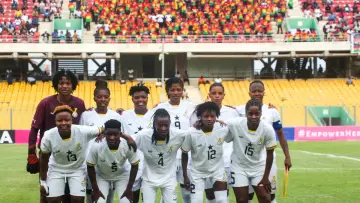
Ghana awaited in the quarter-finals. The match lasted 120 minutes and once again finished goalless. Algeria’s defence, with Chloé N’Gazi behind it, withstood Ghana’s pressure. Algeria also created opportunities, but neither team managed to break the deadlock. Ghana won the shootout 4-2 after Cynthia Konlan saved the penalties taken by Marine Dafeur and Inès Belloumou.
Algeria were eliminated after playing 390 minutes without conceding a single goal.
The statistic explained both their transformation and their limit. They had built a team capable of surviving against anyone, but they had scored only once. Their defensive solidity carried them into the last eight; their lack of attacking threat prevented the run from becoming something greater.
They had not reached the World Cup, but they no longer looked like a team attending the Women’s Africa Cup of Nations merely to measure the distance that still separated them from the continent’s leading powers.
The victory that changed the scale of their ambition
Algeria did not have to wait long to prove that their quarter-final appearance had not been an accident.
In the first round of qualifying for the 2026 Women’s Africa Cup of Nations, they defeated South Sudan 5-0 and 3-0. The real examination came afterwards. To return to the tournament, they had to eliminate Cameroon, one of the historic powers of African women’s football and a regular presence in the competition’s decisive stages.
Algeria won 2-1 in Oran.
They then travelled to Douala and won again, this time 1-0. The 3-1 aggregate victory secured a second consecutive qualification and turned the resistance shown in Morocco into something more than a strong defensive run. Farid Benstiti’s team had defeated Cameroon in both legs.
The progress can also be seen in the rankings. In FIFA’s latest update, published on 16 June 2026, Algeria stood 74th in the world. The Confederation of African Football ranked them as the continent’s eighth-best team.
They are not yet among the continent’s leading sides, alongside Nigeria, South Africa, Morocco and Zambia. But they have moved close enough that competing against those teams no longer resembles an impossible mission.
Benstiti has been central to that transformation. He arrived in 2023 after a long career in French women’s football, including spells in charge of Olympique Lyonnais and Paris Saint-Germain. His Algeria have been built on organisation, defensive concentration and a squad that combines players developed inside the country with a majority raised in football systems abroad.
A national team built on both sides of the Mediterranean
The squad selected for the 2026 Women’s Africa Cup of Nations reveals the true shape of that structure.
Of the 26 players called up by Benstiti, only two belong to Algerian clubs: goalkeeper Amina Haleyi of JS Kabylie and forward Khouloud Ournani of CF Akbou.
The other 24 play abroad.
Many compete in France, from the professional divisions to clubs lower down the pyramid. Others play in England, Turkey, Switzerland or Saudi Arabia. Inès Belloumou belongs to West Ham; Marine Dafeur plays for Bristol City; Aicha Hamideche represents Beşiktaş; Sofia Bekhaled is on loan from Lyon at Servette; and Lina Boussaha plays for Saudi club Al-Ittihad.
That does not mean they all share the same story, nor can the national team be reduced to a simple extension of the French diaspora. But it does reveal a reality: Algeria still depend heavily on sporting structures abroad to provide many of their internationals with the competitive and professional environments they need.
Benstiti has turned that dispersion into a national team.
He has brought together players from different leagues, developmental backgrounds and career paths around a recognisable identity. The result is not always a fluent attacking side, but it is one that knows how to protect itself, keep matches alive and force opponents to play for long periods without finding space.
The squad has also undergone significant renewal for 2026. Seven players will make their Women’s Africa Cup of Nations debuts, while several experienced members of the previous squad have been left out or have retired from international football. Benstiti retains important figures such as N’Gazi, Belloumou, Dafeur, Sofia Guellati, Mélinne D’Oria and Lina Boussaha, but he is trying to add alternatives to a team that needs to produce more with the ball.
The game growing inside Algeria
Algeria’s dependence on players based abroad does not mean that women’s football lacks a domestic structure.
CF Akbou represents one of its most interesting projects.
The club was founded on 8 March 2010, International Women’s Day, in the province of Béjaïa, within the Kabylie region. Its original aim was not to create one of the country’s strongest teams immediately, but to offer girls in the area, from the age of six, the same opportunity to play sport as boys.
Akbou developed youth teams, provided equipment without charging fees and made community work part of its identity. Its academy sides won national titles and numerous players reached Algeria’s national youth teams. The club also became involved in community campaigns, support for families and charitable projects far beyond the football pitch.
Sporting success eventually followed. Akbou were promoted to the top division in the 2013-14 season and, ten years later, won the league, the Algerian Cup and the League Cup to complete the first domestic treble in their history.
Akbou demonstrate that women’s football exists and is developing inside Algeria. They also reveal how far it still has to go: despite their academy work and domestic success, only one of their players appears in the squad for the Women’s Africa Cup of Nations.
The national team can find players inside the country.
It still cannot find most of them there.
A door closer than ever before
Algeria will begin the Women’s Africa Cup of Nations against Senegal on 26 July, in the opening match of the tournament. They will then face hosts and leading contenders Morocco before completing the group stage against Kenya. Only the top two teams will advance to the quarter-finals.
Reaching that stage would equal their best result, but this time the quarter-finals carry a prize that was not at stake in the previous edition.
The four winners will qualify directly for the 2027 World Cup in Brazil. The four defeated quarter-finalists will still enter additional play-offs to determine which two African teams advance to the intercontinental qualifying tournament.
The margin for error is small.
Morocco will play at home, Senegal also reached the quarter-finals of the previous Women’s Africa Cup of Nations and Kenya are returning to the competition after a decade away. Algeria do not begin as favourites to progress from the group, nor can they rely only on the defence that surprised the continent a year ago.
To reach the World Cup, they will have to preserve what has driven their progress and find what they were missing.
The men’s national team left the World Cup after encountering the limit that still separates Algeria from the final rounds. The women will travel to Morocco with another barrier ahead.
In 2025, they learned how not to concede.
In 2026, they must score the goal that changes their history.