THE OTHER NATIONAL TEAM · NORWAY
During the men’s World Cup, FemGol will trace the history of some of the women’s national teams from the countries taking to the pitch. Because a country’s football doesn’t fit in a single team.
Tonight, Norway face England for a place in the World Cup semi-finals. They have returned after a 28-year absence and already gone further than ever before. After eliminating Brazil, Erling Haaland leads a generation that has ensured the country no longer has to follow major tournaments from the outside.
For that team, almost everything that is happening is new.
For Norwegian football, it is not.
Long before Haaland could score at a World Cup, Norway’s other national team had already learned how to compete with the most powerful countries, beat them and return home with a trophy. It was the women who delivered the country’s first major international title. Another European Championship, a World Cup and an Olympic gold medal followed.
The country’s first major title
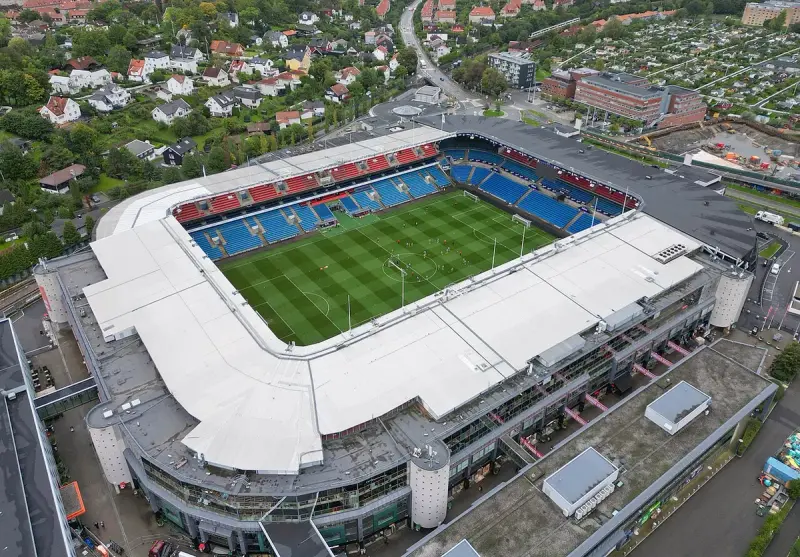
On 14 June 1987, Norway faced Sweden in the Women’s European Championship final at Oslo’s Ullevaal Stadion.
Trude Stendal scored both Norwegian goals. Sweden pulled one back late on, but the 2-1 victory made Norway European champions. It was not only the first title won by that team. It was the first major international tournament won by any Norwegian national side, men’s or women’s, since the federation was founded in 1902.
That victory did not immediately usher in a period of dominance. Norway lost the European finals of 1989 and 1991 to Germany. Later in 1991, they were beaten by the United States in the final of the first FIFA Women’s World Cup.
They were close to everything, but had yet to rule anything.
The wait ended in 1993. Birthe Hegstad’s goal against Italy secured Norway’s second European title. In six years, they had reached four continental finals and won two of them. They were no longer a team that had simply taken advantage of an opportunity on home soil.
They were a major power.
The team that reached the top
The 1995 World Cup in Sweden showed how far Norway could go.
They scored 21 goals and conceded only one in the five matches before the final. Norway overcame Denmark in the quarter-finals, defeated the United States in the semi-finals and met Germany again in the match for the title.
The final was played in the rain at Råsunda Stadium. Hege Riise opened the scoring after carrying the ball towards the penalty area and placing her shot beyond the goalkeeper. Marianne Pettersen added the second only a few minutes later. Norway won 2-0 and became world champions. Riise was named the tournament’s best player.
That victory was not a fleeting appearance by a small country. Norway had reached both of the first two World Cup finals and had eliminated the United States before beating Germany. At a time when the hierarchy of the women’s game was still taking shape, Norway were among the teams everyone else had to chase.
The cycle still had one final major title to deliver.
At the Sydney 2000 Olympic Games, Norway met the United States again. The Americans were world champions and defending the gold medal they had won four years earlier. The match went into extra time before Dagny Mellgren reacted to a loose ball and scored to make it 3-2. The golden-goal rule brought the final to an immediate end.
In thirteen years, Norway had won two European Championships, a World Cup and an Olympic gold medal.
They no longer needed to be introduced as a surprise. They were one of the standards by which the women’s game was measured.
The world caught up
There is no exact date on which that power disappeared.
Norway remained competitive. They finished as European runners-up in 2005 and 2013, reached the continental semi-finals in 2009 and made the World Cup quarter-finals in 2019. What they lost was not their ability to produce good players, but the advantage they had built over other countries.
Germany consolidated its dominance. The United States expanded an already enormous player base. England, France, Spain, the Netherlands and other federations increased their investment, while major clubs brought more structures, academies and resources into the women’s game. Norway had arrived early, but international growth meant that was no longer enough.
Their own federation now acknowledges the problem. A report presented in 2025 warned that Europe’s largest football nations were investing heavily, that international development was moving faster than Norway’s and that the domestic league was struggling to retain the best players it produced. Its objectives include making the Toppserien fully professional and placing it among Europe’s six best leagues by 2030.
The national team’s results reflected the same loss of ground. Norway were eliminated in the group stage of the 2017 and 2022 European Championships. At the latter, they suffered an 8-0 defeat to England, the heaviest in the history of the Women’s EURO finals. Japan knocked them out in the round of 16 at the 2023 World Cup.
Norway had not disappeared. They simply no longer decided where the women’s game was heading.
The stars were not enough
The paradox is that the country continued to produce some of the best players in the world.
Ada Hegerberg became the first winner of the women’s Ballon d’Or and is the all-time leading scorer in the Women’s Champions League. Caroline Graham Hansen established herself as one of Barcelona’s most decisive attackers, while Guro Reiten and Frida Maanum played for some of Europe’s strongest clubs.
Norway could assemble names that made them look like contenders. The problem was turning them into a national team of the same standard.
Hegerberg’s relationship with the national side showed that the difficulties extended beyond the pitch. The striker stepped away from international football in 2017 because of her disagreement with the federation’s treatment of the women’s game. She remained away for almost five years before returning in 2022. The absence of one of the country’s best players showed that the structure was not meeting the standards it demanded of its footballers.
At Women’s EURO 2025, Norway won all three of their group matches and recovered some of the cohesion lost in previous tournaments. Their run ended in the quarter-finals, when Cristiana Girelli scored in the 90th minute to give Italy a 2-1 victory. Norway were competitive again.
They had not yet returned to where they had once been.
A story that did not begin with Haaland
The men’s national team now take the field surrounded by the kind of attention they had waited decades to receive.
Haaland can lead them into a World Cup semi-final and open an entirely new chapter for that team. But Norway’s international football story does not begin with him. Long before his arrival, the country’s women won the federation’s first major title, became world champions and defeated the United States to claim Olympic gold.
Norway can celebrate their men finally arriving without turning those earlier achievements into the prologue to this generation.
They do not need Haaland to teach them that winning is possible.
They need to remember who taught them first.