THE OTHER NATIONAL TEAM · SPAIN
During the men’s World Cup, FemGol will trace the history of some of the women’s national teams from the countries taking to the pitch. Because a country’s football doesn’t fit in a single team.
Spain play in the World Cup final today.
The men’s national team face Argentina in New Jersey, sixteen years after defeating the Netherlands in Johannesburg. It is their second final. They could end the night with a second star above the crest.
Spain’s other national team already have one.
They also know what it means to face the reigning world champions in the final match of the tournament. They did so against England in Sydney on 20 August 2023.
It was the first World Cup final in their history.
They did not need a second chance.
In red, but without the crest
The journey to that night had begun 52 years earlier.
On 21 February 1971, seventeen Spanish footballers faced Portugal at La Condomina in Murcia. The match ended 3-3 in front of around 3,500 spectators, with goals from Laura, Conchi and Ana María.
The national anthem was played before kick-off.
The Spanish crest, however, was missing from their shirts.
The Royal Spanish Football Federation did not recognise the team and tried to prevent the match from appearing official. It also refused to allow the referee, Sánchez Ramos, to wear the regulation uniform. He had to take charge in a tracksuit.
The players took the field anyway.
They did not need the federation’s permission to know who they represented. They wore red, listened to the anthem and played against another national team. The only thing missing was for the institution responsible for Spanish football to accept that they were part of it too.
The RFEF did not recognise the women’s national team until November 1980.
The first official match took more than two further years to arrive. It was played in A Guarda on 5 February 1983, once again against Portugal.
This time, the players were allowed to wear the crest.
Spain lost 0-1, but that defeat entered records that had excluded the draw at La Condomina. Almost twelve years had passed between the first team to represent the country and the first national side the federation was willing to recognise.
Thirty-two years before a World Cup
Official recognition did not end the wait.
Spain reached the semi-finals of Euro 1997 in their first appearance at the tournament, but did not qualify for another European Championship until 2013.
The World Cup remained even further away.
The national team had to wait until 2015 to make their debut in the competition. Thirty-two years had passed since their first official match and 44 since that afternoon without a crest at La Condomina.
Their experience in Canada lasted three games. Spain drew with Costa Rica, lost to Brazil and South Korea and were eliminated in the group stage.
Four years later, they returned to the World Cup with a different team and greater ambition. They recorded their first victory, advanced from the group stage for the first time and faced the United States in the round of 16.
The eventual champions needed two Megan Rapinoe penalties to win 2-1.
Spain had begun to compete with the best.
They had still never won a World Cup knockout match.
The final they did not let slip away
Before the 2023 World Cup, Spain had played seven matches in the competition and won only one.
In Australia and New Zealand, they needed another seven to become world champions.
The path was not inevitable. After defeating Costa Rica and Zambia, the national team ended the group stage with a 4-0 defeat by Japan.
They responded by beating Switzerland in the round of 16. They overcame the Netherlands after extra time in the quarter-finals and reached a World Cup semi-final for the first time.
Spain had never played one before.
Salma Paralluelo put Spain ahead against Sweden in the 81st minute. Rebecka Blomqvist equalised in the 88th. One minute later, Olga Carmona collected a short corner and shot from outside the penalty area. The ball struck the crossbar and went in.
Spain were in the final.
Five days later, Olga scored again.
She received the ball on the left and drove a low shot beyond Mary Earps. It was the 29th minute. England pushed after the break and Earps saved a penalty taken by Jenni Hermoso, but the score did not change.
When the match ended, Spain were world champions.
The national team that had needed twelve years to be officially allowed to wear the crest had just placed a star above it.
Defending what they won
The title in Sydney did not stand alone.
Six months later, Spain defeated France in the final to win the inaugural Women’s Nations League. In 2025, they reached a European Championship final for the first time, although England prevailed on penalties and once again left Spain one step short of the title.
Before the end of that year, Spain retained the Nations League against Germany.
In June 2026, they also secured direct qualification for the World Cup in Brazil. They will arrive at the 2027 tournament as defending champions and with a task they have never faced before: defending the star.
They no longer need to prove that they can reach a World Cup.
Nor that they can reach a final.
They already know how to win one.
The last story was at home
During this World Cup, FemGol has explored the stories of the other national teams from the countries taking the field.
The last one was at home.
Spain play in a World Cup final today. The men’s national team are attempting to win their second World Cup against Argentina, the reigning champions.
The women have already travelled that road.
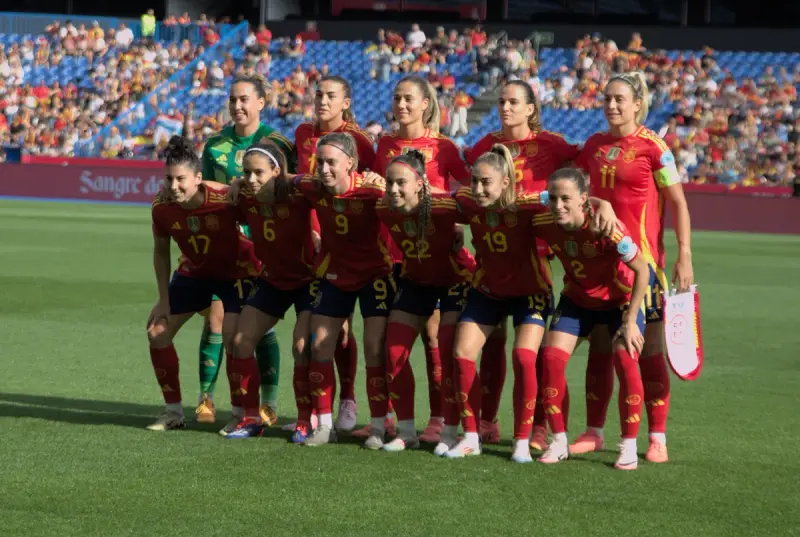
In 1971, they took the field wearing red but were not allowed to display the crest. In 2023, they reached the final match of a World Cup for the first time and ended the night with a star above it.
The journey took 52 years.
The final was decided by one goal from Olga Carmona.
The World Cup ends today.
So does this journey through its other national teams.
Because Spain’s football cannot fit into a single national team.