THE OTHER NATIONAL TEAM · COLOMBIA
During the men’s World Cup, FemGol will trace the history of some of the women’s national teams from the countries taking to the pitch. Because a country’s football doesn’t fit in a single team.
Colombia are out of the World Cup. Switzerland held firm through 120 goalless minutes and won the penalty shootout 4-3, leaving the men’s national team one step short of the quarter-finals.
Colombia’s other national team also knows what it is like to lose that way.
But its recent story does not end with a shootout.
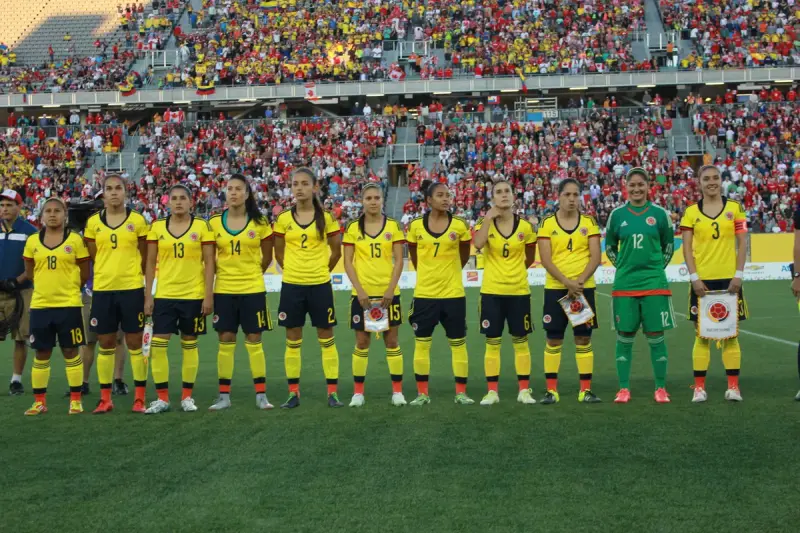
Two days before the men’s World Cup began, Colombia defeated Paraguay 4-3 and won the inaugural CONMEBOL Women’s Nations League. It was the senior national team’s first title in a confederation competition and the reward for a side that had spent fifteen years reaching finals without finding a way past Brazil.
Ana María Guzmán opened the scoring after eight minutes. Paraguay responded and Colombia went into half-time behind. Marcela Restrepo, Linda Caicedo and Guzmán again, this time in the 89th minute, completed a victory that took the team to the top of the standings. Six wins, two draws and 20 points from a possible 24: unbeaten champions and qualified for the 2027 World Cup in Brazil.
It was not a Copa América. Brazil, already qualified for the next World Cup as hosts, did not take part. But nor was it a friendly tournament created simply to fill the calendar. The first South American Women’s Nations League brought together the confederation’s other nine national teams in an eight-match qualifying competition, with two direct places at Brazil 2027 available. Colombia were the most consistent side over eight months.
Fifteen years finishing behind Brazil
Colombia did not emerge from nowhere.
Their recent history can be told through second-place finishes. They were Copa América runners-up in 2010, 2014, 2022 and 2025. Four lost finals, all against Brazil, across fifteen years. Each confirmed that Colombia belonged among South America’s leading teams; none placed a trophy alongside that progress.
The most recent defeat was also the one that left the smallest gap between the two teams. Colombia and Brazil drew 4-4 after 120 minutes in the 2025 final. The winner was decided on penalties and, once again, it was Brazil. Colombia returned home as runners-up for the fourth time, having come within one kick of changing the continent’s hierarchy.
Ten months later, they did not have to defeat Brazil to become champions. They had to do something different: remain consistent across eight matches, win at home and away, withstand Argentina’s pressure and go into the final match in Paraguay knowing that only victory would guarantee the title.
The Nations League did not erase the four previous finals. It gave them an ending.
The national team arrived before the structure
Colombia’s development did not follow the usual order either.
First came a national team capable of competing. Then came the domestic competition that was supposed to sustain it.
Colombia finished second in South America in 2010, qualified for their first World Cup in 2011 and made their Olympic debut at London 2012. The country’s first professional women’s league, however, did not begin until 2017. FIFA itself acknowledged that its creation was partly a response to the need to provide a structure for players who were already competing at World Cups, Olympic Games and Copa América tournaments.
That contradiction explains part of Colombia’s story. The players were not the final product of an established professional system. For years, they had to move ahead of it.
The league gave Santa Fe, América de Cali, Deportivo Cali and other clubs an initial professional platform, but its history has been marked by short calendars, intermittent projects and unequal working conditions. The 2026 competition features 16 teams and a 16-match opening phase, but it is still searching for the stability that Colombia’s best players have found abroad.
The national team therefore also serves as a meeting point between different generations and different destinations. Leicy Santos and Daniela Montoya belong to the group that learned to compete with Brazil before a professional league existed. Linda Caicedo, Mayra Ramírez, Jorelyn Carabalí, Ilana Izquierdo and Ana María Guzmán represent a period in which Colombian players are reaching major clubs abroad while still emerging through the country’s youth teams and competitions.
This is not only Linda Caicedo’s national team. But it is impossible to tell its story without her.
The generation that stopped being a surprise
Caicedo was 17 when she led Colombia to the final of the 2022 Under-17 World Cup. That team became the first Colombian national side, men’s or women’s and at any age level, to contest a World Cup final. Spain won 1-0, but Colombia discovered that its most promising generation could compete for more than recognition.
A year later, several of those players joined forces with the previous generation at the senior World Cup.
Colombia defeated South Korea and Germany, finished top of their group, eliminated Jamaica and reached the quarter-finals for the first time. England had to come from behind to win 2-1. What was presented from the outside as a surprise was, within Colombia, the continuation of a process that had already taken the national team to the 2011 and 2015 World Cups.
At the Paris Olympics, they reached the quarter-finals again. Colombia went 2-0 ahead against Spain, allowed them to equalise and were eliminated on penalties. At the 2025 Copa América, they came close to the title once more and again lost from the spot.
It was possible to describe it as bad luck.
It was also possible to see a team that kept reaching the matches in which something was at stake.
In Paraguay, during the final round of the Nations League, Colombia found themselves in one of those moments again. This time, they did not let it slip away.
Brazil 2027 will not be a journey into the unknown
Brazil 2027 will be Colombia’s fourth World Cup appearance, after Germany 2011, Canada 2015 and Australia and New Zealand 2023. They will no longer travel to discover whether they can progress beyond the group stage. They did that in 2015. Nor will they need to prove that they can compete with a major power. They defeated France at that tournament, Germany in 2023 and forced Spain to survive an Olympic penalty shootout.
The challenge will be to confirm that the 2023 quarter-final was not the ceiling for a generation, but the beginning of a permanent place among the world’s leading national teams.
To achieve that, the league will need to continue growing, clubs will need to maintain their projects and young players will need more than a few months of competition. The national team has proved that Colombia produces enough talent. The structure must still prove that it can retain it, develop it and turn it into a lasting advantage.
The men leave the World Cup after another penalty shootout. The country’s other national team knows that feeling well. It lost that way to Spain in Paris and to Brazil in the most recent Copa América.
Its response was not to declare itself eternally unlucky.
It returned, played eight matches without losing and lifted a trophy.
When Colombia asks what it should do after losing from the penalty spot, its women have already provided an answer.