THE OTHER NATIONAL TEAM · ARGENTINA
During the men’s World Cup, FemGol will trace the history of some of the women’s national teams from the countries taking to the pitch. Because a country’s football doesn’t fit in a single team.
Argentina and England meet in Atlanta tonight with a place in the World Cup final at stake.
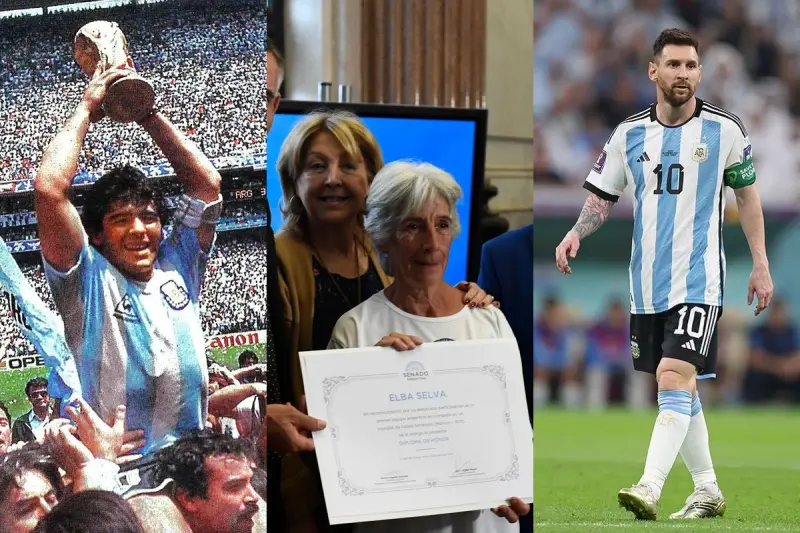
For Lionel Messi, it will be his first match against the England national team. For Argentine football, it will be another chapter in a fixture inevitably associated with Diego Maradona, the Estadio Azteca and his two goals in 1986.
But Maradona was not the first.
Fifteen years earlier, another left-footed Argentine had worn the number ten against England in the same stadium.
On 21 August 1971, Argentina defeated England 4-1 in a women’s world championship that was neither organised nor recognised by FIFA. More than 100,000 people attended the match at the Estadio Azteca. Elba Selva scored all four Argentine goals.
The team had travelled without a coach, medical staff or support from the Argentine Football Association. The players had to piece together their kit, sew the numbers onto their shirts and share the limited equipment available. They were not professionals. They worked, cared for their families and played wherever they could find space in a sport that still treated them as an anomaly.
Selva worked in a wire factory and had a two-year-old son. She hesitated before accepting the call because the trip meant leaving her job and family responsibilities behind without any guarantees in return.
She eventually travelled to Mexico, received the number ten shirt and produced one of the most extraordinary individual performances in Argentine football history.
Argentina finished fourth in the tournament. The victory over England did not lead to a stable competition, professional contracts or a lasting national-team project. The players returned home, and many went straight back to their jobs.
Nor did Selva immediately become a celebrated figure.
While the 1986 match was replayed, celebrated and passed down from one generation to the next, the 4-1 victory of 1971 survived mainly in the memories of those who had taken part. For decades, the players occupied little space in the official history of Argentine sport.
Today they are known as Las Pioneras — The Pioneers.
Their story began to be recovered through the efforts of the players themselves, researchers and journalists. Institutional recognition arrived almost half a century later, when Law 27.596 declared 21 August the Day of Argentine Women Footballers.
The date does not commemorate a title recognised by FIFA or a decision made by the federation. It remembers a victory achieved by a team that represented Argentina without receiving the support of its institutions.
The women’s national team had to move forward for decades without a stable structure.
Argentina did not make their first official World Cup appearance until 2003. Three years later, they won the greatest title in their history by defeating Brazil 2-0 in Mar del Plata and lifting the 2006 South American Championship. The result ended Brazil’s absolute dominance, qualified Argentina for the 2007 World Cup and secured a place at the Beijing 2008 Olympic Games, still the team’s only Olympic appearance.
The champions of 2006 called it the invisible feat.
The phrase described a reality that had not changed as much as the results suggested. In 2017, the internationals went on strike to demand unpaid allowances and minimum working conditions. Two years later, the AFA and the Argentine footballers’ union signed the agreement that began the professionalisation of the top division, although only part of each squad was protected by professional contracts.
The current national team competes in a different environment and has achieved something that seemed impossible for decades: continuity. It is now trying to turn regular qualification into a genuine competitive breakthrough.
Argentina finished third and unbeaten at the 2025 Copa América Femenina. They won all four group-stage matches, were eliminated by Colombia in a penalty shootout in the semi-finals and then defeated Uruguay, also from the spot, in the third-place play-off.
The inaugural CONMEBOL Women’s Nations League came next. Germán Portanova’s side finished second with five victories, three draws and no defeats, securing one of the two direct places at the 2027 World Cup in Brazil.
It will be Argentina’s fifth World Cup appearance and their third in succession.
The next step remains out of reach. Argentina have still never won a match at a FIFA Women’s World Cup. They collected their first points in 2019 and recovered from three goals down to draw with Scotland, before once again going out in the group stage in 2023.
Brazil 2027 will offer another opportunity to claim that first victory and reach the knockout rounds for the first time.
Tonight, the attention will be on Messi and the memories will inevitably return to Maradona.
But Argentina’s history against England does not belong only to them.
Before either of them, there was Elba Selva.
And when her opportunity came, she did not score two.
She scored four.