THE OTHER NATIONAL TEAM · SCOTLAND
During the men’s World Cup, FemGol will trace the history of some of the women’s national teams from the countries taking to the pitch. Because a country’s football doesn’t fit in a single team.
Tonight, Scotland face Brazil in Miami. For the men’s team, it is their first World Cup since France 1998, twenty-eight years on. Scottish football knows what it is to wait.
The women’s team knows too. Though their story started much earlier, and with the country against them.
The munitions workers’ match
On 2 March 1918, while the Great War was still consuming Europe, Celtic Park hosted a match billed as Scotland versus England. In reality, the players on the pitch were workers from two large factories tied to the war effort: Beardmore’s, on Clydeside, and Vickers-Maxim, in Barrow-in-Furness.
The match drew around 15,000 people. Vickers won 4–0.
The scoreline mattered less than everything else: in one of the best-known stadiums in Britain, thousands of people had come to watch women who worked in the war industries play football.
It made little difference in the end. When the war ended and the men returned to the pitches, the institutions moved quickly to reclaim the territory. The Scottish Football Association banned its affiliated clubs in 1948 from lending their facilities to women’s teams and from allowing recognised referees and officials to take part in their matches. It was not a ban on playing. It was the systematic removal of everything that made organised play possible.
Europe’s only no
In 1971, UEFA put a proposal to a vote: women’s organisations should be integrated into each country’s national football federation.
The result was 31–1.
Thirty-one countries voted in favour. Scotland was the only one that voted against.
It did not abstain. It said no.
Six clubs, a loan and the snow in Greenock
Scotland’s players did not wait for the federation to change its mind.
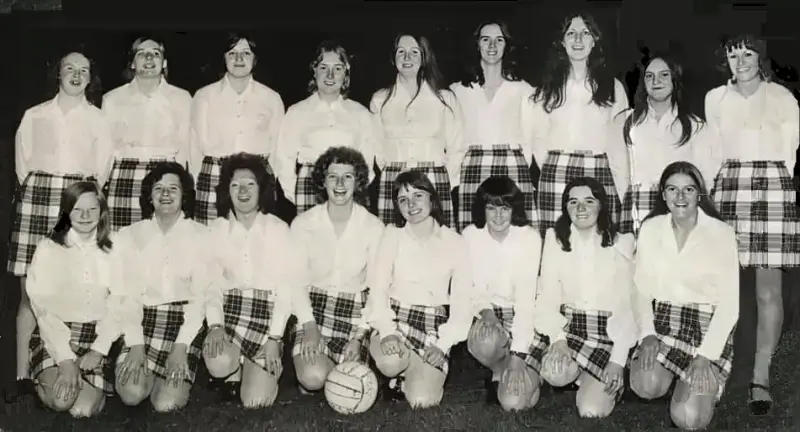
In September 1972, six clubs founded the Scottish Women’s Football Association. Its first secretary, Elsie Cook — manager of Stewarton Thistle — immediately set about organising an international match against England. She negotiated the ground, the travel, the logistics. When it came to paying for the shirts, there was no money. Cook took out a loan. Rangers donated the shorts.
On 18 November 1972, with the pitch at Ravenscraig Stadium covered in ice and snow falling through the second half, Scotland and England played the match now recognised as the first official international of the Scottish women’s national team.
Scotland led 2–0. Mary Carr opened the scoring. Then came Rose Reilly, seventeen years old, who scored directly from a corner. England came back in the second half and won 3–2.
The match showed that the team existed because its players had built it themselves. Without permission, without a budget, in the snow.
The player who had to leave
Rose Reilly was not simply a brave teenager who had scored from a corner on her debut. She was one of the finest players of her generation.
Scotland had nothing to offer her. She left first for France and then Italy, where she spent two decades winning leagues, cups and individual honours. The Scottish Women’s FA handed her a lifetime ban in 1975, after she and other players demanded better conditions.
In 1984, Rose Reilly scored in the final of the Mundialito Femminile, the most significant international tournament before the FIFA Women’s World Cup existed. Italy beat West Germany 3–1.
A Scottish footballer lifted an international title with another country’s team because her own had expelled her.
The year they finally arrived
The Scottish FA assumed control of the women’s national team in 1998. From that point, structures began to grow: development centres, a top-level national competition and a more recognisable pathway for players. It took almost twenty years to bear fruit at the highest level.
In 2017, Scotland played their first European Championship. In 2019 came their first World Cup, in France, in Group D alongside England, Japan and Argentina.
The first two matches ended in defeat: 2–1 against England, 2–1 against Japan. In the third, against Argentina, progressing to the round of sixteen meant winning.
Kim Little scored in the nineteenth minute. Jen Beattie in the forty-ninth. Erin Cuthbert in the sixty-ninth. With twenty-one minutes remaining, Scotland led 3–0. The last sixteen seemed within reach.
What followed belongs to the most painful chapters of modern women’s football. Argentina scored in the seventy-fourth minute. In the seventy-ninth, a shot struck the bar and deflected in off goalkeeper Lee Alexander’s body: 3–2. In the ninety-fourth minute, after a lengthy VAR review, a penalty was awarded. Alexander saved Florencia Bonsegundo’s shot. VAR intervened again: the goalkeeper had moved slightly before the kick was taken. Retake. Bonsegundo scored.
3–3. Scotland were out.
Their first World Cup in forty-seven years of history ended with a re-taken penalty in stoppage time because a goalkeeper had failed to keep her foot on the line at the moment of the kick.
What remains
Scotland did not qualify for the 2023 World Cup. Kim Little, who had opened the scoring in Paris and who at thirty-five is still playing for Arsenal — last year she was part of the team that won the UEFA Women’s Champions League — retired from the national team in 2021 with 140 caps and 59 goals.
The captaincy now belongs to Caroline Weir, a midfielder at Real Madrid. In the first phase of 2027 World Cup qualifying, Weir finished as the top scorer across the entire European qualifying round with ten goals and three hat-tricks. Scotland won their group and face the Czech Republic in a two-legged play-off between 7 and 13 October.
If they advance, a second play-off tie against Lithuania or Sweden awaits, between late November and early December.
Another possibility lies further ahead. Scotland are part of the United Kingdom’s joint bid to host the 2035 Women’s World Cup alongside England, Wales and Northern Ireland. It is the only bid submitted, but the award still needs to be formally ratified by FIFA. If it does so at the extraordinary Congress it will hold before the end of 2026, Scotland will take part in hosting a Women’s World Cup for the first time and will have the chance to return to the tournament on home soil.
Tonight, as the men’s team looks for their second win at this World Cup in Miami — they beat Haiti, they lost to Morocco, a draw may not be enough, and only a win would guarantee them a place — it is worth remembering that the other Scottish team has been at this for far longer.
They built a federation out of six clubs and a loan. They played in the snow without anyone’s permission. They survived being Europe’s only no.
And they have kept saying yes ever since.