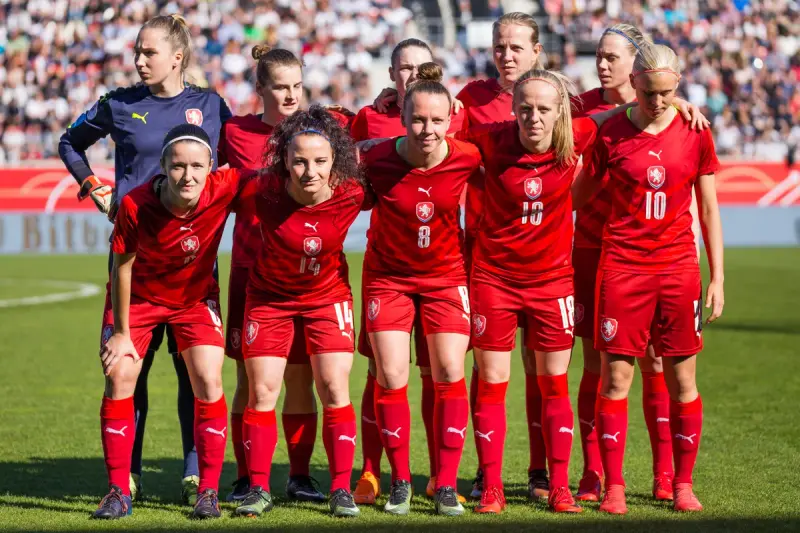
THE OTHER NATIONAL TEAM · CZECHIA
During the men’s World Cup, FemGol will trace the history of some of the women’s national teams from the countries taking to the pitch. Because a country’s football doesn’t fit in a single team.
Tonight, Czechia face Mexico at the Estadio Azteca.
The men’s team needs to win. After losing to South Korea and drawing with South Africa, only a victory guarantees them a place in the next round.
The Czech women know that feeling well — having the tournament within reach and one last border left to cross.
They have never played in a Women’s World Cup. Never in a Women’s European Championship. They have reached decisive play-offs several times, competed against some of the best sides in Europe and built generations capable of getting close.
But the first time they nearly played in a World Cup, they did not lose a qualifier.
They had the invitation. They had an opponent. They had a date, a city and a kick-off time.
The match posters were already printed.
What they did not have was permission to travel.
Thirty-four teams born from a magazine
In 1966, the Czechoslovak magazine Mladý svět published an article entitled Holky, do toho!: “Girls, go for it!”
The proposal was simple: encourage women to form teams and take part in a football tournament.
The response exceeded all expectations.
Within a month, thirty-four women’s sides had registered. Twenty-six of them competed on 22 and 23 October in the O srdce Mladého světa tournament.
Among them was a newly formed team built around Slavia Prague. Their coach, Vilém Marzin, had brought together players from handball, athletics, tennis and other sports. One of them was Marie Ševčíková, a young tennis player who had moved to Prague for work.
Slavia beat Sparta 1–0 in the final.
It was not yet a league. There was no established women’s federation. But that public call had proved something the institutions had not anticipated: there was no shortage of women who wanted to play. What was missing was somewhere to meet.
The Slavia women’s team was officially founded in February 1967 and began training three times a week. That same year it travelled to Italy and won an international tournament in Riccione, beating teams from Bologna, Milan and Florence.
In a short time, a side born around a magazine article had become one of the strongest women’s teams in Europe.
The first national team
On 23 February 1968, Czechoslovakia and Italy met in Viareggio.
It was the first recognised international women’s match in the history of either national team.
Czechoslovakia went ahead in the sixth minute through Michlerová. Italy came back to win 2–1, but the result was almost beside the point. A national team now existed. Czechoslovak women footballers could compete abroad, face international opposition and aspire to something bigger than those early tournaments organised without any official structure.
Over the summer, Slavia travelled to Denmark. They played the Femina BK, one of the most important clubs in European women’s football. They won the first match and lost the second. A relationship between the two clubs was formed.
A few weeks later, that relationship would change the lives of two players.
The journey that did not end
On 21 August 1968, Warsaw Pact forces invaded Czechoslovakia and brought the Prague Spring’s reformist project to an end.
In October, Marie Ševčíková, her brother Petr and her Slavia team-mate Jana Mandíková left the country with authorisation for a brief trip to West Germany.
They did not return.
Ševčíková and Mandíková went to the Danish embassy in Bonn, obtained visas and travelled to Denmark. There they were welcomed by Femina BK — the same club they had played against a few months earlier.
Both began new lives away from home and carried on playing football.
Ševčíková would not see her parents again in person for fourteen years.
Meanwhile, back in Czechoslovakia, the team they had left behind kept growing. Their players were already known abroad and counted among the best in a discipline that still had no competitions recognised by FIFA or UEFA.
Then an invitation arrived.
The World Cup that already had posters
In 1970, a private organisation linked to Italian women’s football staged the Coppa del Mondo femminile Trofeo Martini & Rossi.
It was not a FIFA-recognised World Cup. The international body would not organise its first official Women’s World Cup for more than two decades. But the tournament used the World Cup name, brought together teams from several continents and was one of the largest international events in women’s football to that point.
Czechoslovakia were invited.
The team was due to face Denmark on 8 July 1970 at 9:30 pm at the Bologna municipal stadium. The winner would advance to the semi-finals. Participation seemed settled. The draw was made. The team knew their opponent. The posters advertising Czechoslovakia v Denmark had been printed.
Then came the order: the team would not travel.
Coach Vilém Marzin attributed the decision directly to those in charge of Czechoslovak women’s football. The domestic press reported only that Czechoslovakia had withdrawn from the competition. Some Italian newspapers mentioned visas not being granted and linked the absence to the political climate following the Prague Spring.
No single complete explanation was ever formally established.
What was clear was the outcome. Czechoslovakia’s participation was cancelled at the last moment, denying that generation access to the biggest international tournament available. Denmark were left without an opponent. The organisers had to bring West Germany back into the draw — a team already eliminated by England.
The Czechoslovak players stayed home.
Not all of them.
Champions in another shirt
Denmark were represented at the tournament by Femina BK.
In their squad were Marie Ševčíková and Jana Mandíková.
The match that would have set the two emigrants against their former Slavia team-mates never took place. Instead, Denmark beat West Germany 6–1. Then they defeated England 2–0 in the semi-finals.
On 15 July, some 40,000 people came to the Stadio Comunale in Turin for the final between Italy and Denmark. The attendance was so large that the organisers did not have enough tickets for everyone who wanted to get in.
Denmark went ahead in the eighteenth minute. Ševčíková delivered the cross from the right and Helene Østergaard Hansen made it 0–1. Italy pushed for an equaliser in the second half and even had a penalty, but their captain sent it wide.
Then Ševčíková appeared again.
Near the end, she received the ball far from goal and struck a shot that went in off the crossbar. 2–0.
Denmark were champions of that first unofficial Women’s World Cup.
Two players who had come up through Slavia Prague lifted the trophy in Danish colours while the country that had been invited to compete remained at home.
Marie Ševčíková had left her country after an invasion and ended up scoring in a World Cup final.
She remains one of the most successful Czech women footballers in history. Also one of the least remembered.
A new country, the same door
Czechoslovakia ceased to exist at the end of 1992. From 1993, the Czech Republic began competing as an independent national team.
The country’s name changed. The frontier separating its players from a major tournament final did not.
Czechia have never played in a Women’s World Cup or a Women’s European Championship. Not for lack of trying. The team has reached decisive qualifying rounds and play-offs several times. It has had generations led by players such as Lucie Martínková, Kateřina Svitková and current captain Klára Cahynová. On 7 March 2026, Cahynová reached 126 international appearances and became the most capped player in the history of Czech national teams — ahead of Lucie Martínková, who held the women’s record with 125, and Petr Čech, who holds the men’s record with 124.
In 2024 the team reached the final play-off round for UEFA Women’s Euro 2025. Their opponent was Portugal. Czechia drew 1–1 at the Estádio do Dragão and came home with the tie open. In the return leg they levelled the aggregate score again, but Portugal won 2–1 in Teplice and went through 3–2 on aggregate.
Once more, the tournament stayed on the other side.
The coach of the first win
Since the start of 2025, the team has been managed by Jitka Klimková.
She is no stranger to firsts. Klimková had previously managed New Zealand and was on the bench when the Pacific side beat Norway in the opening match of the 2023 World Cup. It was the first ever World Cup victory for New Zealand, men’s or women’s.
Her task with Czechia is to deliver another first.
The road to Brazil 2027 started well. The team led their qualifying group going into the final two matchdays, level with Wales and in control of their own destiny. But they drew 1–1 at home to Albania and lost 3–1 in Cardiff. They finished second. The door is still open, though the path has become considerably harder.
Scotland, and then another border
Czechia will face Scotland in the first round of the play-offs. The first leg will be played in the Czech Republic on 9 October. The second leg follows four days later in Scotland.
Whoever wins will still not be at the World Cup.
The second and final qualifying round will see them face the winner of the Sweden v Lithuania tie. Barring a major upset, that means either Czechia or Scotland will then have to eliminate one of the established powers of European women’s football.
Two rounds. Four matches.
More than half a century after the team had their match posters printed for a trip to Italy, the Czech women are still trying to play their first World Cup.
Tonight, the men take to the Azteca pitch trying not to be eliminated from one. Only a win guarantees their place.
The women still have a few months before their own border comes around again. First Scotland. Then, most likely, Sweden.
The first time, they did not need to win a qualifier.
They already had the invitation, the opponent, the date and the posters.
All they needed was to be allowed to go.