THE OTHER NATIONAL TEAM · QATAR
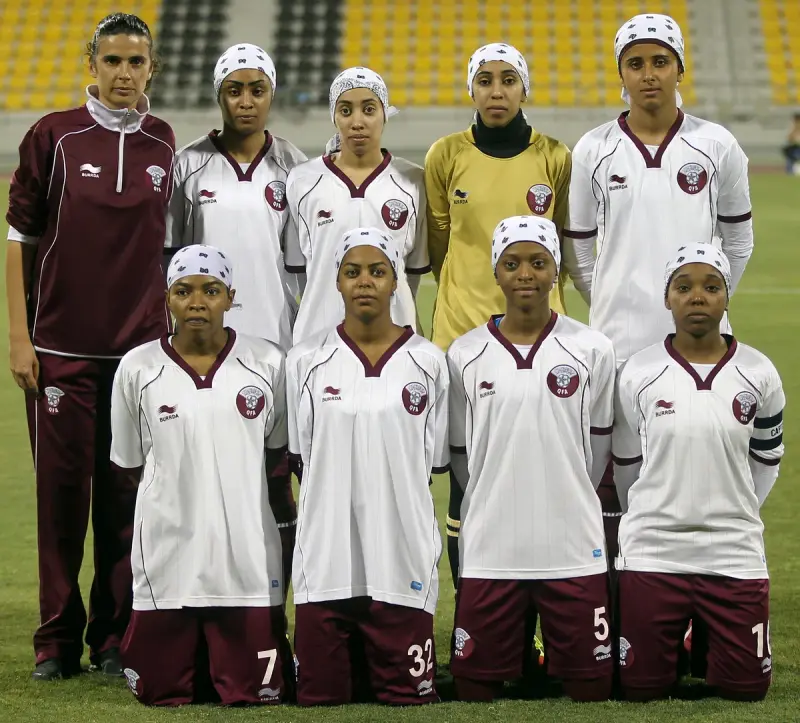
During the men’s World Cup, FemGol will trace the history of some of the women’s national teams from the countries taking to the pitch. Because a country’s football doesn’t fit in a single team.
Tonight, Qatar play Bosnia and Herzegovina for the chance to stay in the World Cup.
One more match. One more opportunity. The chance to correct what went before and earn the right to keep appearing on the fixture list.
Qatar’s women’s national team has spent twelve years waiting for something similar.
They have not played an official match since April 2014. They do not appear in the FIFA world ranking. There is no announced call-up, no qualifying round, no date of return.
This was not a team that never came to exist.
It existed, it played, and then it disappeared.
A team built around a World Cup
Qatar’s Women’s Sports Committee had been created in 2001, but the major institutional push came whilst the country was preparing its bid to host the 2022 men’s World Cup.
The first women’s squad began to take shape in 2009 and made its international debut the following year at the Arabia Women’s Cup in Bahrain.
The beginning was brutal.
Qatar lost all three matches, against Bahrain, Syria and Palestine. They did not score a single goal and conceded the kind of heavy defeats that come when a team built from scratch is thrown straight in against more experienced opponents with no comparable structure behind them.
Those results could be read as proof of everything that was still missing.
They could also be read as proof that, at last, there was a team that had things left to build.
Qatar’s players now had a shirt, a squad number and a place on the pitch. The scoreboard said they were a long way off. Their presence said they had started.
From the first matches to the FIFA ranking
In the years that followed, Qatar continued to play friendlies and small regional tournaments. The team entered the FIFA world ranking for the first time in 2013.
That same year, the Qatari football federation announced the third edition of a women’s league made up of seven clubs attached to recognisable names in the country’s football: Al Sadd, Al Rayyan, Al Gharafa, Al Arabi, Qatar SC, Al Khor and Al Ahli.
On paper, a structure was beginning to take shape.
A domestic competition. An international team. Experienced coaches. Players who could imagine a path from starting out to representing their country.
In April 2014, Qatar travelled to Jordan for the WAFF Women’s Championship. They lost all three matches, against Palestine, Jordan and Bahrain, and finished last.
It was their last official competition.
There was no announcement marking the end. No farewell, no public decision explaining what would happen to the players.
The fixtures simply stopped appearing.
Existing without competing
The team has come together on special occasions.
In December 2020, a Qatari side took part in a match against American club Washington Spirit during a sporting festival in Doha. In November 2021, Qatar’s players faced members of the Afghan women’s national team who had been evacuated following the Taliban’s return to power, at the Khalifa International Stadium.
These were meaningful moments.
The problem is that a national team cannot be built from isolated moments.
Neither event returned Qatar to official competition, to the FIFA ranking or to the Asian qualifying rounds. The team could reappear for an afternoon and vanish again when the stadium lights went out.
Meanwhile, the country was completing some of the most advanced sporting facilities in the world, hosting foreign delegations and organising the largest men’s football tournament on the planet.
The 2022 World Cup arrived.
The women’s team that had begun to form around that bid had already been absent from the fixture list for eight years.
There was no shortage of women who wanted to play
The absence of a national team does not mean there were no women in Qatar interested in football.
Research published by the Center for International and Regional Studies at Georgetown University gathered testimonies from players who organised their own games in unlit spaces and used their car headlights to see the ball.
They did not wait for the perfect structure to exist.
They found a pitch and played.
The problem was turning that desire into something sustainable. Some players needed women-only facilities or matches without a male audience in order to take part, given their family, religious or personal circumstances. When those conditions were absent, many were left out.
It was not enough to announce that women were allowed to play.
An environment in which they could actually do so had to be built.
That gap explains part of the distance between large institutional projects and the everyday experience of the players. Qatar could raise stadiums visible across the world and, at the same time, fail to offer a continuous path for the women who wanted to use a pitch.
The captain who had to tell the story
In June 2026, as the men’s team contests another World Cup, the story of that first women’s squad has reached the Tribeca Festival in New York.
Not through the federation.
Through one of its players.
Fatma Al-Ghanim, captain of the first Qatar women’s team, directed Theatre of Dreams, a short documentary set during the 2022 World Cup in which she returns to her own experience. In June 2026, the film was presented at Tribeca, where it held its New York premiere.
The film speaks of courage, cultural resistance and the personal cost of breaking barriers. It does not present the story as an inevitable march towards progress. It also looks at what the first women to occupy a space that was not built for them were made to endure.
Twelve years after the last official match, a former captain has had to turn to cinema to give her team back a story.
The shirt that stopped appearing on the pitch reappears now on screen.
A country ready to host them
Qatar has expressed interest in hosting the first FIFA Women’s Club World Cup, which the governing body has scheduled for 2028.
It has stadiums, training centres, hotels, international connections and organisational experience. It could welcome some of the finest women’s club sides on the planet.
But its own national team has yet to compete.
That is the contradiction no infrastructure can conceal.
The development of women’s football does not consist only of organising major events, receiving foreign delegations or using sport as a symbol of openness. It also consists of ensuring that a girl can start playing, find a competition, progress and aspire to represent her country.
Qatar had a women’s national team.
Its players withstood the early heavy defeats, entered the international ranking and showed that there was a generation prepared to open a path.
What they did not have was continuity.
Tonight, Qatar’s men play Bosnia and Herzegovina for the chance to compete in another match.
The women have spent twelve years waiting for someone to put them back on the fixture list.