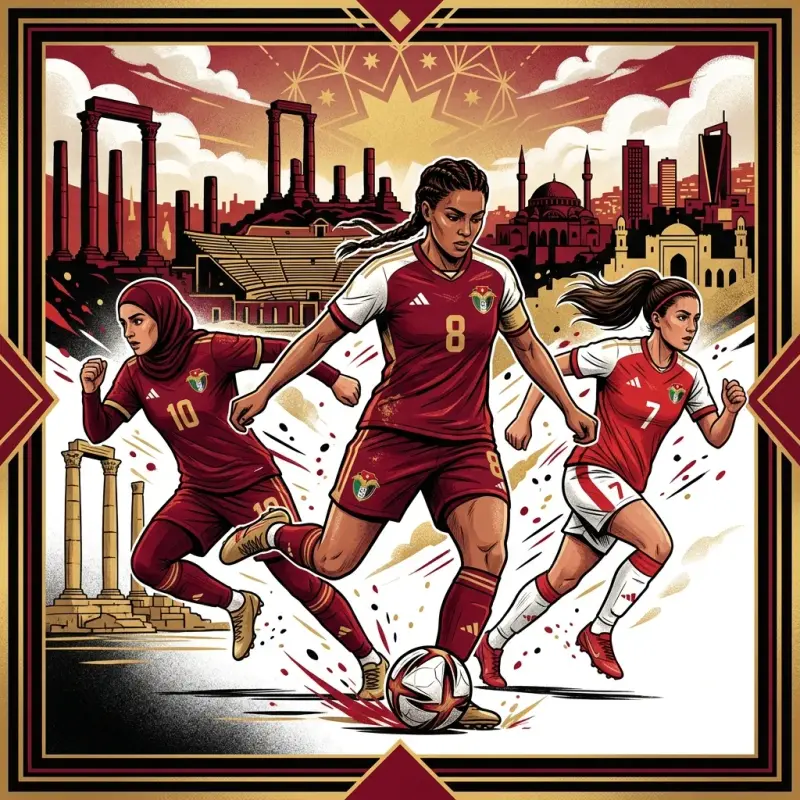
THE OTHER NATIONAL TEAM · JORDAN
During the men’s World Cup, FemGol will trace the history of some of the women’s national teams from the countries taking to the pitch. Because a country’s football doesn’t fit in a single team.
Jordan will bring their first-ever men’s World Cup to a close against Argentina. Jamal Sellami’s side arrived in North America after four decades trying to find a way in. They lost to Austria on their debut, fell again to Algeria, and will face the final matchday already eliminated — but carrying something no previous generation had managed: having worn the Jordanian shirt on football’s biggest stage. On the other side of the same crest, there is another national team. It has never played at a senior World Cup. But ten years before the men travelled to the tournament for the first time, it was the women who made the World Cup travel to Jordan. In 2016, Amman, Irbid and Zarqa hosted the FIFA U-17 Women’s World Cup. It was the first women’s FIFA tournament ever held in the Middle East, and the culmination of a project that had begun barely eleven years earlier, when Jordan assembled its first women’s national team. They did not go to the world. They made the world come to them.
Born winning
Jordan’s women’s national team was founded in 2005. Organised women’s football had little history in the country. There were few clubs, few players and even fewer places where a girl could imagine that what she did with a ball might one day become a career. The first internationals had to learn as they built the path. Stephanie Al-Naber played in the streets of Amman with her brother. Maysa Jbarah came up at a time when assembling a national squad meant searching among virtually every available player in the country. Shahnaz Jebreen, Yasmeen Khair, Aya Al-Majali and the rest of that generation did not inherit a national team. They had to invent one. They did it quickly. Jordan played their first international in September 2005 and won 6–1 against Bahrain. Shortly afterwards they won the first edition of the WAFF Women’s Championship. In 2007 they lifted the trophy again. The team was born and almost immediately became the best in its region. Those victories did not mean the barriers had disappeared. Players still encountered families who did not consider football an appropriate place for a woman, difficulties in training, and a structure too small to guarantee continuity. But winning offered an answer that did not require much explanation. Jordan was building a national team because it already had a national team capable of competing. And in the middle of that beginning, a footballer appeared who would end up running through the entire history of the side. Maysa Jbarah made her debut in the first match of 2005. She scored Jordan’s first goal at an Asian Cup, decided an Arab Cup and was still playing for the national team in June 2026, more than twenty years later. The Jordanian Football Association’s records — which include matches not recognised as full internationals by FIFA — credit her with 153 appearances and 147 goals. In some countries, the history of a national team takes generations. In Jordan, an enormous part of it fits within the career of a single player.
A victory nobody played
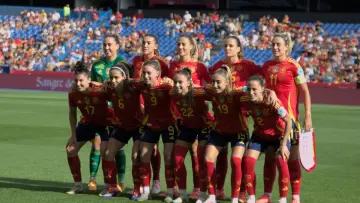
On 3 June 2011, Jordan were due to face Iran in Amman during the Asian qualification for the London Olympics. The match never took place. The Iranian players arrived wearing kit that covered their heads and necks. FIFA ruled it violated the regulations on playing attire and prevented them from taking part. Iran received an administrative 3–0 defeat that ended their Olympic hopes. The images showed their players in tears on the pitch. Jordan were recorded as winners, but they had not emerged unscathed from the same rule. Before the match, they had left several players out of the squad to avoid the same problem. The ban was not simply a dispute between two national teams. It placed Muslim women before a choice that should never have existed: give up part of who they are, or give up football. Prince Ali bin Al Hussein, president of the Jordanian Football Association and at the time a FIFA vice-president, subsequently led the campaign to change the regulations. He argued that the ban was pushing thousands of women away from the sport, and presented models designed specifically for competition — with no pins, and with systems that came loose if pulled. The safety argument began to run out of cover. In July 2012, the International Football Association Board authorised the use of head coverings after reviewing the medical and technical reports. Two years later it incorporated the right to wear them for religious reasons permanently into the Laws of the Game. The change returned to the place from which it had been driven. Jordan faced Spain in the opening match of the 2016 U-17 World Cup. Some players took to the pitch with their heads covered. It was the first time it had happened at a FIFA competition. The score was 0–6. The image was far larger than the scoreline.
The World Cup that came to Amman
Jordan did not host the U-17 World Cup because their team belonged to the elite. They hosted it because they wanted to use a world tournament to build what they did not yet have. Stadiums were renovated and fourteen training pitches were prepared. Coaches, referees, administrators and staff connected to the tournament were trained. Seventy-five per cent of the members of the local organising committee were women. Before the competition began, 460 girls from 44 state schools took part in a school championship. Many had never played with a full kit, referees and a pitch prepared for them. The World Cup was meant to show that girls could play. And that they could organise, lead and occupy spaces around football that had until then seemed reserved for men. On the pitch, the gap was obvious. Jordan lost 6–0 to Spain, 4–1 to Mexico and 5–0 to New Zealand. They finished their first U-17 World Cup campaign with one goal scored and fifteen conceded. But for three weeks, women’s football filled stadiums, schools, television screens and conversations across a Middle Eastern country. Girls who had never had a competition of their own watched players their own age represent Jordan against some of the best national teams in the world. The team could not compete with them. The country could no longer pretend it had not seen them.
West Asia’s firsts
The 2016 World Cup was not the first occasion on which the Nashmiyat had crossed a frontier. Three years earlier they had come through qualification for the 2014 Asian Cup. They won all three of their matches, scored thirty goals and conceded none. With that qualification, Jordan became the first West Asian side to reach the final phase of the continental tournament. The gap reappeared once they got there. They lost 3–1 to Vietnam, fell by the same score to Australia and were beaten 7–0 by Japan, who would go on to win the title. Maysa Jbarah scored Jordan’s first-ever goal at an Asian Cup. Stephanie Al-Naber scored the second against Australia. Jordan did not win a single match, but they had reached a place no team from their region had ever been. Four years later they did not have to travel. The 2018 Asian Cup was held in Amman. It was the first edition organised in West Asia and it distributed five places for the World Cup in France. Jordan had gone from assembling their first internationals in 2005 to hosting, thirteen years later, the most important tournament on the continent. The opportunity seemed built for that generation. Jbarah, Al-Naber and Jebreen had taken the team from the early regional championships to the real possibility of playing at a senior World Cup. Jordan had won all five of their qualifying matches — though they already had a guaranteed place as hosts — and had scored 37 goals. Jbarah had netted thirteen. In the opening match against the Philippines, Jordan went ahead. Maysa Jbarah scored again. Then came the Philippine comeback, the 1–2 and a defeat that changed the whole tournament. Jordan lost 6–1 to Thailand and 8–1 to China. They scored in all three matches but finished bottom of the group. The road to the World Cup required two victories. The first slipped away that night against the Philippines. There was no room left after that. They left without them.
Queens of a border
Jordan’s history can be told through everything it has achieved before its neighbours. They were the first West Asian side at an Asian Cup. They organised the Middle East’s first women’s World Cup. They hosted the first Asian Cup held in that part of the continent. They helped change a rule that was excluding Muslim women. They created a domestic competition presented as the first professional women’s league in the region. They have also won more than anyone around them. In December 2025, the Nashmiyat beat Palestine 3–1 in Jeddah and won the WAFF Women’s Championship for the seventh time. They have lifted seven of the nine editions played and have won five titles in a row. In their region, Jordan are a dynasty. Outside it, they are still searching for their place. They have played in only two senior Asian Cups, in 2014 and 2018. They did not return in 2022 after drawing goalless with Iran and losing the penalty shoot-out that sent the Iranians to the tournament for the first time. Four years later, the story came down to a single match against the same opponent again. Jordan began the 2026 Asian Cup qualifying campaign with a 4–0 win over Lebanon, 5–0 over Singapore and 3–0 over Bhutan. They arrived at the final matchday with nine points, twelve goals scored and none conceded, and a simple advantage to explain. They just needed to avoid defeat against Iran. They lost 2–1. For the second consecutive cycle, the team that had helped open international football to women who cover their heads was knocked out of the Asian Cup by Iran. The history had changed. The result had not.
What has been built
Regional dominance and continental elimination are not an accidental contradiction. They draw a fairly precise picture of where Jordan stand. The country has developed a women’s structure broader than that of most of West Asia. There are grassroots competitions, a first division, a cup and a top tier that is officially professional. Its clubs have won regional tournaments and the federation has increased the support available to women’s football. But the pyramid remains narrow. The most recent public count, included in FIFA’s 2023 Member Associations Survey Report, recorded 1,092 registered players in Jordan. Of those, 914 were under twenty. Only 178 belonged to adult categories. The foundation exists. The difficulty lies in turning it into a long career, a competitive league and a national team capable of sustaining results against Asia’s best. Jordan can beat almost anyone in their region. When the draw brings them closer to Japan, Australia, China, North Korea or the sides that have accelerated their development in recent years, the step up is still too steep.
Return without an invitation
In March 2026, the Jordanian Football Association handed the project to Lamia Boumehdi. The Moroccan coach arrived having won the African championship with TP Mazembe. She was not appointed solely as senior head coach: she also took on technical direction of the women’s programme and oversight of all the women’s national teams. The mission is not simply to win the next match. It is to connect the parts. The girl who starts playing, the teenager who enters a youth squad, the player who tries to continue into adult football and the international who must compete beyond West Asia are all part of the same problem. Boumehdi began her tenure by gathering 31 players from the national championship. She then reduced the group and played her first friendlies. Jordan won 4–3 against Malaysia and 1–0 against Palestine. Maysa Jbarah was among those called up. The player who was there at the beginning is still there as the team tries to begin again. Jordan sit 76th in the FIFA rankings, their lowest position ever. They have not played an Asian Cup since 2018 and will have to wait another cycle to try to return. In the meantime, the men’s team has finally achieved what the country had been waiting decades for: a place at a senior World Cup. The men travelled to it. The women already knew what it meant to watch it arrive. In 2016 they welcomed the world, filled stadiums, changed images and proved that a footballer could represent Jordan without leaving part of herself outside. Before that they had opened West Asia. After that they built a regional dynasty. Now they are after something different. Not to organise the path again. To walk it.