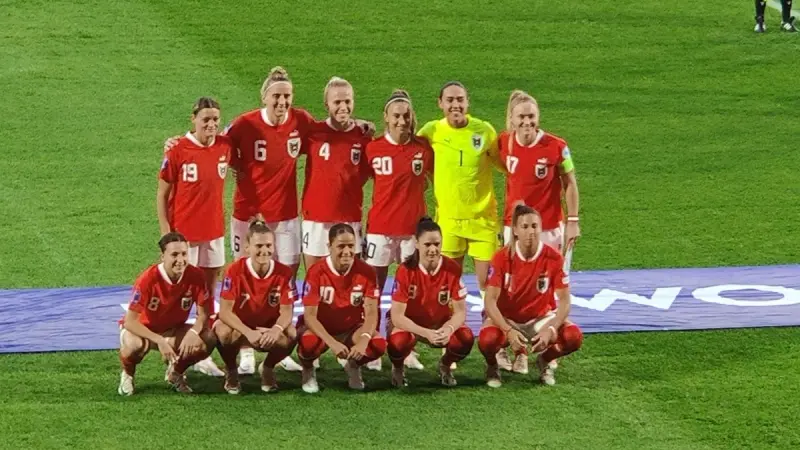
THE OTHER NATIONAL TEAM · AUSTRIA
During the men’s World Cup, FemGol will trace the history of some of the women’s national teams from the countries taking to the pitch. Because a country’s football doesn’t fit in a single team.
Some teams arrive at a tournament to learn and leave having taught everyone else a lesson.
Austria were exactly that at the 2017 Women’s European Championship.
They were making their debut in a major final. They had no history to protect, no world-class star to justify expectations, no past to cling to when difficulties appeared.
They had Manuela Zinsberger in goal. Sarah Puntigam organising the defence. Sarah Zadrazil in midfield. Nina Burger, Nicole Billa and a group that still did not know how far they could go.
They also had something hard to prepare for as an opponent: the freedom of those who do not feel they are losing a place that belongs to them.
Austria reached the semi-finals.
They did not lose a single match in open play.
And they conceded just one goal in the entire tournament.
The day the promise began
Their first match was against Switzerland.
Nina Burger scored the only goal of the game and Austria claimed the first victory in their history at a major finals. They then drew 1-1 against France and closed out the group with a 3-0 defeat of Iceland.
Seven points. Five goals scored. One conceded.
Group winners on their debut.
This was no longer just a new team enjoying the experience. It was a team that was almost impossible to crack.
Spain awaited them in the quarter-finals.
Austria held out for 120 minutes. Spain had the ball, probed for space and built up a catalogue of attempts, but the scoreboard did not move.
The tie went to penalties.
All five Austrian takers scored. Manuela Zinsberger saved one of Spain’s kicks and Sarah Puntigam converted the decisive spot kick.
Austria were in the semi-finals of Europe.
They had not needed to dominate Spain. They had not arrived there by accident either. They had built each match on a coordinated defence, a reliable goalkeeper and the conviction that absorbing the opponent’s game was also a way of controlling it.
Denmark found out the same in the semi-finals.
Another 120 minutes without a goal.
Austria even had the chance to take the lead from the penalty spot during the match itself. They did not take it. In the shootout that followed, the team that had executed with absolute precision against Spain could not score any of their kicks.
Denmark went through to the final.
Austria went home eliminated — but unbeaten in normal time.
They had played five matches, conceded one goal and had been a single shootout away from reaching the final in the first major competition of their history.
The surprise was over.
The promise had just begun.
The problem with raising expectations
Before 2017, qualifying for a European Championship would have been enough.
After 2017, it was not.
That was the true legacy of that generation. They did not win a title, but they changed the way the country could look at its women’s national team.
Austria now knew they could compete against France, eliminate Spain and come within one step of a continental final. They had found a recognisable identity: concentration, discipline, defensive solidarity and a permanent ability to make every match uncomfortable for the opponent.
The next task was to prove it had not been only the miracle of one summer.
They did so in 2022.
Austria returned to the Euros, lost narrowly to hosts England and then defeated Northern Ireland. In the final group match they faced Norway — a side that had been world champions and twice European champions.
Nicole Billa scored the only goal.
Austria reached the quarter-finals again.
Germany ended their run, but the second appearance had confirmed something important: 2017 had not been an anomaly.
Austria might not belong to the group of nations destined to win every tournament.
They already belonged to the group of teams nobody wanted to face.
The absence
The next step should have been continuity.
Instead came the absence.
Austria did not qualify for Euro 2025.
The elimination was particularly difficult to explain because the opponent was Poland — a side they had beaten twice in the group stage, both times 3-1.
In the decisive play-off the opposite happened.
Poland won 1-0 in Gdańsk and repeated the same scoreline in Vienna. Two matches. Two goals conceded. None scored.
Poland secured the first qualification in their history for a major competition.
Austria were left out after having reached the play-off stage at each of their previous two European Championships.
A few years earlier, non-participation would have seemed a normal consequence of their place within European football. Now it felt like failure.
That too was part of the inheritance of 2017.
Austria had changed their own expectations. They could no longer slip quietly back into anonymity.
The generation that remained
The protagonists of that summer did not disappear all at once.
Some gradually stepped back from the squad. Others continued to carry it while younger players emerged.
Sarah Zadrazil kept occupying the midfield. Manuela Zinsberger continued keeping goal for much of the next cycle. Sarah Puntigam became the most capped player in the country’s history.
Nicole Billa went on representing a way of competing that Austria had made their own: attacking every ball as if it might decide the match.
But no generation stays intact.
Austria had to learn to renew the squad without losing what had made it recognisable. The process was not straightforward. Players changed, responsibilities shifted and coaches came and went while the rest of European women’s football was also growing.
The gap Austria had closed in 2017 did not stand still.
It had to be closed again.
The World Cup that does not yet exist
Austria have never played at a Women’s World Cup.
That absence weighs more heavily after reaching a European semi-final and a quarter-final.
The first phase of the road to Brazil 2027 did not offer easy answers either. Austria were drawn with Germany, Norway and Slovenia and lost their first three matches.
The third was a 5-1 defeat to Germany.
Four days later they faced the same side again.
This time they conceded nothing.
The draw represented Austria’s first point ever against Germany — eight-time European champions. It also recovered a familiar image: a team that holds its ground when everything seems set up for the opponent to win.
In May, Lars Søndergaard arrived as head coach. His debut coincided with the 250th match in the national team’s history.
Austria won 1-0 against Slovenia.
It was not enough for a direct ticket. Germany won the group, Norway finished second and Austria took third place.
Brazil is still a long way off.
But it has not disappeared.
Two play-off ties and one answer
The road continues in October against Kosovo.
Austria will play the first leg away and settle the tie at home. If they advance, they will face the winner of the tie between Israel and Switzerland.
Only then will they know whether they secure one of the direct places for Brazil or whether they still need to go through the intercontinental play-off.
It does not look like an impossible route.
It does not allow for many mistakes either.
Austria must get past sides with less international experience, but they already learned against Poland that history does not score goals and that having been the better team a few months earlier protects no one in a knockout tie.
The team that in 2017 had nothing to lose now faces a different situation.
They have a promise to keep.
No longer feeling small
Austria play today.
Their men’s side face Argentina in a World Cup the country had been waiting to return to since 1998. The lights will be on them and on a tournament Austria waited nearly three decades to recover.
The women are still chasing their first.
But it was the women who first gave Austrian football back the feeling that it could compete against the best. They reached a European semi-final when no one expected them to. They eliminated Spain, held France and needed two penalty shootouts before they finally knew defeat.
That summer did not turn Austria into a power.
It did something perhaps more difficult.
It taught them they did not have to feel small.
Nine years on, the question remains open: was 2017 the miracle of one particular generation, or the beginning of a team capable of lasting?
Brazil 2027 may provide the answer.
Austria do not need to repeat that semi-final to prove it was real.
They need to make sure it is not the only place they return to every time they want to remember how far they can go.
Because 2017 was not a ceiling.
It was a promise.
And it is still waiting to be kept.