THE OTHER NATIONAL TEAM · SAUDI ARABIA
During the men’s World Cup, FemGol will trace the history of some of the women’s national teams from the countries taking to the pitch. Because a country’s football doesn’t fit in a single team.
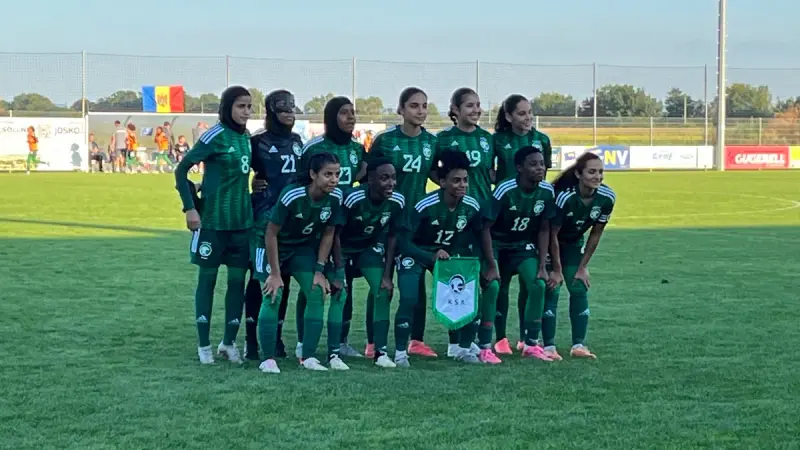
Saudi Arabia’s women’s national team is four years old.
That doesn’t mean Saudi women only started playing football four years ago. It means that four years ago, the country decided to look at them.
What existed before doesn’t appear in any official record. Women organising themselves, finding private facilities, playing tournaments that never made it into any ranking. No federation, no licences, no way of knowing whether a national team would ever exist to aspire to. Until 2017 they couldn’t attend stadiums. The federation’s first recognised women’s competition was held in Jeddah in 2019. An amateur league launched in 2020.
The footballers arrived before the authorisation.
In 2021, when the federation opened trials to form the first national squad, seven hundred women turned up. German coach Monika Staab — decades of developing women’s football across different countries behind her — had to reduce that number to thirty. Some candidates travelled for hours to reach training sessions. None of them were paid to play.
On 20 February 2022, in Malé, the capital of the Maldives, Saudi Arabia played their first international match. Opponent: Seychelles. In the fourteenth minute, Al Bandari Mobarak scored the first goal in the national team’s history. They won 2-0. The players cried.
It was hard not to cry. They had spent years playing for no one, and suddenly there was a shirt, an anthem and a scoreboard.
Who they are
Four years and fifty-something matches later, there are players who already have a history.
The captain is Sara Al-Hamad, a 33-year-old Al Nassr player who has been there since day one. The all-time top scorer is Al Bandari Mobarak, now at Al Hilal — the same player who scored in the fourteenth minute in Malé and who has kept adding to her record ever since. The most-capped player is Lana Abdulrazak, an Al Ittihad midfielder with 44 appearances at the age of 21. She made her debut at 17.
That tells you something about the generation. Basmah Al-Shnaifi is 17 and has nine caps. Maram Al-Yahya is also 17 and has ten. These are players who joined a team that already existed. They have no memory of a time when it didn’t.
And there is one player who carries the whole story in her travel schedule: Ameera Abualsamh, a 20-year-old forward who studies and plays for the McMaster Marauders in Canada, and flies back for every call-up. The national team already has a diaspora.
The coach who connects worlds
Since December 2023, the person overseeing all of this is Lluís Cortés. The Catalan coach won the first ever women’s Champions League in Barcelona’s history in 2021, then managed Ukraine in impossible circumstances, before arriving in Riyadh in January 2024 on a contract through 2027. The fact that the coach who put Barcelona at the top of European women’s football is now building this from almost nothing says something about where women’s football in the region is heading.
Where they stand
FIFA places them at 157, their best-ever ranking. At the 2024 WAFF Women’s Championship, played on home soil, they lost all three group-stage matches. At the 2025 edition, also in Saudi Arabia, they finished fourth: two wins and two draws — both the semi-final and the third-place match went to penalties without a defeat in normal time. The progress is measurable, even if the distance ahead remains enormous.
The federation announced in 2022 the goal of reaching a World Cup within ten years. Brazil 2027 is out of reach. The 2031 edition is the target.
Saudi Arabia invests in sport as a tool of international projection and the women’s team is part of that display. That is a fact, and naming it doesn’t cancel everything else. It doesn’t cancel the seven hundred women who turned up to trials without knowing what would happen. It doesn’t cancel Mobarak scoring in the fourteenth minute. It doesn’t cancel a 17-year-old with ten caps who joined a team that already existed and has no memory of it not existing.
Today in Atlanta the men play. The women are not there.
They’ve spent four years building the team that will change that.