THE OTHER NATIONAL TEAM · IRAN
During the men’s World Cup, FemGol will trace the history of some of the women’s national teams from the countries taking to the pitch. Because a country’s football doesn’t fit in a single team.
Some women’s national teams are explained by their titles. Others by their stars. Iran is explained, before anything else, by its very existence.
Today Iran’s men play their World Cup against New Zealand, in Group G. They arrive as a recognised Asian power, with an enormous following and a regular presence at the major tournaments. But turn to the women’s side and the story changes completely: it isn’t about rankings or qualifying tables, but about something more basic. About playing in a country where women’s football has never been able to separate itself from the social context around it. Indeed, in Iran the question hasn’t only been whether women can play football, but whether they could even enter a stadium to watch it.
A team starting a long way back
On the pitch, Iran are modest. They sit around 68th in the FIFA ranking and have only just played their second Asian Cup — after debuting in 2022 — at the 2026 edition, held in Australia. They drew a brutal group, with the hosts, South Korea and the Philippines, and the tournament confirmed the gap: three matches, three defeats, no goals scored and a 0-9 aggregate (0-3 to South Korea, 0-4 to Australia and 0-2 to the Philippines). They have never played a World Cup.
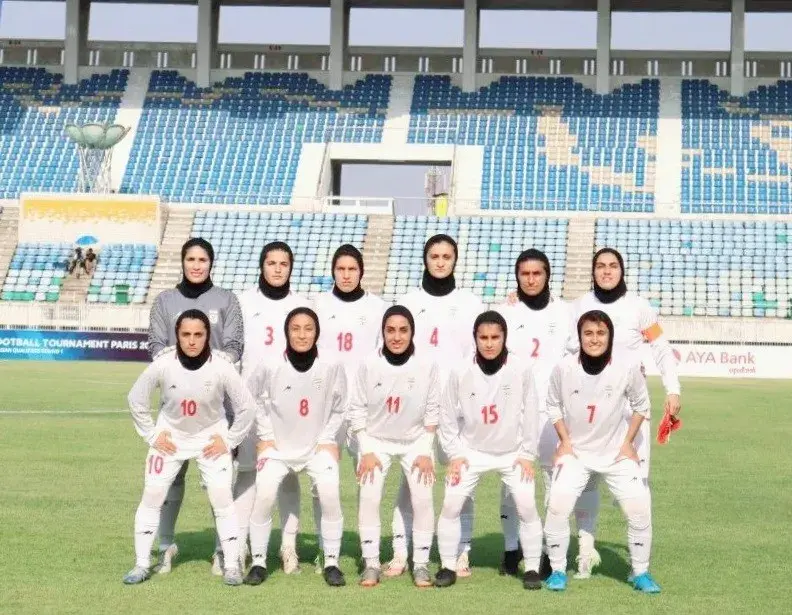
It isn’t for a lack of players, but a matter of the starting point. Iran’s women compete in the hijab and under the mandatory dress code of the Islamic Republic, and have built a national side with almost everything against them. While other Asian federations were building stable leagues and pathways to professionalisation, Iran has had to develop its football within a far more restrictive framework.
The match they lost before kick-off
If one old image sums up the obstacles, it’s from June 2011. Iran were due to play a London 2012 Olympic qualifier in Jordan. The players took the field in their full kit and the veil covering their hair, but FIFA’s rules at the time didn’t allow that covering: the team lost 3-0 without playing, effectively eliminated from the Olympic race. FIFA would later approve the sports hijab in 2014, but an entire generation missed its Games over what it wore on its head.
The “Blue Girl” and the forbidden stands
The harshest part isn’t about those who played, but about those who wanted to watch. Since the 1979 Revolution, women were barred for four decades from entering stadiums to watch men’s football. It wasn’t a written law, Human Rights Watch notes, but it was enforced for years, with arrests and abuses against those who tried.
In 2019, Sahar Khodayari, an Esteghlal fan nicknamed the “Blue Girl” after her club’s colours, was arrested for trying to slip into a stadium disguised as a man. Facing a possible prison sentence, she set herself alight on the courthouse steps and died days later. Her death forced FIFA to apply pressure, and that October 2019, in the Iran-Cambodia match at Tehran’s Azadi stadium, around 3,500 women were able to enter and watch their national team for the first time in some forty years. Iran won 14-0, but the score was beside the point: in the stands, segregated from the men, sat a victory that had cost a life.
An opening that comes and goes
That day was a truce, not a full stop. Women’s access remains inconsistent and depends on who governs each city. There was an enormous gesture in December 2024, when around 45,000 women filled the stadium in Isfahan for a Sepahan-Persepolis match played with a women-only crowd; FIFA president Gianni Infantino hailed it as progress. But even that episode cut both ways: it was arranged as a punishment of the male support for misogynistic chants, and groups such as Open Stadiums pointed out that access remained limited and exceptional.
The backdrop was set in 2022, with the death of Mahsa Amini in the custody of the morality police and the “Woman, Life, Freedom” uprising. Football didn’t stay out of it: at that men’s World Cup, Iran’s players fell silent during their anthem in the opening match, a gesture read as support for the protests.
The anthem, silent once again
What almost nobody expected was that the women would repeat that gesture, live and in front of the world. In their opening match at the 2026 Asian Cup against South Korea, Iran’s players stayed silent during the anthem of the Islamic Republic. They didn’t explain why — they never have — but the reading was immediate. Iranian state television went as far as branding them “traitors.” Three days later, against Australia, they did sing.
What came next spilled well beyond sport. Figures within the regime branded the players “wartime traitors” — an accusation that in Iran can carry the death penalty — which spiked fears for their safety. When the tournament ended, several members left the team camp in Australia and sought protection; the Australian government offered humanitarian visas (reports spoke of as many as seven people, players and staff). The global players’ union, FIFPRO, accused the AFC and FIFA of doing too little to protect them, even though the risk was foreseeable.
The episode also unfolded in fits and starts. Several of them changed their minds and returned to Iran with the rest of the squad, among them the captain herself, Zahra Ghanbari, the team’s all-time top scorer. Back home, Ghanbari had her assets frozen — later released — amid reports of threats to those around her. That the hardest decision should be whether to stay or go home, and that going home carries consequences, says everything about the conditions they play in.
So this isn’t just a team that loses matches. It’s a team that competes while its players carry questions that should have no place in sport: what they can say, what they must keep quiet, and what going home might cost them.
And, even so, there’s talent
The proof that the problem isn’t the players is on the futsal court. In futsal, Iran are a power: two-time Asian champions, in 2025 they lost in the semi-finals to Japan, took third place by beating China 3-1 and qualified for the first FIFA women’s futsal World Cup. Their star, Maral Torkaman, 22, finished as the continental tournament’s top scorer with six goals.
That contrast says it all: Iran don’t lack players, or passion, or footballing culture. What they lack, above all in eleven-a-side, is an environment that lets them turn that base into a consistently competitive national team. The question isn’t whether Iran could have a good women’s side. It’s what would happen if their footballers had the same conditions, the same protection and the same normality as anyone else.
Today the cameras are on the men’s Iran against New Zealand. That’s only logical — it’s the World Cup. But a country’s football doesn’t fit into ninety minutes, or into a single team. And in Iran’s case, the other half of the story isn’t about how they play, but about something that comes first: about letting them play, letting them watch, and being able to do it without fear.
Sources: Human Rights Watch · FIFA · Reports from CNN, NPR, Al Jazeera, Center for Human Rights in Iran, Open Stadiums, AFC, Tehran Times, Mehr News, IranWire, ESPN, and Wikipedia.