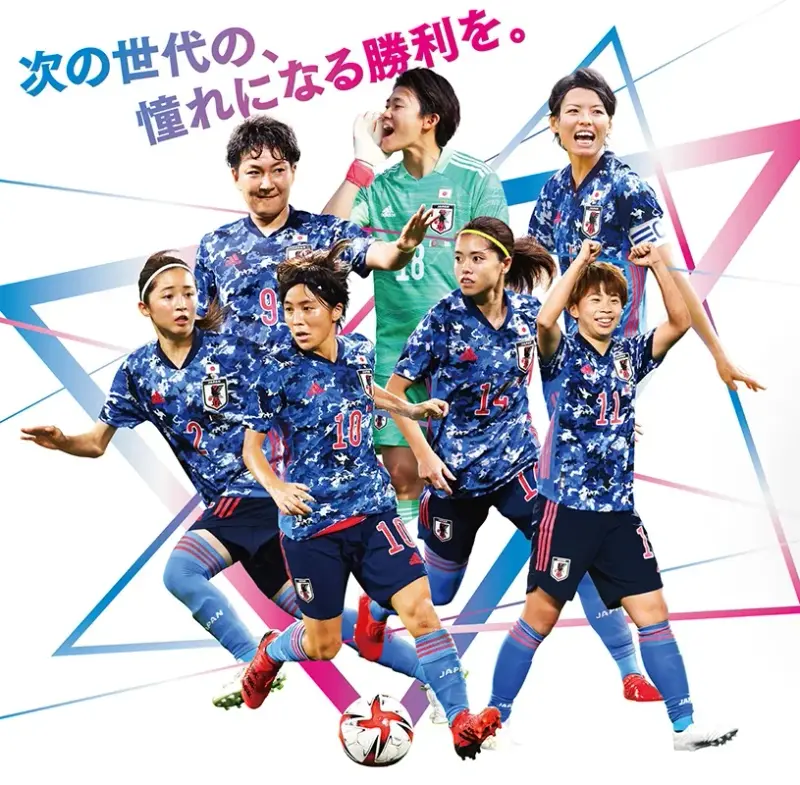
THE OTHER NATIONAL TEAM · JAPAN
During the men’s World Cup, FemGol will trace the history of some of the women’s national teams from the countries taking to the pitch. Because a country’s football doesn’t fit in a single team.
Today Japan play the Netherlands. They’ll do it at the men’s World Cup, in one of those matches that invite talk of tempo, pressing, technique, structure and an increasingly recognisable idea of football. Japan are no longer an exotic name on the men’s map. They are an awkward, modern, competitive opponent. A side no sensible team looks down on.
But there’s another Japanese national team that isn’t searching for its place. It already has it.
Japan’s women, the Nadeshiko, will arrive at the Brazil 2027 World Cup as champions of Asia. They don’t need to wait for a play-off, a fluke, or a dramatic final match. They sealed their ticket in March, in Australia, and did so in the most emphatic way possible: by winning the Asian Cup.
While the men’s side tries to advance in a tournament Japan have never conquered, the women carry a different story. The Nadeshiko have already done what no other Asian team, men’s or women’s, has managed at senior level: win a FIFA World Cup.
The country that has already touched the summit
Japan were world champions in 2011. And it’s worth writing without playing the fact down: they weren’t just the first Asian women’s side to do it. They were the first senior team in Asia, men’s or women’s, to lift a FIFA World Cup.
It happened in Frankfurt, against the United States, in a final still remembered as one of the most thrilling in the history of women’s football. Japan weren’t favourites. The United States had more tradition, more power, more star quality and more presence. Japan had something else: patience, technique, conviction and a way of playing the game very much their own.
The Americans went ahead twice. Japan answered twice. The second time, in the 117th minute, with a goal from Homare Sawa that turned the final into something more than a match. Then came the penalties and the definitive coronation. Sawa finished the tournament as top scorer and best player. Saki Kumagai, then a very young footballer, scored the decisive penalty. Japan lifted the cup.
That title also carried an enormous emotional dimension. It came just months after the Tōhoku earthquake and tsunami, in a country still reeling from tragedy. For a few weeks, the Japanese women’s team became a symbol of collective resilience. It wasn’t only football, though it was football too. It was a team that played a different way and that, precisely for that reason, had proved it could win.
The flower that was no mere decoration
“Nadeshiko” is the name of a flower, but in Japan it also carries a cultural weight tied to a traditional idea of femininity: delicate on the outside, strong within. Applied to football, the term is something of an imperfect metaphor, but it helps explain the image that accompanied the national team for years.
Japan didn’t impose themselves physically. They didn’t frighten anyone with size. They didn’t build their wins on collisions. They did it through precision. Through the short pass. Through coordinated movement. Through organised pressing. Through the player who appeared behind an opponent before the opponent even knew the space existed.
Their football was recognisable. And that, for a national team, is no small thing.
After the 2011 World Cup came Olympic silver at London 2012. Then another World Cup final in 2015, again against the United States, this time a clear defeat. Japan were still up there, but the summit was no longer a discovery. It was a burden. As happens to every team that wins something too big, from then on each generation began to measure itself against a shadow.
It wasn’t enough to compete. You had to resemble those champions.
Coming back without asking permission
For a while, Japan seemed stuck in a strange zone: too big to be treated as a surprise package, too far from the title to always sit in the front row. They kept producing technical footballers, kept competing at the major tournaments, kept being a difficult side to face. But the international narrative began to look elsewhere.
Until the 2023 World Cup.
In Australia and New Zealand, the Nadeshiko produced one of the most striking group-stage performances of the tournament. The 4-0 win over Spain was no accident, no goal rush without context. It was a tactical exhibition. Japan had less of the ball than the future world champions, but understood the match better: they waited, won possession, ran and struck with a precision that left Spain without answers.
Hinata Miyazawa finished that World Cup as top scorer with five goals. Japan went out in the quarter-finals to Sweden, but left a very clear impression: this wasn’t nostalgia. There was a new generation ready to compete from a recognisable idea, albeit adapted to a much more physical, faster and more global game.
Japan weren’t trying to be 2011 again. They were trying to be something else with the same roots.
The title that set them on the road to Brazil
Confirmation came in March 2026, in Australia. The Asian Cup also served as the road to the Brazil 2027 World Cup, and Japan left little room for doubt.
First they secured World Cup qualification with a 7-0 thrashing of the Philippines in the quarter-finals. Then they kept advancing to the final. There waited Australia, the hosts, with Stadium Australia roaring on the Matildas and the chance to lift a continental title in front of their own fans.
Japan won 1-0.
The goal was scored by Maika Hamano in the 17th minute, a strike worth a whole tournament. It wasn’t a comfortable final. Australia pressed, piled up chances and forced Japan to hold out longer than they would surely have liked. But champions are also recognisable in those matches: when they can’t play as well as they know how, they find a way not to fall.
It was Japan’s third Asian title, after those won in 2014 and 2018. Riko Ueki finished as the tournament’s top scorer with six goals. Ayaka Yamashita was named best goalkeeper. And the team closed the competition with an imposing record: six wins, 29 goals for and just one against.
Brazil 2027 was already on the horizon. But Japan weren’t arriving merely with a ticket. They were arriving with a crown.
A champion that changed manager
And then something strange happened: the coach who had just won the Asian Cup left his post.
Nils Nielsen, a Danish coach and the first foreign manager in Nadeshiko history, had been hired in late 2024. In under a year and a half he qualified the team for the World Cup and won the continental tournament. Less than two weeks after lifting the Asian Cup, he was no longer in charge.
The departure was officially explained by the end of his contract, but the sporting message that followed was fairly clear. Japan wanted a different energy. A different competitive tone. More aggression, more steel, more drive. Those were the words that accompanied the eventual arrival of Michihisa Kano — first Nielsen’s assistant, then interim, and finally permanent head coach.
Kano inherits a situation that is both awkward and privileged. Awkward, because he replaces a coach who had just won. Privileged, because he takes over a side that are champions of Asia, qualified for the World Cup and built around a generation that no longer needs much explaining.
The question isn’t whether Japan can compete. We already know that. The question is whether they can intimidate again.
A generation spread around the world
Today’s Japan can’t be understood from Japan alone. The creation of the WE League in 2021 helped professionalise the domestic ecosystem, but many of the team’s key footballers already play abroad. Especially in England.
Yui Hasegawa, Ayaka Yamashita and Aoba Fujino are part of the Japanese core at Manchester City. Hinata Miyazawa plays for Manchester United. Riko Ueki is at West Ham. Fuka Nagano, Risa Shimizu, Maika Hamano, Toko Koga, Kiko Seike, Moeka Minami, Honoka Hayashi, Saki Kumagai and other internationals have filled out various English clubs. Japanese football no longer exports isolated cases. It exports a generation.
There’s also a close link for Spanish audiences: Chika Hirao, goalkeeper at Granada CF, has been part of Japan’s recent squads. She isn’t the team’s headline figure, but she is proof of just how far the Nadeshiko map has opened up.
That internationalisation changes a great deal. Japan keep their technical base, their collective intelligence and their passing culture, but many of their players now live week in, week out with more physical duels, more demanding calendars and different competitive contexts. They are no longer just a well-organised side. They are a well-organised side with players hardened in increasingly tough leagues.
And that makes them more dangerous.
Hasegawa, the quiet centre
If there’s one player who helps explain this Japan, it’s Yui Hasegawa. She doesn’t always appear in the highlights. She doesn’t always get the headline. But she is often the one who decides what kind of match is being played.
Hasegawa doesn’t need to carry the ball half the pitch to dominate. It’s enough for her to turn at the right moment, to receive where others don’t dare, to clear a build-up, to draw a press or to pick the pass that quickens a move that seemed asleep. She is one of those midfielders who organise without raising their voice.
Around her, Japan have assembled very different pieces. Miyazawa offers arrivals and a threat from deep. Hamano has nerve, a fine strike and a competitive maturity that doesn’t always match her age. Fujino provides imbalance. Ueki gives presence up top. Yamashita holds things together from goal. Kumagai retains authority, memory and leadership: she is the living bridge to that champion generation of 2011.
It isn’t a team built around a single star. It’s something more Japanese, in the best footballing sense: a structure in which every player seems to know what the next one needs.
Japan don’t warn you by shouting
International women’s football has very clear focal points. The United States, Spain, England, Germany, France, Sweden, Brazil. They are names that fill the conversation even when they aren’t playing. Japan, by contrast, tend to turn up another way. Less noise, less star billing, fewer grand statements.
But when the tournament comes, they’re there.
They were there in 2011 to change history. They were there in 2015 to show it had been no fluke. They were there in 2023 to thrash the future world champions. And they will be in Brazil 2027 as champions of Asia, with a global generation, technically and competitively mature.
Today the cameras are on the men’s Japan against the Netherlands. That’s only natural. It’s the World Cup. It’s a great match. But a country’s football doesn’t fit into ninety minutes, or into a single team.
Japan also play in the women’s game.
And that team already knows something the others are still trying to work out: their road to the World Cup is already made.
Now the hardest part begins.
To be a contender again without having to warn anyone.