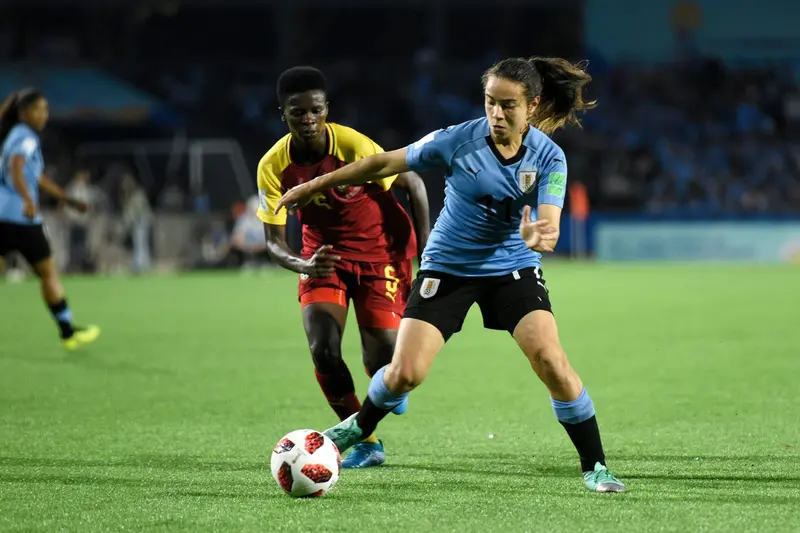
THE OTHER NATIONAL TEAM · URUGUAY
During the men’s World Cup, FemGol will trace the history of some of the women’s national teams from the countries taking to the pitch. Because a country’s football doesn’t fit in a single team.
Uruguay reach the final round of the men’s World Cup group stage without a win. After drawing with Saudi Arabia and Cape Verde, Marcelo Bielsa’s side need to beat Spain to guarantee their progress and avoid an exit that would be hard to explain in a country used to measuring its football in stars, titles and impossible feats.
On the other side of the same crest there is another Celeste.
It shares the four stars, but none of them tells its story. It has never played a World Cup, and it has just missed out on the one to be held in Brazil in 2027. And yet, less than a year ago, it produced one of the finest runs in its history after doing something that ought to be perfectly understood in Uruguay: taking a stand.
Six days before the start of the 2025 Copa América, the players refused to train.
They were not asking for bonuses for winning. They were asking for the conditions to be able to try.
Before the AUF recognised them
Uruguay’s women’s national team did not begin when the Uruguayan Football Association decided to organise it.
There is press evidence of a match between representative sides of Uruguay and Argentina played at the Belvedere stadium in 1962. Eight years later, Zulma Palavecino, linked to Nacional, helped drive the creation of the Amateur Women’s Football Association alongside other officials. That AAFA ran, from 1971, a competition involving teams from Montevideo and the country’s interior. Nacional won the first five editions.
There were Las Águilas Negras, Las Amazonas, Las Charrúas, Las Rebeldes de Florida and Las Estrellas de Santa Lucía. There were also teams from San José, Tacuarembó and Sarandí.
There was women’s football in Uruguay. What there was not yet was a structure that wanted to preserve it.
It took the AUF until 1996 to create a dedicated council and officially register its first players. On 27 October that year an experimental five-a-side championship began. In 1997 came the first eleven-a-side league.
Also in January 1997, Uruguay faced Canada in the first official match of its women’s national team recognised by the federation. They lost 1-3 at the Centenario stadium, as the curtain-raiser to the men’s match between Uruguay and Argentina in qualifying for France 1998.
They played while the crowd waited to see the men.
Then they had to wait 24 years to return.
Twenty-four years away from the Centenario
The women’s national team’s next appearance at the Centenario did not come until June 2021.
Almost two and a half decades passed between the match against Canada and the return against Puerto Rico. Uruguay won that day 5-1, but the result explained less than the setting: the national side of a country that built much of its identity around that stadium had gone 24 years without its women players setting foot in it.
During that time, the Celeste competed without ever establishing themselves among South America’s leading sides. Their best continental finish was third place at the 2006 Copa América, which earned them a place at the following year’s Pan American Games. They never made it to a World Cup or an Olympic Games.
There were generations capable of coming close. The under-17 side were South American runners-up in 2012 and played at that age group’s World Cup. Belén Aquino and Esperanza Pizarro, two of the senior team’s current standard-bearers, grew up within a youth structure that had begun to compete more consistently.
The challenge was no longer to prove that Uruguay had players.
It was to make sure they could develop as such.
Playing without an ambulance
In June 2024, the national team’s players used a friendly against Russia to publicly back the demands of the players in the domestic league.
They denounced the cut in the number of matches, the growing use of training complexes instead of stadiums, and the absence of ambulances, stretchers, medical insurance and other basic services. The protest came, moreover, during a FIFA window marked by last-minute changes to the organisation of the friendlies.
They were not demanding that Uruguayan women’s football should immediately resemble the men’s game.
They were demanding that it should resemble a sporting competition.
A year later, the dispute reached the senior side directly. Uruguay were due to play the 2025 Copa América in Ecuador, but their preparation was once again marked by improvisation. The internationals questioned the travel planning, the training conditions, the daily allowances and the fact that they could not even make normal use of all the facilities at the Complejo Celeste while preparing for the tournament.
On 5 July they decided not to train.
“We are still without a favourable response on improving our conditions,” they explained. The measure, they added, was not against their passion, but in favour of a fair right.
The team called off the protest after reaching an agreement with the federation, just days before their opening game.
Then they started to play.
With everything against them
Uruguay drew 2-2 with Ecuador in their opening match after going two goals ahead. They lost narrowly to Argentina, beat Peru 1-0 and reached the final round needing to beat Chile.
They did so 3-0.
For the first time, the Celeste reached a Copa América knockout semi-final. The third place won in 2006 had come through a final round-robin; in 2025, Uruguay had to win a decisive match to make the last four.
Pamela González, captain and one of the players who had led the demands, would not let the result erase what had happened before the tournament.
“We did not come with good preparation,” she recalled after eliminating Chile. Even so, she concluded, they had made history “with everything against us”.
Brazil halted the adventure in the semi-finals with a 5-1 win. In the third-place match, Uruguay again faced Argentina, drew 2-2 and lost on penalties. They finished fourth, with Belén Aquino, Wendy Carballo and Pamela González as the team’s top scorers, on two goals each.
They did not better the 2006 finish.
But they showed that the medal need not be an isolated memory.
A generation that went abroad
Today’s Celeste also tells the slow transformation of Uruguayan football through where its players have ended up.
Pamela González spent much of her career in Spain before joining Portugal’s Racing Power. Esperanza Pizarro arrived at Deportivo de La Coruña. Belén Aquino moved from Internacional to Corinthians. Wendy Carballo plays for Bahia.
The national team relies more and more on players who had to leave the domestic league to find more competitive structures.
That talent was not enough to reach Brazil 2027.
Uruguay finished eighth in CONMEBOL’s first women’s Nations League, with one win, three draws and four defeats. The 1-0 loss to Colombia confirmed their elimination from the World Cup places, and they closed the tournament with a draw against Venezuela at the Centenario.
The gap to South America’s best sides remains wide. So too is the gap between a good generation and a structure capable of sustaining it.
The other way to resist
Uruguay has turned resistance into part of its footballing mythology.
It calls it garra, represents it with four stars and uses it to explain how a small country can compete with anyone.
For the women, however, resisting was never only about holding on inside the pitch. It also meant playing for decades without recognition, spending 24 years away from the Centenario, competing without basic conditions, and stopping a training session when carrying on would have served to make all of it seem normal.
Uruguay’s women’s national team has still not reached a World Cup.
But it has already done something that is also part of the story of the Celeste: refusing to accept that its place was decided in advance.