THE OTHER NATIONAL TEAM · SOUTH AFRICA
During the men’s World Cup, FemGol will trace the history of some of the women’s national teams from the countries taking to the pitch. Because a country’s football doesn’t fit in a single team.
This Thursday, while South Africa’s men’s team face Czechia at the World Cup, another of the country’s football stories deserves to step out of the background.
In early June, Japan beat the South African women’s team 5-0. It was not a narrow defeat or an accident that could be explained away by a refereeing decision. Japan took Banyana Banyana apart and turned the first of their two friendlies into an exhibition.
Three days later they met again.
This time South Africa held firm, corrected their mistakes and won 1-0 with a strike from Linda Motlhalo. The result delivered no title and no qualification, but it explained the team rather well: Banyana Banyana did not become great because they stopped losing. They became great because they learned not to stay inside their defeats.
Now they are preparing to return to Morocco. There, between July and August 2026, they will play an Africa Cup of Nations that will also serve as a road to the 2027 World Cup in Brazil.
South Africa are no longer waiting to be invited into history.
They are looking to keep writing it.
A team born during a country’s transformation
The South African women’s team played their first official match on 30 May 1993 against what was then Swaziland, today Eswatini.
South Africa had not yet held the 1994 elections that would bring Nelson Mandela to the presidency. The country was trying to leave apartheid behind and to rebuild sporting institutions that for decades had been shaped by racial segregation and international isolation.
The women’s team was born within that process.
Their nickname, Banyana Banyana, is usually translated literally as “the girls, the girls”, although in sporting language it also works as a form of encouragement: “come on, girls”. It was the female version of Bafana Bafana, the popular name of the men’s team.
Among the players in that first team was Desiree Ellis.
Back then she was a midfielder and vice-captain. More than three decades later she is still inside the same story, now as head coach and as the manager who led the country to its greatest achievements.
There are few national teams in the world whose evolution can be followed almost in full through a single person.
Ellis knew the birth, the early defeats and the years of invisibility. She also led the first World Cup appearance, lifted the first Africa Cup and took the team to a World Cup knockout round.
She did not inherit Banyana Banyana.
She helped build it.
Five finals to learn how to win one
South Africa reached the African final on their first attempt, in 1995. They then returned to the title match in 2000, 2008, 2012 and 2018.
They lost all five.
For more than two decades, Banyana Banyana lived close to the place they wanted to occupy without ever conquering it. Nigeria dominated the continent and Equatorial Guinea also managed to interrupt that dominance, while South Africa piled up medals that proved their consistency and reminded them of everything they had not yet won.
The 2018 final was especially painful.
South Africa had beaten Nigeria in the group stage and reached the decisive match without losing a single game. The final ended goalless and the Nigerians once again prevailed on penalties.
The defeat, at least, opened a new door: as finalists, South Africa secured the first World Cup qualification in their history.
Banyana Banyana had lost another final, but they no longer returned to the same starting point.
From the Olympics to the World Cup
The first major international appearance had come a few years earlier, at the London 2012 Olympic Games.
South Africa did not get past the group stage, but Portia Modise left one of the images of the tournament when she scored from near the halfway line against Sweden. Modise ended her career with 101 international goals and became, in 2014, the first African footballer to reach a century for her country.
London was not a one-off. Banyana Banyana also qualified for Rio 2016 and, after that 2018 continental final, reached the 2019 World Cup in France.
The World Cup debut showed the distance that still separated South Africa from the leading powers. They lost all three matches against Germany, China and Spain. Thembi Kgatlana scored against Spain the first World Cup goal in their country’s history, but the team went home without a point.
It was easy to read that campaign as a ceiling.
South Africa used it as a first step.
Desiree Ellis and the generation that stopped settling
Desiree Ellis had taken over the bench on an interim basis in 2016 and was confirmed as head coach in 2018.
Her team grew around an extraordinarily long-serving generation. Janine van Wyk ended her international career with 185 caps, an African record. Portia Modise had left 101 goals behind. Noko Matlou went from being a forward voted Africa’s best player to becoming a centre-back. Refiloe Jane, Jermaine Seoposenwe, Andile Dlamini and Bambanani Mbane gradually accumulated years and responsibilities.
Around them emerged the talent of Linda Motlhalo, the pace of Thembi Kgatlana and Hildah Magaia’s knack for turning up in the decisive matches.
The best South Africa did not need to have the ball throughout a match. They were comfortable defending with discipline, closing spaces in central areas and accelerating when they won possession. Kgatlana could turn a few free metres into a chance; Motlhalo brought composure and clarity; Magaia attacked the box, and Jane held the midfield.
They were not the wealthiest team, nor the one with the most players in the big European leagues.
But they had learned to recognise themselves.
The night they stopped chasing Africa
The 2022 Africa Cup of Nations was held in Morocco.
South Africa began by beating Nigeria 2-1, the continent’s great historical benchmark. They then defeated Burundi and Botswana, knocked out Tunisia in the quarter-finals and got past Zambia in the semi-finals.
They reached the final with five wins in five matches.
In Rabat they were met by Morocco, the host nation, backed by a packed stadium and by the growth of a project aiming to win its first continental title.
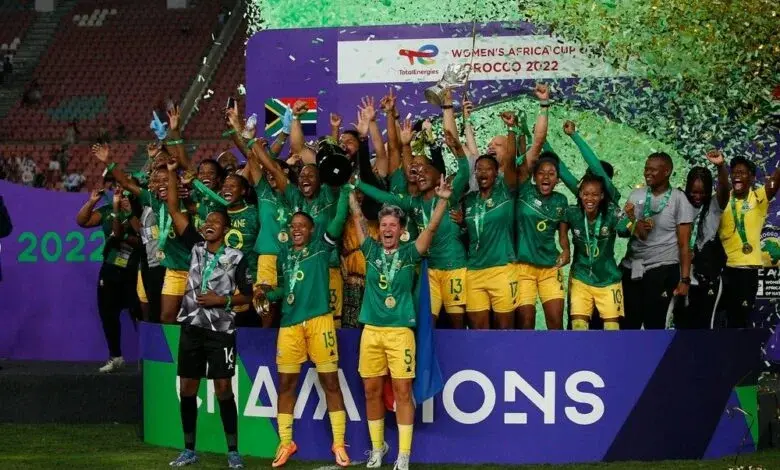
Hildah Magaia scored twice.
Morocco pulled one back, but South Africa held firm and won 2-1. After five lost finals, Banyana Banyana were champions of Africa.
They did not win the tournament by surviving to penalties or benefiting from a kind draw. They won all six matches and beat Nigeria, Zambia and Morocco along the way.
The celebration was also a demand.
President Cyril Ramaphosa received the players at the seat of government in Pretoria and publicly called for equal pay. “You are the queens of Africa. You deserve the same pay for the same work,” he told them, before committing to eliminate every form of inequality in wages. The title had proved the team’s sporting worth. It remained to be seen whether that worth would be reflected in their conditions.
The test came barely a year later.
Having to fight before being allowed to play
Preparation for the 2023 World Cup ended up as a public conflict.
The players refused to play the send-off friendly against Botswana. They were demanding contractual guarantees over the amounts they would receive for taking part in the World Cup and questioned the conditions of the chosen stadium. The federation fielded a makeshift team, made up of players who would not be going to the tournament, and South Africa lost 5-0.
The conflict was resolved a few days later thanks to institutional mediation and a contribution of six million rand from the Motsepe Foundation.
Banyana Banyana were able to travel, but the episode left an uncomfortable question: how could the champions of Africa arrive at a World Cup without their basic financial conditions sorted out?
Those footballers had to negotiate to be treated as professionals and, almost immediately afterwards, compete against the best teams in the world.
They did both.
The goal that found a place for a whole nation
South Africa began the World Cup in Australia and New Zealand losing 2-1 to Sweden, to a goal conceded in the final minute.
In their second match they went 2-0 up against Argentina, but ended up drawing 2-2. They had played well, had scored four goals and had only one point. To reach the last 16 they needed to beat Italy.
The match on 2 August 2023 was chaotic, thrilling and profoundly South African.
Italy went ahead from the penalty spot. An own goal let Banyana Banyana level. Hildah Magaia made it 2-1 and Arianna Caruso restored parity for the Italians.
In stoppage time, Magaia received the ball inside the box and found Thembi Kgatlana.
The forward made it 3-2.
South Africa secured their first World Cup victory and qualified for the round of 16 for the first time. There they were knocked out by the Netherlands, but the tournament had already changed the team’s standing.
Kgatlana’s personal story made that goal even harder to explain. She had arrived at the World Cup after recovering from a ruptured Achilles tendon suffered at the Africa Cup of Nations. On top of that, she lost three family members in the weeks around the tournament.
She could have gone home.
She chose to stay with her team-mates and scored the most important goal in Banyana Banyana’s history.
The women who paid the price of being visible
The story of South African women’s football cannot be told solely through results and trophies either.
Eudy Simelane, a former international, coach and LGBTI activist, was raped and murdered in 2008 in KwaThema. She was one of the first women in her community to live openly as a lesbian, and her death became internationally linked to the denunciation of violence against lesbian women and of the assaults known as “corrective rape”.
Simelane represents a much harsher part of the story.
For many South African footballers, playing did not only mean challenging the idea that football belonged to men. It could also mean confronting rules about how a woman should behave, dress or love.
Banyana Banyana grew up within those contradictions: recognised as a national symbol when they won, but too often forced to justify their pay, their conditions and even their presence.
That is why their victories have never been merely sporting.
Losing the crown without disappearing
South Africa arrived as champions at the Africa Cup of Nations officially called the 2024 edition, although played in July 2025.
They again reached the semi-finals, but Nigeria regained control of the rivalry. The Super Falcons won 2-1 with a goal from Michelle Alozie in stoppage time. Ghana then beat the South Africans on penalties in the third-place match.
Banyana Banyana came home without a medal.
The tournament confirmed that Africa could no longer be understood solely as a fight between South Africa and Nigeria. Morocco, Zambia, Ghana and other teams were growing. The margin for error was getting smaller and part of the generation that had conquered the continent was nearing the end of its road.
South Africa had to renew themselves without losing what had made them recognisable.
That task continues in 2026.
Morocco, once again
Banyana Banyana secured qualification for the 2026 Africa Cup of Nations after coming through a very tight tie against the Democratic Republic of the Congo. After a 1-1 in the first leg, Thembi Kgatlana scored in stoppage time of the second match and averted an elimination that would have been devastating.
The tournament will be held in Morocco from 25 July to 16 August.
South Africa will share a group with Ivory Coast, Burkina Faso and Tanzania. Reaching the semi-finals will mean a direct ticket to the 2027 World Cup in Brazil. The teams knocked out in the quarter-finals will still be able to fight for two African places in the intercontinental play-off.
The goal is no small one.
South Africa want to play their third consecutive World Cup and prove that the 2022 title and the 2023 last-16 run were not the final flicker of an irreplaceable generation.
To prepare, Ellis took the team to Japan. There they conceded five goals in the first match and found a win in the second.
Perhaps that is the best way to arrive in Morocco: remembering that nothing they have achieved was easy, and that no defeat has to be final.
Banyana Banyana have not built their history by promising they will never fall again.
They have built it by proving they can always get back up.