THE OTHER NATIONAL TEAM · AUSTRALIA
During the men’s World Cup, FemGol will trace the history of some of the women’s national teams from the countries taking to the pitch. Because a country’s football doesn’t fit in a single team.
When the Socceroos take to the pitch in Seattle tonight to face the United States, they won’t be the first Australians to play a big match in recent months. In March, Stadium Australia hosted a final with 74,397 people in the stands — a historic record for the AFC Women’s Asian Cup — and the Matildas on the pitch. They lost 1-0 to Japan. But that’s not the beginning of the story. The beginning was 2023, and it has everything to do with how a country learned to look.
The birth of an identity
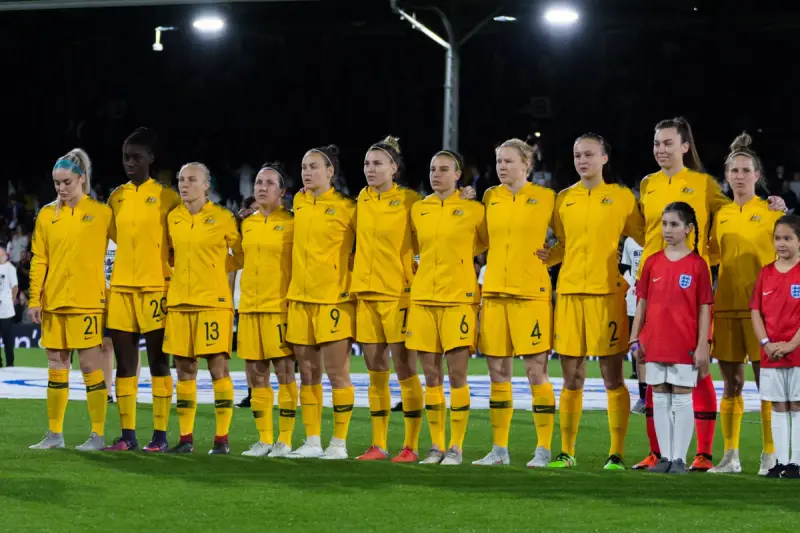
In 1994, when Australia qualified for their first Women’s World Cup, the team still appeared in some documents as the Female Socceroos. The Australian Women’s Football Association organised a vote to find a name of their own. The options included Soccertoos, Blue Flyers, Waratahs, Lorikeets and Matildas. Matildas won. The players didn’t receive the choice with much enthusiasm at the time. But that decision ended up giving the team something beyond value: an identity of their own.
Since 1995, the Matildas have appeared at every World Cup. Integration into the Asian Football Confederation in 2006 raised the competitive bar: reaching major tournaments was no longer a matter of dominating Oceania — you had to go through Japan, China and Korea. The change also made them better. In 2010 they won the Asian Cup — the only continental title in their history — beating North Korea on penalties.
The summer that changed everything
None of that, however, prepared Australia for what happened in the summer of 2023. The team reached the World Cup semi-finals for the first time in their history, in a tournament they co-hosted with New Zealand. Town squares filled up to follow matches on big screens. Yellow shirts appeared in offices, schools and stations. People who had barely watched women’s football suddenly knew the names of Mackenzie Arnold, Steph Catley, Mary Fowler, Caitlin Foord and Hayley Raso by heart. The semi-final against England drew an average audience of 7.13 million and reached 11.15 million — the most watched television programme in Australia since the OzTAM measurement system began in 2001 — not counting pubs, fan zones or pay platforms.
Sam Kerr couldn’t play in the opening matches through injury. When she returned, it was to score a goal that wasn’t enough to level the semi-final. Australia lost 1-3. They finished fourth. The country finished differently.
Beyond the spotlight
The great risk of any World Cup effect is mistaking the warmth of a tournament for a structural shift. In 2024, more than 21,000 new players registered in Australian women’s football, taking total female participation to 221,436 according to Football Australia. The growth was real. But it also revealed another side: clubs without adequate changing rooms, a shortage of coaches, facilities that hadn’t been designed for that level of demand. That is the real match Australia has been playing ever since.
Meanwhile, the team went through its most difficult spell since the boom. At Paris 2024 they were eliminated in the group stage. Tony Gustavsson left his post. Sam Kerr, who suffered an anterior cruciate ligament rupture in January 2024, went 692 days without wearing the Matildas shirt.
The response was Joe Montemurro — Italian-born, raised in Melbourne, former head coach of Arsenal Women, Juventus and Lyon — who took charge in 2025 with a clear proposal: that the Matildas stop relying solely on their physical potential and learn to control matches through the ball. It doesn’t mean breaking with everything that came before. Kerr, Foord, Catley, Alanna Kennedy, Mackenzie Arnold and Hayley Raso remain the recognisable heart of the squad. Mary Fowler, Kyra Cooney-Cross and Ellie Carpenter must take on an ever-greater share of responsibility. The goal is not to find the next Sam Kerr. It is to build a team that doesn’t need to.
Confirmation of the journey
In March 2026, Kerr returned to major competition with the Matildas at the Asian Cup, hosted on home soil. She scored the winner against China in the semi-finals. The final, at Stadium Australia, with those 74,397 in attendance, was lost to a Maika Hamano goal in the first half. Japan took the trophy. Australia took direct qualification for the 2027 Women’s World Cup in Brazil — their ninth consecutive appearance — and confirmation that their public was not a mirage from 2023.
The Matildas head into this summer having drawn their friendly series against Mexico: a 0-1 defeat in Newcastle on 6 June, a 3-1 win in Sydney three days later. A result that captures their moment fairly well: enough talent to compete with anyone, still searching for the consistency the new system demands.
Tonight the men are chasing a place in the next round in Seattle. The ticket to Brazil 2027 is already secured. In Australia, a country’s football has long since stopped fitting in a single team.