THE OTHER NATIONAL TEAM · HAITI
During the men’s World Cup, FemGol will trace the history of some of the women’s national teams from the countries taking to the pitch. Because a country’s football doesn’t fit in a single team.
When Haiti’s men’s side takes to the pitch to face Brazil, the temptation will be to tell the story of the small against the giant. Of a country returning to a World Cup 52 years on against the side that has won it more than anyone. Of the painful opener against Scotland — 0-1, a lone John McGinn goal — and the test that follows. Of the remote possibility, the feat and the miracle.
But Haiti does not need women’s football to invent a miracle for them.
They already had one. Or rather, they built something that from the outside looked very much like one.
In February 2023, the women’s side beat Chile 2-1 to earn the first World Cup qualification in their history. Both goals were scored by Melchie Dumornay, a player who had not yet turned twenty. But to reduce that night to her talent would be to tell only the most visible part of the story.
Behind Dumornay stood a generation that had spent years growing up together, leaving for abroad and learning to represent a country they could often not return to in order to play.
They were called the Grenadières. And for the first time, they were about to stand on the biggest stage.
Two goals to cross the world
Haiti had to travel all the way to New Zealand to earn the right to go back a few months later.
The Caribbean side had missed out on a direct CONCACAF spot and had to come through the intercontinental play-off. First they beat Senegal 4-0: Roselord Borgella scored twice. Then came Chile, with a more experienced squad and one of the best goalkeepers in the world in Christiane Endler.
Dumornay scored before half time and again in added time. Chile pulled one back when the match was nearly over, but Haiti held firm.
The final whistle did not just qualify a team. It completed the journey of a generation that had already given notice five years earlier, when Haiti took part in the 2018 Under-20 Women’s World Cup in France — the first appearance by any Caribbean side at a major FIFA women’s tournament. Sherly Jeudy scored the goal that got them there; Nérilia Mondésir was the captain; Kerly Théus was the goalkeeper. The team lost all three matches but left behind something more important than the results: proof that a foundation existed.
The success of 2023 did not come from nowhere. It had started much earlier.
A World Cup without points, but not without mark
The draw showed no mercy to the debutants.
Haiti were placed in a group with England, European champions; Denmark, an established elite side; and China. Three opponents with more experience, more resources and far more developed structures.
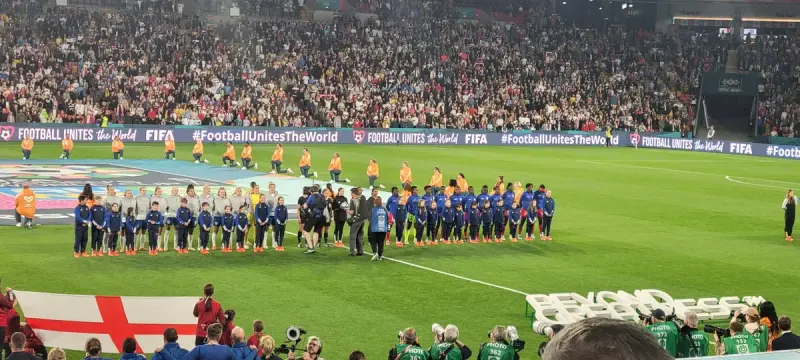
They lost all three matches. England won 1-0. China also edged it by the minimum. Denmark closed out the group with a 2-0 win. Haiti finished with no points and no goals scored, but conceded only four across the entire tournament and were still alive going into the final matchday. They competed against the European champions until the end and forced every opponent to take seriously a side appearing at a Women’s World Cup for the very first time.
There was no round-of-sixteen place, no victory to compress into a celebration clip. There was something less spectacular but perhaps more important: the certainty that Haiti could be there without merely filling a slot.
The World Cup was not the end of a story. It was the first proof of concept.
Much more than Melchie Dumornay
Talking about Haiti means talking about Melchie Dumornay.
The midfielder has become one of the most important players of her generation. Her power, her ability to drive with the ball, her runs into the box and her way of showing up in the biggest moments have taken her to Lyon — the club of seven Champions League titles. She was named CONCACAF Player of the Year in both 2023/24 and 2024/25, becoming the first Haitian to win the award and the first to retain it.
But Haiti did not arrive at the World Cup with a single footballer.
From the 2018 and 2023 cycle: Mondésir — captain, attacking reference — Borgella, Théus, Kethna Louis, and Jeudy, who appears in every chapter of the story: she scored the goal that qualified Haiti for the 2018 Under-20 World Cup, played in the 2023 senior tournament, and in April 2026 scored the 1-1 equaliser against the Dominican Republic that sealed their place in the CONCACAF W Championship. Jennyfer Limage, the centre-back of the 2023 squad, was injured against England in the first game, recovered, and provided the decisive assist to Jeudy three years later.
Then there are those who represent continuity: Claire Constant, who missed Australia and New Zealand through a knee injury but scored in the 2026 qualification campaign, alongside more recent additions like Roseline Éloissaint, Darlina Joseph and Chelsea Domond.
Dumornay can decide a match. Haiti’s existence as a competitive national side depends on everything else.
Playing at home while not being in Haiti
In April 2026, Haiti played two of their decisive CONCACAF qualification matches at the Stade Roger Zami in Le Gosier, Guadeloupe. They were listed as the home side. They were not at home.
The displacement captures a reality that runs through Haitian football. Violence and insecurity have forced their national teams to play abroad matches that should be held in front of their own people. The men’s side also built much of the road back to the World Cup far from Haitian soil.
The Grenadières have learned to live with that contradiction. They represent Haiti, but they gather elsewhere. They act as the home side on other people’s territory. Many of their players spend their entire careers at foreign clubs. The diaspora is not a supplement to the team — it is an essential part of its survival.
None of that turns each victory into a solution for the country. Football cannot repair a humanitarian crisis or restore safety to the streets on its own. But it can provide a common ground. For ninety minutes, players who grew up inside and outside Haiti wear the same shirt. And a scattered fanbase finds a national team it can still call its own.
The road to Brazil goes through Mexico
Haiti have already completed the first stage of their journey to the 2027 World Cup.
They finished top of Group D in the CONCACAF qualification phase, unbeaten: ten points, seventeen goals scored, one conceded. They thrashed Belize 9-0 and Anguila 5-0, won 2-0 in Suriname and sealed their place in the CONCACAF W Championship with a 1-1 draw against the Dominican Republic — Jeudy’s goal, Limage’s assist.
On the bench, a new chapter has also begun. In February 2026, the federation handed the team to Pia Sundhage, one of the most decorated coaches in international football: two Olympic gold medals with the United States (2008 and 2012), and FIFA’s best women’s coach of the year. A signing that speaks volumes about the ambitions of the project.
The next obstacle will be enormous. Haiti face Mexico in the CONCACAF W Championship quarter-finals on 28 November at the Texas Health Mansfield Stadium. The winner qualifies directly for Brazil 2027. The loser moves to the CONCACAF play-in, where a path to the World Cup can still be found.
Mexico will arrive as favourites. Chile were favourites in 2023 too.
Haiti already know that distances that look immense can be closed in a single match.
Coming back would itself be a step forward
Qualifying for Australia and New Zealand was historic because it had never happened before. Getting to Brazil would mean something different: continuity. It would confirm that a generation did not appear for one summer and then disappear. That Haiti can aim to compete at consecutive World Cups. That Dumornay is not an isolated exception but the most brilliant player in a team that keeps growing around her.
The Grenadières’ great challenge is no longer simply to make the world discover them. It is to stop the world from forgetting them again.
While the men’s side faces Brazil and looks to extend their return to the World Cup, the other national team is also preparing its own fight. They do not play at home. Many times they cannot even get close to it.
But they keep playing to come back.
Because Haiti also play. And the Grenadières have already shown they do not need anyone to give them a place.