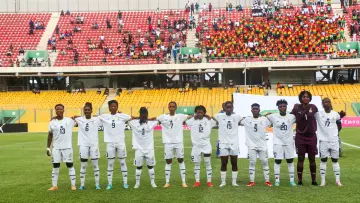
Cameroon beat Malawi 3-0 at the Prince Moulay Hassan Stadium in Rabat and are WAFCON champions for the first time.
All three goals came before the interval. Marie-Gisèle Ngah Manga scored on twenty minutes and again in first-half stoppage time, with Naomie Ndjoah Eto in between on the half hour. The second half finished goalless.
It is Cameroon’s first continental title at their fourth final. They had lost the other three — 2004, 2014 and 2016 — and lost all three to Nigeria, who were not there this time: Cameroon knocked them out in the quarter-finals. In between came eleven semi-finals without ever lifting it.
Three hours without a goal, then three in forty-five minutes
Cameroon reached the final with five goals in five matches and none at all in the two knockout ties that took them there.
They won the quarter-final against Nigeria 1-0 with a goal on twenty minutes. Then they spent a hundred and twenty minutes against the hosts without scoring, and the semi-final went to penalties. Between the two, that was three hours of knockout football and one goal.
On Sunday they scored three in forty-five minutes.
Ngah Manga got the first on twenty minutes, the same minute in which Cameroon had opened the scoring against Nigeria. Ndjoah Eto made it two on the half hour, set up by Maéva Nyadjou, who had scored that goal against the holders. Ngah Manga got the third in first-half stoppage time: Ndjoah Eto got away down the right and crossed for her to head it in.
The numbers do not describe control of the ball: possession finished level at 50%. They describe finishing. Cameroon had fourteen shots to nine, six big chances to one, and 2.88 expected goals against 0.70.
A goalkeeper who has not been beaten since 6 August
Cameroon have not conceded since the group stage.
The two goals they have let in all tournament were a Mali penalty and Cape Verde’s equaliser on 6 August. Since then they have played ninety minutes against Nigeria, a hundred and twenty against Morocco and ninety in the final: three hundred minutes without conceding, all three with Michaely Bihina in goal.
Bihina made nine saves against Nigeria and stopped four penalties against the hosts — the one Morocco took on 118 minutes, with the match still alive, and three in the shootout. She was not asked for anything of the sort in the final, because Malawi barely arrived.
Twelve goals in five games, and none in the sixth
Malawi had scored twelve goals before the final, more than any of the other three semi-finalists. Nine of them belonged to the Chawinga sisters.
Both started in Rabat and neither scored. Lovemore Fazili’s side created one clear chance in the whole match and began emptying the bench before the break: the first change came on forty-three minutes with the score still 2-0, and the second at the start of the second half.
They played without Rose Kadzere, who scored two of those twelve and was suspended after her red card in the semi-final.
They are African runners-up in their first appearance at the tournament, and the seventh different side to reach a final since 1998. CAF makes a narrower point: they are the first team from southern Africa to reach a final on debut.
Four players finish on five goals
Ngah Manga’s brace pushed her into the group at the top of the scoring chart in the very last match. She ends the tournament on five: the three she had, two of them penalties, plus the two on Sunday.
That leaves her level with Zambia’s Barbra Banda, Côte d’Ivoire’s Inès Konan and Temwa Chawinga, who went into the final tied at the top and played ninety minutes without scoring. The first three had already finished their tournament; Chawinga still had Sunday to play.
None of the four pulls clear: WAFCON 2026 ends with four top scorers.
What the two of them take away
CAF raised the prize money for this edition and the champions collect two million dollars.
All four semi-finalists had already secured their place at the 2027 World Cup before the weekend, so the final was for the title and nothing else. Cameroon, who had gone looking for it in eleven semi-finals and three finals, take it at the fourth.
The final was refereed by Egypt’s Elmaghrabi, appointed by CAF.