Qualifying for the 2026 Women’s Africa Cup of Nations ended on 28 October 2025.
The 12-team field appeared complete: hosts Morocco and 11 nations that had won their qualifying ties.
Cameroon, Ivory Coast, Mali and Egypt were out.
Eight days later, all four were back in.
On 5 November, the Confederation of African Football expanded WAFCON from 12 to 16 teams. Because qualifying had already finished, CAF needed another way to fill the four new places.
It did not stage a play-off. Nor did it compare how narrowly each side had lost.
It used the FIFA Women’s World Ranking.
Cameroon were ranked 66th, Ivory Coast 71st, Mali 79th and Egypt 95th. They were the four highest-ranked teams eliminated in the final qualifying round, so they were added to the tournament.
The largest WAFCON in history was therefore created by changing the size of the competition after the route into it had closed.
A second door opened
The FIFA ranking gave CAF a quick and verifiable way to order the eliminated teams. It avoided a discretionary selection and allowed the tournament to expand without adding more matches to the calendar.
But that criterion was not part of the qualifying process when the ties began.
The teams had entered qualifying believing there was one route to Morocco: win their tie. Once the matches were over, CAF created another.
The first depended on the result on the pitch.
The second depended on a team’s accumulated ranking.
That naturally favoured established national sides with a longer record of international competition. The ranking rewards results over time, regular activity and previous performance. It offers more protection to a traditional power enduring one poor qualifying tie than to an emerging team that has not yet had enough matches to build ranking points.
The method was not arbitrary.
It was chosen after the event.
That distinction matters.
Had the expansion been approved before qualifying began, the competition could have been designed to award 15 places alongside Morocco’s automatic berth. CAF could also have announced in advance that the four highest-ranked losing teams would receive a second chance.
Every nation would then have known the rules before playing.
Instead, CAF completed qualifying, increased the size of the finals and only then decided how to fill the new spaces.
Four qualifying ties sent eight teams to Morocco
The outcome can be summarised without revisiting every score.
Algeria eliminated Cameroon. Both will play at WAFCON.
Ghana eliminated Egypt. Both will play at WAFCON.
Cape Verde eliminated Mali. Both will play at WAFCON.
Senegal eliminated Ivory Coast. Both will play at WAFCON.
The winners secured their places through the original system. The losing sides still depended on an expansion that did not exist when they played.
Those qualifying ties were not meaningless. Winning guaranteed a place and removed any reliance on what CAF might decide later. Defeat only stopped being final for four teams.
But the final outcome is hard to ignore: four ties that were meant to hand out four places ended up sending all eight of their participants to the tournament.
The reward for winning remained.
The punishment for losing changed afterwards.
Growing was not the problem
The expansion has sporting arguments behind it.
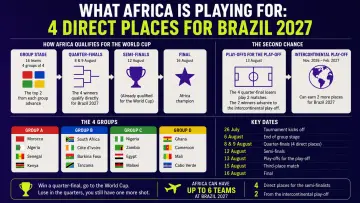
WAFCON will now have four groups of four teams. There will be more countries represented, more matches and more footballers competing in the main continental tournament.
The new format also simplifies the first phase: the top two in each group will reach the quarter-finals. There will be no need to compare third-placed teams from different groups.
CAF maintains that the change will strengthen competitiveness and support the growth of African women’s football.
The debate is not necessarily about whether 16 teams take part.
It is about when that was decided.
Expanding the tournament before qualifying began would have meant opening up more places. Doing it afterwards meant rescuing eliminated teams.
The difference does not change the final line-up, but it does change the legitimacy of the route.
An elimination that could end at the World Cup
The four reinstated teams will arrive in Morocco with the same sporting rights as the other twelve.
The WAFCON semi-finalists will qualify directly for the 2027 Women’s World Cup in Brazil. Two more teams will advance to the intercontinental play-off.
That opens a possibility that sums up the whole story: a team eliminated in October and reinstated through the ranking in November could end August with a direct ticket to the World Cup.
When the matches begin, the tournament will no longer distinguish between the teams that won their ties and those that came in later. All of them will start on zero points.
But they did not arrive by the same road.
The 2026 WAFCON will be the biggest edition in history because CAF decided the time had come to grow.
It will also be the tournament in which the rules changed after the eliminated teams were known.
Qualifying closed one door.
The ranking opened another once the tournament had already finished choosing its participants.