If a screenwriter had pitched FC Badalona Women’s season, it would have been sent back as implausible. A club founded in Sant Joan Despí that moves to Badalona, launches a new identity — ONA, “wave” in Catalan —, plays its league home games more than a hundred kilometres away, in Palamós, loses three points in the committee rooms for travelling without a doctor, spends several weeks without a registered head coach, and welcomes a majority shareholder from London halfway through the campaign. And which, with all of that on its back, finishes tenth and produces the most surprising Copa de la Reina semi-final run of the season.
Let us take it piece by piece, because the pieces deserve it. The club is the heir of Levante Las Planas, founded in 1983 in a neighbourhood of Sant Joan Despí, with a women’s section since 1998. It made its top-flight debut in 2012/13 and returned to the elite in 2022/23. In the summer of 2024 it moved its first team to Badalona in search of facilities worthy of the category; in July 2025 came the full rebirth: FC Badalona Women, a new crest and the ONA brand. The paradox was immediate: since the Municipal de Badalona did not have the natural grass Liga F requires, the team had to play its league home games in Palamós — covering the cost of adapting the pitch — and prepare for the season in Sant Cugat. A club with three homes and none.
Three points for a doctor
The sporting season began with Ana Junyent and a side that was hard to beat and flirted with the European places. Junyent left in November with the team eighth, and her assistant, 28-year-old Marc Ballester, took charge: at first without appearing as the registered head coach for several weeks, then fully from January. His league record — seven wins in eighteen matches — and above all his cup run have earned him a renewal until 2027.
February brought the episode that defines the year: the RFEF deducted three points for repeatedly travelling without a club doctor — six away trips in nineteen matchdays, with six previous fines and an explicit warning. The club announced an appeal, arguing that Liga F’s own competition rules only require the home side to provide medical cover; the final table, with the -3 applied, suggests it got them nowhere. Without the sanction, Badalona would have finished ninth. With it, tenth on 36 points — which remains, in context, an extremely comfortable survival.
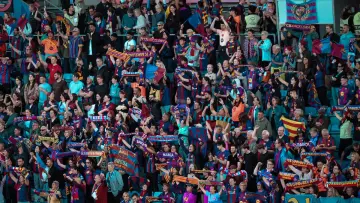
And then there is the cup, the season’s sporting respite: Osasuna, Granada and Real Sociedad — the latter via a penalty saved in the 90th minute — all fell on the way to a historic semi-final against Barcelona. The first leg, a 0-0 in Badalona with María López Valenzuela towering between the posts; the return, a 1-4 at the Johan Cruyff with a consolation goal from Lice Chamorro, who finished the season as the team’s top scorer alongside Itzi Pinillos, the full-back who scores like a forward.
Mercury13 and the new era
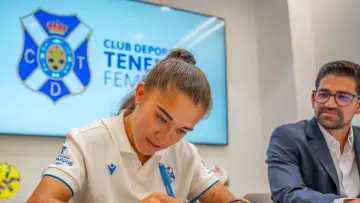
On 10 March, with the season still running, came the institutional news: Mercury13 — a London-based multi-club group dedicated exclusively to women’s football, owner of Italy’s Como and England’s Bristol City, with Juan Mata and Giorgio Chiellini among its investors — became the club’s majority shareholder. It is the first women’s football multi-club platform to enter Liga F, with Pedro Iriondo, formerly of FIFA and Olympique de Marseille, as chief executive. The new money lands at a club with delicate accounts — the CSD is demanding the repayment of a grant of close to a million euros, and last season a player publicly alleged unpaid wages, which the club flatly denied — so institutional order is the project’s first item of homework.
For 2026/27 there is a road map: a return to the Estadi Municipal de Badalona, now with council-funded natural grass; Ballester renewed; the first confirmed continuities — Pinillos, Cubedo — with goalkeeper Valenzuela’s renewal also on track, as reported by AS; and six departures, Chamorro and Banini among them, that promise yet another squad rebuild. It will be, at last, the season in which Badalona Women play in Badalona. After the year they have lived through, even that will feel like a revolution.