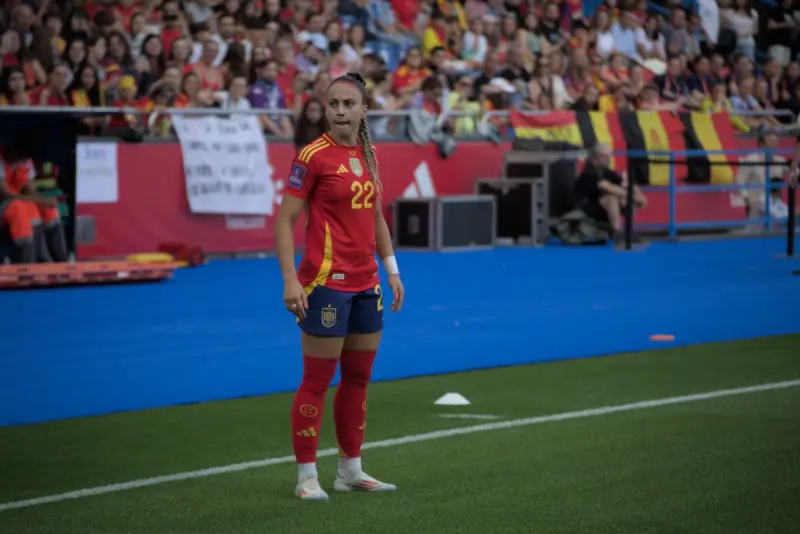
February 2022. The Arnold Clark Cup is a pre-tournament friendly ahead of the European Championship, and Athenea del Castillo is not in Jorge Vilda’s initial squad. She is with the under-23s, preparing for a different match, in a different city.
Then Mariona Caldentey is injured in Spain’s opening match against Germany. Athenea gets the call and travels to join the senior squad.
She plays the second half against England and is named player of the match. She excels again against Canada. By the end of the tournament, she has been voted best player of the competition.
The original list did not include her. The tournament ended by choosing her as its finest player.
That, in many ways, has been her story: the match always finds her, even when the starting eleven does not.
The dribble as a statement of intent
Some players use the ball to protect themselves. Athenea uses it to expose herself.
Her game often begins with a situation that is simple to describe and difficult to resolve: a winger facing a defender. She could try to reach the byline, cut inside, or combine with a team-mate. But almost always there is a recognisable intention: to provoke something.
The dribble contains a contradiction. It is one of football’s most celebrated actions and also one of the most likely to end in dispossession. To keep attempting it requires accepting that not every try will come off, that the defender will read the movement, that the ball will go out of play.
That you will have to ask for it back.
That persistence explains much of what Athenea is. Not because she always beats her opponent, but because a mistake rarely stops her from seeking the next duel.
In a Spain side built on combination play, patience, and midfield dominance, she offers something different. She can stretch the pitch, accelerate a possession that has grown predictable, and force a defender to abandon her position.
Her presence introduces a question that cautious teams do not always dare to ask: what happens if someone decides to attack right now?
From Solares to Real Madrid
Athenea del Castillo Beivide was born on 24 October 2000 in Solares, Cantabria.
She started playing at eleven at SD Reocín, then moved through Ave Fénix Racing and Racing Féminas, where she competed in the second division. In two seasons with the senior Racing side she scored 37 goals in 46 matches.
In 2019 she signed for Deportivo de La Coruña, newly promoted to the top flight. There she played alongside Teresa Abelleira and made her first-division debut. Deportivo were one of the revelations of the 2019-20 season, but were relegated the following year.
Then Real Madrid called.
Athenea signed in the summer of 2021 and has not left since. Her identification with the club leaves little room for ambiguity. “I would never play for Barça, not even if they were the only club left in the world, because my dream is to play for Real Madrid,” she told EFE in 2024.
In a sport where players rarely speak so openly about their allegiances, she said it without qualification.
Her game at Madrid has expanded season by season. For much of her career she felt most comfortable on the left wing, where she could receive with space and drive towards goal. Over time she incorporated new routes from the right side. During Euro 2025 she explained that she had not enjoyed playing on that flank at first. Working with Alberto Toril and his coaching staff helped her improve her left-footed striking, occupy inside positions, and have more than one option when receiving.
She did not abandon the player she had always been. She gave her more answers.
Her own path
In the mixed zone in Berne, after scoring against Italy at Euro 2025, a journalist asks her about the goal. Athenea has not yet seen it again. She asks for a phone, presses play, and watches the move for a few seconds.
“I didn’t think I’d bent it that much,” she says.
There is a naturalness in that remark that is hard to manufacture: that of a player capable of deciding an international match and then genuinely surprised when she sees what she has done.
During the tournament she was also photographed holding Pass It On, Idiot — a book on leadership, teamwork, and creating positive environments. It was not entirely coincidental. Athenea had begun speaking openly about wanting to take on greater responsibility within her teams. “I don’t need an armband to show who I am. I say what I think and give my opinion whenever I need to, always with respect and maturity,” she said during the tournament.
That approach to leadership has not always placed her in the majority.
A few weeks after Spain became world champions in 2023, 39 players signed a joint statement demanding deeper reforms at the federation following what had happened with Luis Rubiales and Jenni Hermoso. Athenea was one of two World Cup winners who did not sign. She published her own statement: she condemned what had happened to Jenni, rejected Rubiales’s behaviour, and recalled that she had taken part in the original collective complaint. But with Rubiales gone and Vilda dismissed, she felt key demands had been met and would not consider withdrawing from the squad.
“We are footballers. We owe it to our profession and we must fulfil our duty,” she wrote.
It was not a comfortable position. It was not the majority position. She held it.
The European Championship that confirmed her
Athenea arrived at Euro 2025 without a guaranteed place in the starting eleven. Spain’s attack contained players with established roles and profiles especially well suited to the team’s combination game. She offered something else.
She started on the bench for the first two matches, then came into the side against Italy in the final group game. Spain fell behind, but Athenea responded within minutes. She received on the right, drove inside, and combined with Alexia Putellas. Alexia flicked the ball back with her heel and the Cantabrian struck first time from the edge of the area, curling it into the top corner. Spain won 1-3.
A week later, the side faced a different problem. Switzerland had held out for over an hour in the quarter-final and the score remained 0-0. Athenea came on in the 62nd minute. Four minutes later, Aitana Bonmatí received inside the area and laid it off with her heel. Athenea arrived to score the opener. Spain won 2-0 and advanced to the semi-finals.
The moment encapsulated much of her career: waiting on the bench, given an opportunity, needing four minutes to change the match.
But Athenea had no intention of being defined by that role. “I am more than an impact substitute. I have shown throughout my career that I have far more to offer and that I can contribute just as much from the start,” she said during the tournament.
In the final against England she was in the starting eleven. Spain took the lead, England equalised, and the title was decided on penalties. Athenea did not lift the trophy, but she had reached the last game of the competition after beginning the tournament without a guaranteed place in the squad.
The courage to take someone on
The 2025-26 season did not begin as the previous ones had. A change of manager at Real Madrid shifted hierarchies, and Athenea went through several months of reduced game time.
The response came in January.
She scored in the Supercopa de España semi-final against Atlético de Madrid, netted twice against Levante, and provided an assist against Sevilla. The performances earned her Liga F Player of the Month for January.
On 11 February, at the Stade Charléty in Paris, she appeared again. Real Madrid were losing to Paris FC when Caroline Weir equalised. Just before half-time, Madrid launched a counter-attack. Athenea came in from the right and placed the ball past the goalkeeper to make it 1-2. It was her 200th appearance for Real Madrid — making her the second player to reach that milestone in the women’s side, after Misa Rodríguez. Madrid won the tie 2-3.
The sequence does not make the months before irrelevant. On the contrary: it gives them meaning. A career is not built solely from the periods when everything works. It is also defined by what a player does when minutes dry up, another competitor arrives, or the manager looks for different solutions.
Athenea responded the way she plays.
She received the ball. She looked up. She sized up the defender.
And she tried again.
Redacción · FemGol