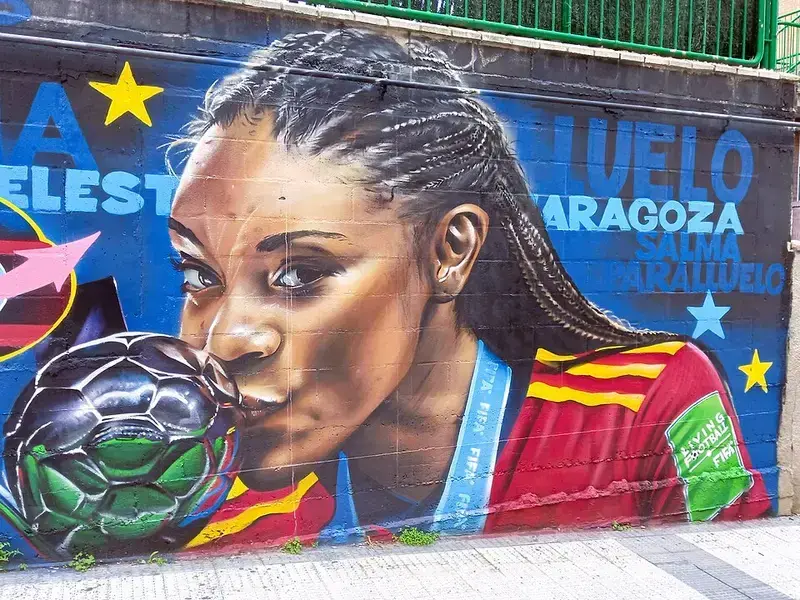
The final was already won.
The 90th minute in Oslo. Barcelona were beating OL Lyonnes 2-0 and Europe was turning blue and red again. Salma Paralluelo picked up a ball outside the box, took a few steps and struck with her left foot. The shot flew into Christiane Endler’s top corner with that clean violence of finishes in which the body seems to know the outcome before the ball does. Minutes later she scored again. Barcelona lifted their fourth Champions League after a 4-0 win over Lyon, and Salma signed off with a brace just when the match seemed to have said everything it had to say.
It was not just a forward’s brace in a European final. It was the answer of a footballer who had spent part of the season recovering from a partial ligament tear in her left knee. Another way of coming back. Another way of reminding football that, when the space opens up, few players can cover it like she can, a talent we analyse in detail in her tactical evolution.
And perhaps it was also a goodbye. Her contract with Barcelona ends on 30 June 2026, the renewal talks have not reached a deal and everything points to her leaving on a free transfer. At 22, Salma Paralluelo is once again facing a decision that can change her life. It is not the first time.
The girl who didn’t want to choose
There are footballers whose story begins with a ball. Salma Paralluelo’s began with a question: why did she have to choose?
She played football and competed in athletics, and not as a complementary hobby: she was extraordinary at both. Born in Zaragoza on 13 November 2003, she was a sprinter —200m, 400m, 400m hurdles— who carried onto the pitch an acceleration that seemed to belong to another sport. In February 2019, aged 15, she ran the 400m indoors in 53.83 and took bronze at the Spanish senior championships; she held seven national age-group records. Ahead of her lay a path that pointed, quite naturally, towards an Olympic Games.
The story since has turned that into a biographical curiosity —“she had to choose between athletics and football”—, but choosing meant giving up a life in which she had already proved she could reach the elite. She was not abandoning a hobby: she was closing a career that, for many people, would have been enough. FIFA itself asked her about it in 2018 and she admitted how hard it was: on the track she found individual satisfaction; in football, the team and a shared responsibility. On a track you run alone; on a pitch, speed can open the way for a whole team.
Learning to stop
In 2019, Villarreal signed her and let her keep combining football with athletics. The definitive decision did not come at once: first came the injury.
In April 2021, aged 17, she ruptured the anterior cruciate ligament in her left knee. For an athlete built around arriving early, it meant learning a new discipline: waiting. A cruciate ligament does not heal in a hurry; the body sets its own pace and forces you to rebuild what used to be automatic. The injury did not threaten a season: it touched the core of her sporting identity. That summer, too, any chance of fighting for the Tokyo Olympics in athletics slipped away.
She came back, played the final stretch of the season with Villarreal and, in July 2022, aged 18, left top-level athletics and signed for Barcelona until June 2026. The choice was made. The career, in truth, was only just beginning.
Three World Cups before turning twenty
The bet paid off immediately, and on a scale almost no one foresaw. She had already been a U-17 world champion in 2018. In 2022 she won the U-20 World Cup in Costa Rica, with two goals in the final against Japan (3-1). And in the summer of 2023 she completed the set with the senior title at the 2023 World Cup.
What made her a star was not the trophies but two instants in Australia. In the quarter-finals, against the Netherlands, she came off the bench and, in the 111th minute of extra time, drove forward, changed direction and finished: the ball clicked the post and went in. Four days later, against Sweden, she scored the opener on 81 minutes. Spain reached their first World Cup final and won it against England, with Salma in the starting eleven. She left the tournament named best young player and became the first footballer in history to win the U-17, U-20 and senior World Cups. All of it before turning twenty.
She had arrived even before the natural arc of a career. A young footballer usually gets a few years to make mistakes without every error becoming a verdict; Salma barely had them. She finished third in the 2023 Ballon d’Or and third again in 2024. The conversation stopped being about her potential: suddenly she was expected to dominate matches and settle finals every week.
The other side of the instant
The gift for turning up when everything is decided has a less kind side: sometimes the instant goes wrong, and the same spotlights are watching.
At Euro 2025, Spain reached the final hoping to crown a historic cycle. Salma, with a more intermittent role in the tournament, came on late against England and had several clear chances in extra time to break the 1-1. None went in. The match went to penalties and she missed the last of the shootout; Spain finished runners-up and Salma faced a wave of criticism.
It is worth keeping perspective. The same player who took the decisive penalty —the hardest to take— is the one who, two years earlier, had taken the ball in the 111th minute of a World Cup. Whoever steps up for the deciding moments wins some and loses others; the rare, valuable thing is to step up. At 21, Salma had already lived both versions of the same gesture.
The body interrupts the story again
The knee returned. On 25 October 2025, Barcelona announced a partial ligament tear in her left knee. She came back on 14 January 2026 against Atlético de Madrid: she came on in the second half and scored in stoppage time. Two months out, a few minutes, a goal.
Then came something harder to recover than fitness: continuity. Claudia Pina had grown on the left, Ewa Pajor held the centre of the attack and Caroline Graham Hansen was still a reference. Salma had to earn minutes in a forward line where almost everyone could start. And her best version reappeared when the team needed it most: she was decisive in the Champions League semi-finals against Bayern, scored in the Copa de la Reina final and closed the season with the brace in Oslo. The campaign that had begun with a torn knee ended with her lifting the Champions League. It was not the story of a footballer who recovered her old speed, but of one who learned to come back.
According to the club’s records, she leaves Barcelona with more than 130 matches and around 75 goals in blue and red, and a haul of three Champions Leagues, four leagues, three Copas de la Reina and four Super Cups. These are the figures of an established career, even if we still tend to speak of her as a project.
A place where she can be Salma
Now she can leave on a free, following Alexia Putellas, Mapi León and Ona Batlle, in a summer when the European champions are losing their reference points to financial limits. That a 22-year-old, with those numbers, three Champions Leagues and a brace in the last continental final, should reach the market without a transfer fee says a great deal about how women’s football is changing: the big clubs no longer compete only to discover talent, but to keep it, and the best players are starting to hold real power over where and how they continue.
Her next choice should not come down to the highest bid or the biggest badge. She needs a place that does not see her only as a weapon to run into space, but one that keeps building the footballer able to intervene when the pitch gets small: receiving with her back to goal, pinning a centre-back, choosing when to attack the box and when to wait. A project that lets her play, make mistakes and, at last, stop being “the future”.
Because that has been the strange toll of her precocity: she was an international before she was old enough to drive, an athlete of senior level competing in youth categories, a three-time world champion before twenty. She always arrived so early that the world had time to demand the next thing before celebrating the last one.
In Oslo, with the final already won, Salma received a ball outside the box. She could have let the seconds run down and waited for the party. Instead, she advanced and struck for the top corner. Perhaps because it is what she has always done: run to open space, run to come back from injuries, run while everyone else decides what she might become. Except that Salma Paralluelo no longer runs to catch up with the future. She runs to choose it.