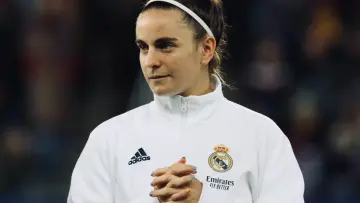
On 12 February 2026, around the 40th minute of a Champions League tie against Manchester United, Silvia Lloris planted her right foot to change direction and felt a crack. She tried to get up and wanted to walk off by herself. She kept saying that she could do it until she took one step and realised she could no longer control her leg. Her knee, as she would later describe it, felt like jelly.
Tests the following day confirmed a tear to her anterior cruciate ligament. There was also an injury to the meniscus.
But it was not only her knee that broke.
“Getting injured broke my heart too.” That was the title Silvia chose for the first video in which she decided to tell the story of her recovery.
She did not record the fall, the call home or the night in hospital. Nor did she record the first few days, when she needed help to get up, shower or go to the toilet. There is only Silvia speaking to the camera. Sometimes she smiles; at other times, she stops, takes a breath and waits a few seconds before carrying on.
She does not show the most painful moments. She remembers them afterwards.
Other people’s pain
Silvia’s father had travelled to Manchester to watch her play. On the way to the stadium, he said something neither of them would forget:
—Darling, we need to appreciate the matches we’re getting to experience and enjoy them to the full.
A few hours later, he watched her leave the pitch unable to control her knee.
Silvia knew that something serious had happened. The doctor began examining her on the bench and she understood what the abnormal movement in the joint meant. Carmen Menayo ended the uncertainty:
—Silvia, that’s it.
Silvia stopped crying. Those words did not change what had happened, but they made it final. There was no other explanation left to look for and no alternative possibility to hold on to.
“What’s done is done,” she remembers replying to the doctor.
She showered, had her leg bandaged and returned to sit with her teammates during the second half. Football had stopped for her, but the match continued for everyone else.
Then she had to pick up the phone. Her mother was in Murcia. Her brother was waiting for news. The following day, 13 February, was her grandmother’s birthday and would also have been the birthday of her late grandfather.
Silvia did not yet have the scan results, but she knew her body. The hardest part was not imagining the diagnosis. It was saying it out loud to the people who loved her. Her father went blank. Her mother did not know what to say. Some of her teammates approached her in tears, and Silvia was the one trying to comfort them.
She was already thinking about the operation and everything she would have to do to return. Everyone around her was still trying to understand what had happened. Silvia smiled, thanked people for every message, call and hug, and kept saying that she was fine.
“It seemed as though someone had died, and I was alive and ready to face it,” she says.
Silvia, the one who had been injured, had taken it upon herself to reassure everybody else. Until someone who knew her well called her:
—Silvia, give yourself permission not to be okay. Give yourself permission to cry.
When she was finally alone, she cried. She asked herself why it had to happen then, when she was playing, competing in the Champions League and living through one of the most exciting periods of her career.
She found no answer.
Learning to depend on others again
Silvia began living independently at 16. She was used to living alone, organising her own life and looking after herself. The operation on 17 February brought that independence to an abrupt end.
She went into surgery feeling calm. Her only requests were that they repair everything they found and make sure her glasses were put back on as soon as she woke up, because without them she would barely be able to see the people around her.
During the operation, “La salvación” by Arde Bogotá began to play. Silvia retains a hazy memory of trying to sing along while under the effects of the anaesthetic and repeating:
—What a tune! What a tune!
Then came the pain.
The first night in hospital was, she says, “the worst night of my life, without a doubt”. When the anaesthetic wore off, her entire leg began to hurt. Her quadriceps kept contracting and every movement became unbearable. She cried in silence, tried to breathe and did not sleep.
The following morning, she wanted to go home even though she could barely move on her crutches. Her father drove slowly, with the hazard lights on, trying to avoid every bump in the road.
During the first few days, she needed help to get up, sit down, go to the toilet, shower and move a leg that no longer felt like her own. She had gone from playing in a Champions League tie to depending on her mother for the most basic tasks.
Her mother stayed with her in Madrid for a month. She reorganised her days around her daughter’s needs, but managed to make sure that Silvia’s knee was not the only thing that existed between them.
“I have been the happiest person this month,” Silvia says.
The injury had temporarily taken football and independence away from her. At the same time, it had given her something her professional life rarely allowed: an entire month with her mother.
She is not grateful for the injury. She does, however, recognise the love that appeared around her and the unexpected chance to feel like a daughter again.
When her mother had to return to Murcia, Silvia tried to explain it to the camera. She struggled to speak.
“My chest aches with love,” she said.
The injury had wounded the whole family. The family had also begun to heal her.
When your knee is fine but you are not
On 14 April, shortly before two months had passed since the operation, Silvia recorded herself after a day she described as a rollercoaster.
The assessment had gone very well. Her flexion, extension, quadriceps activation and walking were all progressing correctly. She should have left feeling happy.
She left frustrated.
If everything was going so well, she wanted to run, jump and begin the next exercise. She was told that she could not do so yet.
Throughout her career, she had learned that work led to progress. If she did 50 one day, she wanted to do 60 the next. Once she reached 60, she aimed for 70.
Recovering from an ACL tear does not follow that logic. She could feel ready and meet every target, but her body still needed time that could not be shortened through greater effort, discipline or determination.
It was explained to her by comparing recovery to a pregnancy: even if everything seems to be going perfectly in the fifth month, what is happening inside the body still needs time.
Silvia understood the theory. Living through it was much harder.
Her knee was recovering well, and she felt guilty for not being able to feel completely happy about it. She knew that other footballers experienced pain, swelling or difficulty regaining their movement. She considered herself fortunate, but she still wanted more.
After the gym, she went to watch her teammates train. She saw them run, jump, challenge one another and strike the ball. For years, she had hated going out for a run by herself. Now she looked at people running in the street and thought how lucky they were.
Her knee was fine.
That day, she was not.
Finding Silvia again
For weeks, her entire life was rehabilitation: reducing the swelling, recovering her extension, bending the knee, walking and pedalling.
When she began to regain her independence, she was told that she also needed to rebuild a life outside the injury. She had stopped reading. She lived for the next exercise and kept thinking about what else she could do to speed up a process that could not be accelerated.
She needed to find Silvia again, not just the footballer.
In another video, she laughs as she describes her first days in the swimming pool. She can keep herself afloat, but she never learned proper technique. Her left leg provides the drive; the right, still recovering from surgery, barely follows.
She describes herself as “a dizzy duck”. She asks for advice, laughs at her breathing and celebrates her aching muscles as a sign that she is working again.
She also says that she is considering seeing a psychologist and wants to start studying psychology in September. She recognises that she has built an emotional wall to protect herself and the people around her, and wants to learn how to lower it.
That is why her videos do not show only a physical recovery. On one day, she is proud of her progress. On another, she is frustrated. She can be grateful for everything she has and cry over what she has lost. She can feel fortunate for the month she spent with her mother and, at the same time, wish that none of it had happened.
She does not try to resolve those contradictions. She talks about them.
More herself than ever
Silvia Lloris could have waited. She could have returned to the pitch and then told a perfectly ordered story: the injury, the suffering, the work and the comeback.
She would have been speaking from a known ending.
She chose to speak before that. While she still could not run. While she did not yet know how she would feel when she struck a ball again. While she still had to stop in the middle of a sentence because remembering her family broke her voice.
Her videos reveal something no scan can show: the shockwave caused by an injury.
A father left speechless. A mother who reorganises her life to care for her daughter. Teammates who cry. A footballer who tries to comfort all of them because she believes that showing her own pain would increase the suffering of the people she loves.
Until she understands that she also needs a place where she can stop protecting everybody else.
That place is the camera.
Silvia says that she will come back stronger. She has no doubt about it. But her most important promise is not about muscles, knees or matches.
“Above all, I know I will come back more myself than ever.”