Some careers tell themselves, front page after front page, and others you have to go looking for. Sonia Bermúdez’s is one of the latter, and that says more about the era than about her. Because when a forward scores 123 goals in 141 games for FC Barcelona and no one puts her at the centre of the poster, the problem isn’t the forward.
Bermúdez belongs to a generation that had to be good twice over: good enough to win matches, and good enough for someone to bother watching. Today Spain play finals, fill stadiums, export talent and argue over squad lists as if they were affairs of state. When she started out, Spanish women’s football lived in another room: fewer spotlights, less structure, less memory. Talent there was; what was missing was a country willing to treat them as what they were.
The finest finisher of her time
Sonia Bermúdez Tribano (Vallecas, Madrid, 15 November 1984) was, for years, the best forward in Spanish football. Her tally at Barça — that 123 in 141 — set a club record that only two names everyone does know would later surpass: Jenni Hermoso and Alexia Putellas. She was the top scorer in the Primera División four seasons in a row (2012, 2013, 2014 and 2015). Four. On the bounce. In any other context, that’s a statue outside the stadium.
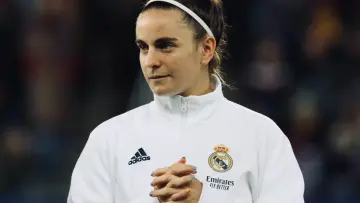
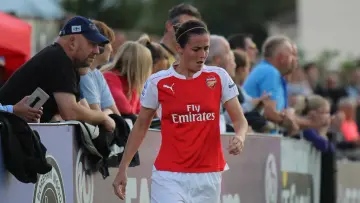
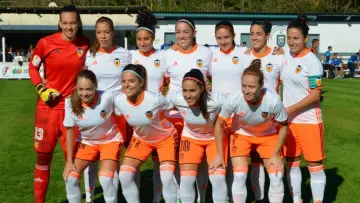
Her biography is a map of the women’s football of her time, with everything that implies in terms of upping sticks and starting from scratch. She made her name at Sporting de Huelva, passed through Sabadell and Rayo Vallecano — the club of her own neighbourhood — crossed the Atlantic to play for the Western New York Flash in the United States, shone at Barça and closed the circle at Atlético de Madrid and Levante, where she retired in 2020. Nine league titles split between Rayo, Barça and Atlético, and three Copa de la Reina trophies, one with each. With Spain she scored 35 goals in 63 caps and lived through a founding moment: the first World Cup in Spain’s history, at Canada 2015.
She played, in short, almost her entire career in the years when being a footballer in Spain was still an act of faith, right before professionalisation arrived. Too late to be a black-and-white founding myth; too early to enjoy the industry she helped to build. That in-between zone of the story — the players who didn’t just win, but quickened the pace between survival and the elite — is hers.
From goalscorer to dugout
What’s interesting is what she did next, because that’s where the character shows. Instead of cashing in on her name, Bermúdez took on the quiet work of player development. She started at the bottom, with Real Madrid’s youth side, and from there moved up through the Federation: under-15s, under-19s, under-23s. Youth ranks, yes, but in Spain they’re no minor matter: they’re the laboratory where it’s decided how an idea of play is passed on and how young players are prepared for an ever more demanding senior side. With the under-19s she won two consecutive European Championships, in 2023 and 2024 — the second in a penalty shoot-out final against Germany — developing precisely the players now beginning to break through above.
That was her case. In August 2025, the RFEF chose her to replace Montse Tomé at the helm of the senior team, with Iraia Iturregi — formerly of Athletic, one of the most respected coaches in the country — as her assistant. The move had something of an internal handover about it, but also of a symbol: the women who had sustained the game’s growth were now to steer its next phase. Bermúdez began by speaking of the veterans with respect — “Jenni Hermoso is a legend,” she said — while pushing the youngsters forward without hesitation.
Inheriting a machine
The line at her unveiling was as lovely as it was perilous: to coach the best team in the world. Because that’s the paradox of the job. Bermúdez didn’t inherit a side in rebuild, but a world champion, a squad full of talent and an enormous weight of expectation. Before, Spain dreamed of arriving; now they have to win. And that difference changes everything.
Her first competitive block confirmed the challenge wasn’t too big for her. Spain retained the Nations League in late 2025 — 4-0 against Sweden in the semi-finals, 3-0 against Germany in a final settled in Madrid — and put qualification for the 2027 World Cup in Brazil on track with authority: a 4-0 win over England at Son Moix, one of the national team’s best performances in years, and a thrashing in Iceland to seal direct qualification. In a few months, she went from a bet with questions to a coach with answers.
It doesn’t mean everything is settled: no Spain coach lives in a comfort zone any more. Every absence is read into, every adjustment scrutinised, every match measured not only by the result but by the sense of control. Bermúdez has tried to keep the team’s identity without freezing it: Spain still want the ball, but in her version there’s a more vertical intent, an eagerness to hurt sooner, to stop possession becoming mere aesthetic routine. It isn’t a break. It’s a nuance. And sometimes nuances are what separate a coach who inherits from a coach who leads.
Someone who helped build the ladder
There’s something circular in all this. The forward who scored goals to open up space when almost no one was watching now coaches players who were born with role models, structure and a far wider horizon. The international who played Spain’s first World Cup is now preparing the defence of a star. And her double legitimacy — she knows the veterans because she shared a dressing room with many of them, and the youngsters because she developed them — is no minor detail in a group where legends, players in their prime and talents banging on the door all coexist.
The spotlight reached her late as a player. As a coach, she has decided she doesn’t need it: she works, she wins and she lets the results do the talking. Because Sonia Bermúdez hasn’t reached the summit as a visitor. She has reached it as someone who helped build the ladder.