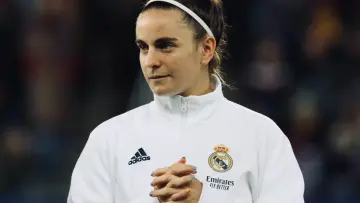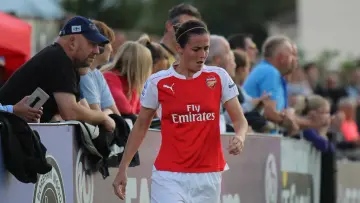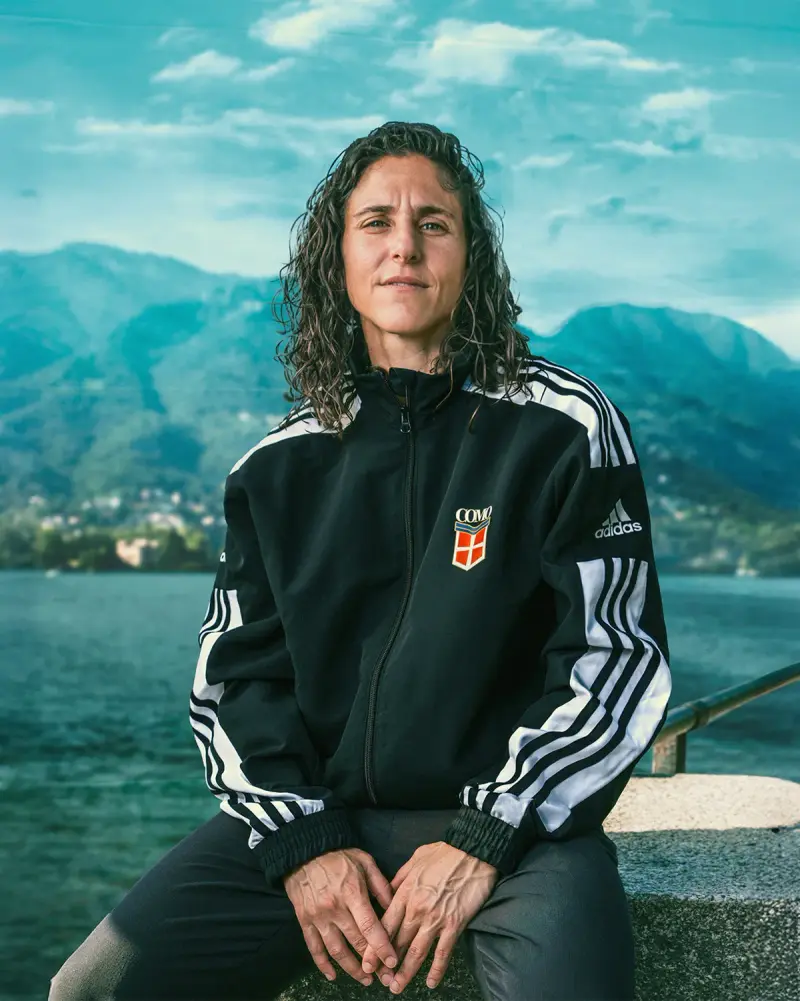
There’s an unfair way to tell Vero Boquete’s story: as if she belonged solely to the past. As if she were a sepia photograph of Spanish women’s football, a historic captain, a pioneer handy for explaining where we come from but not necessarily where we are.
The trouble is that Vero doesn’t allow herself to be filed away so easily.
At 39, Verónica Boquete Giadáns is still competing, still changing countries, still choosing projects with a hint of frontier about them, and still forcing her career to be written in the present tense. The latest stop has been Como 1907, a club that in the summer of 2025 was preparing for its adventure in the Italian women’s Serie B and has ended the season celebrating promotion to Serie A, with the Galician as captain.
Another move. Another dressing room. Another door.
The one who left when leaving was strange
Boquete’s career is better understood by looking at a map than at a statistics table. Santiago de Compostela, Zaragoza, Barcelona, the United States, Sweden, Germany, France, China, Italy. Some footballers build a career by collecting titles. She built hers by collecting routes as well.
When she started out, Spanish women’s football didn’t yet offer a professional structure capable of sustaining long, recognised, well-paid careers. For many players, the ceiling was too close. For Boquete, the answer was to leave.
It wasn’t a romantic postcard or an exotic adventure. It was a working decision. To go where the training was better, where the competition was higher, where women’s football was already some years ahead. In her case, leaving wasn’t running away: it was looking for the place where her talent would have a real chance.
In time, that route came to seem normal. Today a Spanish footballer can sign for England, Italy, Mexico, the United States or Germany without anyone treating it as a curiosity. But there was a time when doing so was almost a statement of intent. Before exporting Spanish women’s talent became a trend, Vero was already abroad, showing there was a wider world out there.
An international scrapbook hard to match
Boquete’s footballing passport carries names that count. Portland Thorns, Tyresö, Frankfurt, Bayern Munich, Paris Saint-Germain, AC Milan, Fiorentina. Few CVs explain the recent history of European and American women’s football quite so well.
In Sweden she played for that Tyresö side that gathered talent from across the world. In Germany she reached a summit that seemed impossibly distant for a Spanish footballer at the time: the women’s Champions League. In 2015, with Frankfurt, she became the first Spaniard to win the great European club title. A year earlier she had already been named among FIFA’s candidates for best player in the world, when Spain was still learning to see itself as a top-tier national team.
That’s Vero’s paradox: many of her triumphs arrived before the country was ready to celebrate them in full.
She wasn’t just a good footballer outside Spain. She was an uncomfortable piece of evidence. Proof that Spanish talent existed but, too often, needed to leave to be taken seriously.
Captain of a Spain that hadn’t won yet
Boquete was also captain of a Spain side that looked nothing like today’s. Not the world champions, not the team of Ballon d’Or winners, not the one that takes finals for granted. Hers was the Spain that was beginning to force its way through, the one still fighting to reach the major tournaments and to be treated with the minimum respect the elite demands.
With the senior national team she gathered 62 caps and 38 goals. She was a key part of qualification for the 2013 European Championship and for the 2015 World Cup in Canada, the first in Spain’s history. But her role can’t be understood through matches and goals alone. It also has to be understood through her voice.
After that World Cup, the Spanish internationals publicly called for change. They demanded different preparation, a different structure, a different way of treating the team. It came at a cost. As so often in women’s football, raising your voice didn’t come free. But it also left a seed behind.
The generation winning today didn’t appear out of nowhere. It walked onto ground that others had hardened first. And Vero Boquete was one of those who walked it when it was still full of stones.
Como 1907: another frontier, another promotion
The easy thing would have been to turn the final stretch of her career into a long goodbye. One last quiet contract. A tribute season. A decorative kind of veteranship.
Boquete chose something else.
In July 2025 she signed for Como 1907, a women’s project preparing to compete in the Italian Serie B after acquiring the sporting title of Chievo Women. It wasn’t the most obvious destination for a player with her history. She arrived from four seasons at Fiorentina and could have chosen a more comfortable storyline. But Como offered something that fits her career closely: building.
The club didn’t present her merely as an experienced footballer. It presented her as a figure called on to guide a young and ambitious squad. And that’s exactly what ended up happening.
Como won Serie B with three matchdays to spare and secured promotion to the women’s Serie A. At the celebration, Boquete spoke as captain. Not as a marquee guest, not as a name on the poster, but as part of a group that had taken on the pressure of winning and turned it into a title.
At 39, Vero did once again what she has done so many times: arrive somewhere, read what was missing and help to build it up.
The pioneer who refuses to be a statue
The word pioneer carries a danger: it can sound like a museum. It serves to acknowledge, but also to set aside. It places a footballer in a display case, thanks her and leaves her there, still, as if her main function were to have existed before the rest.
With Boquete it doesn’t work.
Yes, she was a pioneer. Yes, she cleared a path. Yes, she helped make it normal for a Spanish footballer to leave, compete, win, lead and leave again. But to reduce her to that would be to fall short. Because she didn’t just open a door: she kept walking through it.
Every new generation of Spanish players who sign abroad without asking permission carries something of that first decision. Every footballer who sees a move overseas not as exile but as opportunity walks on ground that Vero helped to make less strange.
But her story doesn’t end there. It doesn’t end with Frankfurt’s Champions League, or Spain’s armband, or the Fiorentina years, or even Como’s promotion. As long as she keeps competing, the right phrase isn’t “Vero Boquete was”.
The right phrase is simpler.
Vero Boquete carries on.