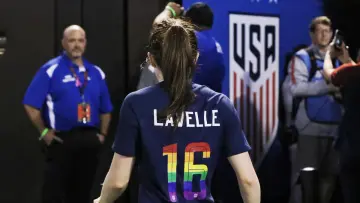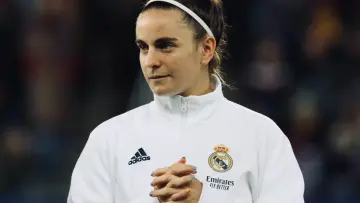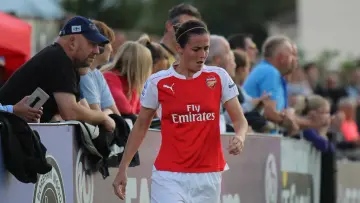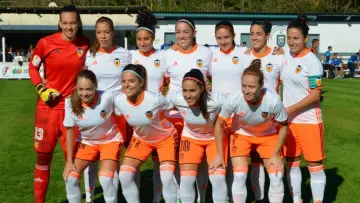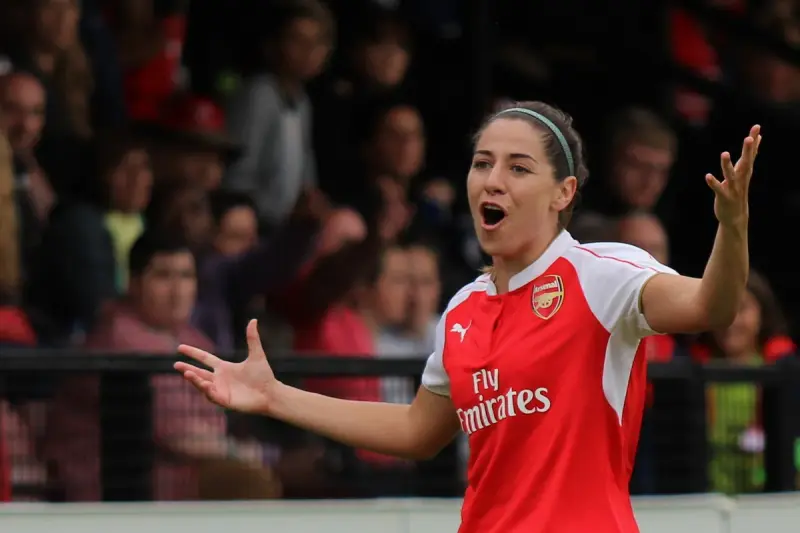
Vicky Losada has chosen the road home.
At a time when several of Liga F’s most recognisable players are moving to England, the Catalan midfielder is returning to Spain five years after leaving Barcelona. She joins FC Badalona Women on a season-long loan from Bristol City, around 30 kilometres from Terrassa, where her story began.
It is more than a geographical return. Losada has acknowledged that she also needed to come back for emotional reasons and wants to enjoy the final years of her career in a football culture that feels closer to her own.
At 35, she no longer needs to discover how far she can go. She has won the Champions League, six league titles, seven Copas de la Reina, an FA Cup and a Serie A. She has played in Spain, the United States, England and Italy. She represented Spain at two World Cups and two European Championships and, against Costa Rica at Canada 2015, scored the country’s first goal at a Women’s World Cup.
The challenge now is different: deciding how she wants to navigate the final stage of her career.
Losada joined Barcelona’s academy in 2004, aged 13, and made her first-team debut in 2006. That Barcelona bore little resemblance to the side that would eventually dominate Europe. The players trained at night, endured endless bus journeys and approached matches without the analysis, recovery and preparation resources that are now part of everyday life at a professional club.
She witnessed the entire transformation.
Losada was there when Barcelona were still trying to establish themselves in Spain, left to experience other football cultures and returned to take part in the club’s definitive rise. She played for Western New York Flash, won the FA Cup with Arsenal and returned to Barcelona in 2016. Five years later, she was part of the leadership group that defeated Chelsea in Gothenburg and won the first Champions League title in the section’s history.
She was not merely a Barcelona player who happened to be there when the winning began. She was one of those who knew the club before victory started to feel inevitable.
Her career offers a measure of how far Spanish women’s football has travelled. Losada began in a game without television coverage, major sponsors or fully professional structures and ended up competing for Europe’s biggest trophies. Asked by UEFA in 2021 about the difference between those two eras, she recalled that the players could not even study their opponents in the early years because they lacked the resources to analyse themselves.
After becoming a European champion, she left Barcelona for a third time.
She spent two seasons at Manchester City, had a brief spell with Italian champions Roma and returned to England to captain Brighton. In 2025, she signed a three-year contract with Bristol City and was again given the armband. The club were aiming to return to the English top flight and turned to a player accustomed to carrying responsibilities beyond her position on the pitch.
She is now temporarily stepping away from that project to return to Liga F.
FC Badalona Women are not merely adding a decorated career to their squad. They are signing a midfielder whose game has always been built around understanding what a team needs: offering an outlet, keeping possession moving, recognising where an extra player is required and controlling the tempo without every touch needing to become a decisive action.
Age may have reduced her ability to cover large areas of the pitch, but it has also expanded her capacity to interpret what is happening around her. Her contribution will depend on Marc Ballester finding the right context to protect her and make use of what still sets her apart: her reading of the game, her composure and her experience of bringing order to uncomfortable matches.
She will also have another role.
The club have presented her arrival as a central part of a project seeking to grow within Liga F. Losada knows what it means for a structure to change from within because she already travelled that path at Barcelona. She experienced the demands for better pitches and working conditions before becoming part of an organisation capable of competing with anyone in Europe.
She does not join FC Badalona Women to recreate that story or promise an immediate transformation. She arrives to pass on some of what she learned to a team still building its place in the competition.
Losada has also started to look beyond the pitch. She has spoken about helping to increase the club’s visibility, opening doors for the girls who will follow and the possibility of becoming a coach one day. Trophies, she now admits, no longer explain everything she wants from football.
That is why her return does not feel like an early retirement.
Vicky Losada is moving closer to home, but she is not returning to her starting point. She comes back after watching a team that trained at night become European champions, after learning different footballing languages and after captaining three different clubs.
She still wants to play. She also wants to pass on everything she had to learn while women’s football was changing around her.
FC Badalona Women will be the next club of her playing career. They may also become the first step on the path she chooses once she is no longer a footballer.