Primera Federación Femenina is the division immediately below Liga F.
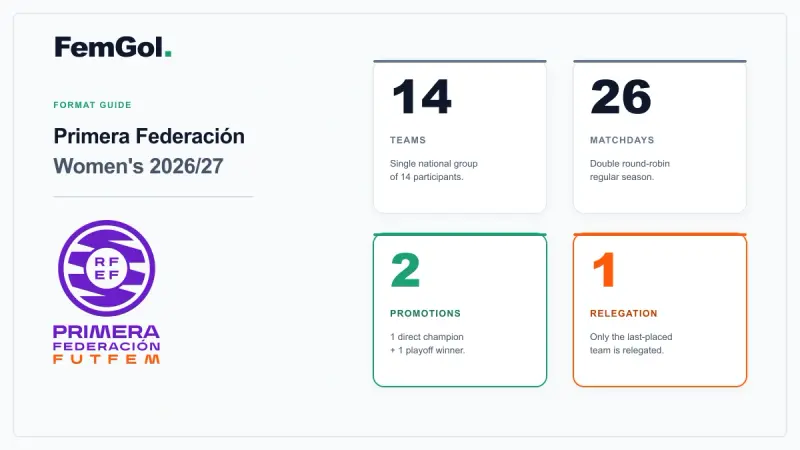
Its format appears straightforward: a fourteen-team league, two promotion places and one relegation place. However, the play-off system and the presence of reserve teams mean that the standings cannot always be read literally.
These are the basic rules for the 2026/27 season.
Fourteen teams and 26 matchdays
Primera Federación is contested in a single group of fourteen teams:
Alhama CF, Athletic Club B, Atlético de Madrid B, Cacereño Femenino, CD Alba Femenino, CD Tenerife Femenino B, FC Barcelona B, Levante UD, Osasuna, Real Madrid B, Real Sociedad B, Real Unión de Tenerife, Sportextremadura CD and Villarreal CF.
During the regular season, each team faces the other thirteen twice: once at home and once away. The season therefore consists of 26 matchdays.
The regular season begins on the weekend of 12 and 13 September 2026 and ends on 9 May 2027. The play-offs follow, with the promotion phase finishing on the weekend of 5 and 6 June.
The usual points system applies: three points for a win, one for a draw and none for a defeat.
Two promotion places to Liga F
The division awards two promotion places.
The team that finishes the regular season in first place earns automatic promotion to Liga F, provided that it is eligible to take the place.
The second promotion place is decided through a four-team play-off: the four highest-placed sides eligible to go up, behind whichever club takes the automatic place. The rules put them second to fifth, but a reserve team that cannot take part pushes the cut-off further down.
The semi-finals pair those four:
- The highest-placed against the fourth.
- The second against the third.
The winners of the two semi-finals then meet in the final. Both the semi-finals and the final are played over two legs.
How the play-offs are decided
The lower-ranked team plays the first leg at home. The higher-ranked team hosts the second leg.
If the aggregate score is level after the two matches, thirty minutes of extra time are played, in two halves of fifteen. Teams carry into it whatever substitutions and stoppages they have not used, and gain one more substitution and one more opportunity to make it.
The position earned during the regular season remains important until the end: if the tie is still level after extra time, there is no penalty shoot-out. The team that finished higher over the 26 matchdays advances.
The winner of the final earns the second promotion place to Liga F.
What happens with reserve teams
Reserve or affiliated teams compete in the same standings and can finish in any position, including first.
They can also be crowned Primera Federación champions. What they cannot do is earn promotion or take part in the play-offs when their senior team is already competing in Liga F.
In that situation, the right to promotion or play-off participation passes to the next eligible team in the standings.
This means that the table can be read in two different ways: the overall sporting standings, which include every participant, and the promotion race, which includes only the teams eligible to move up.
In 2026/27 that is not a hypothetical. Six of the fourteen entrants are reserve teams — Athletic Club B, Atlético de Madrid B, FC Barcelona B, Real Madrid B, Real Sociedad B and CD Tenerife Femenino B — and all six have their senior side in Liga F. None of them can go up. The two promotion places are therefore contested by the other eight clubs: the best of them is promoted automatically and the next four play the play-off.
The presence and influence of reserve teams in the division raise further questions beyond this rule. FemGol examines them in Primera Federación Femenina: the reserve-team league has a solution.
One relegation place
Only one team is relegated during the 2026/27 season.
The side that finishes the regular season in fourteenth and last place is relegated directly to Segunda Federación. The other thirteen retain their place in the division on sporting merit.
The season works as a bridge to the division’s expansion to 28 teams in 2027/28, which is why only one side goes down: four were relegated last season.
What happens when two teams finish level on points
With a single relegation place and a play-off cut-off that can move, finishing level on points decides a great deal.
Between two teams, the first criterion is not overall goal difference but the goal difference across the two matches they played against each other. After that come overall goal difference, goals scored, the fair-play criteria and, as a last resort, a match at a neutral venue.
When more than two teams are level, a separate table is drawn up using only the matches between them, and the points in that mini-table come first.
What does not work the way it does in Liga F
The transfer window is the same: the summer one runs from 1 July until 23:59 on 18 September 2026, and the winter one from 2 January until 23:59 on 2 February 2027.
The rest is different.
A club can register up to 25 players, as in Liga F, but here there is an age cap: no more than eighteen of them can be over 23. There is a floor, too, of eighteen licences.
The bench holds seven substitutes, against twelve in Liga F, with the same five changes spread across three stoppages.
There is no FVS. The division’s rules make no provision for it; Liga F’s do, as its own guide explains.
Matches are played on Sundays between 11:00 and 21:00, and can be brought forward to Saturday within the same window. Midweek fixtures run from Tuesday to Thursday, between 17:00 and 22:00.
One rule only makes sense with a map in front of you: when a club from the Canary Islands or the Balearics plays on the mainland, or a mainland club travels to the islands, the match must be played on a Sunday and kick off no later than 12:00. This season that covers the division’s two Tenerife sides.
And the last two matchdays kick off at the same time in every match that could decide the title, the play-offs or relegation.
Primera Federación can therefore be summarised in four figures: 14 teams, 26 matchdays, two promotion places and one relegation place.