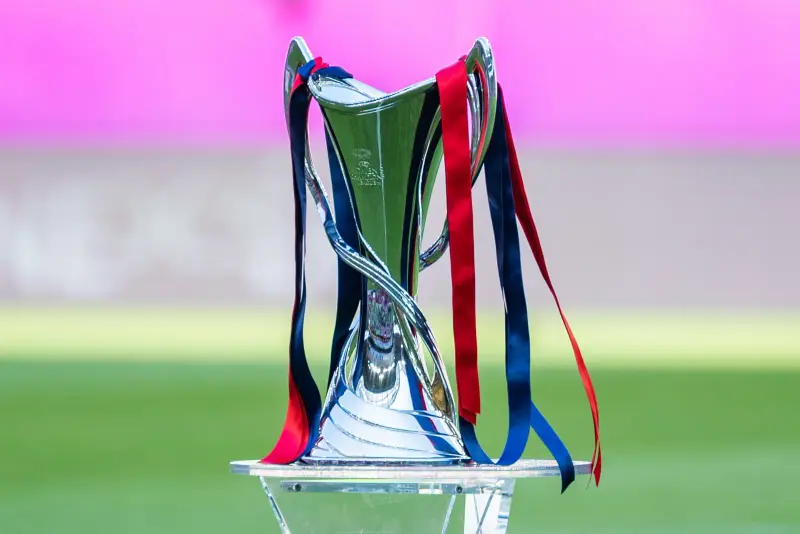
The Women’s Champions League does not have groups. Its long phase is an 18-team league with a single table, in which every club plays six matches against six different opponents — three at home, three away — and never faces most of the table. Three different fates come out of that table, and this is the part worth understanding before September: finishing eighth and finishing thirteenth have nothing in common.
Spain’s season runs on two calendars. One starts on 26 August and belongs to Real Madrid and Real Sociedad, who have to win a tie in the third qualifying round. The other starts on 22 September and belongs to FC Barcelona, who go straight into the league phase.
This is FemGol’s guide to following the competition.
The format: 18 teams, three fates
The 18 clubs in the league phase are drawn from three seeding pots by club coefficient, and each one gets two opponents from every pot, one at home and one away. The holders are the top seed in pot one. Three points for a win, one for a draw, one table for everyone.
When the six matchdays are done, the table splits three ways:
- 1st to 4th: straight into the quarter-finals.
- 5th to 12th: into the knockout phase play-offs.
- 13th to 18th: eliminated.
Those play-offs are not a round of 16. Eight clubs are paired over two legs and four come out, not eight; those four join the top four from the table to make up the quarter-finals.
And the top four are protected twice over: as well as skipping the play-offs, they are seeded in the quarter-finals and play the second leg at home. Finishing fourth rather than fifth is the difference between one tie and two.
One regulation detail that settles level points: in the league phase, goals scored away do break ties — it is the third criterion, after goal difference and goals scored — and there is no head-to-head record, because with a single table and one match between rivals it often does not exist.
Spain’s three clubs
Spain has three clubs in the competition and no more.
FC Barcelona go straight into the league phase as European champions: they beat OL Lyonnes 4-0 in Oslo on 23 May 2026 for a fourth title.
They would have gone straight in without that title, though. UEFA gives a league-phase place to the champions of the top six associations in its ranking, and Spain are third: winning Liga F is already worth a direct place. Because Barcelona met both conditions at once, the slot they freed up went to Häcken.
Eight more clubs join Barcelona directly in the league phase: Arsenal, Manchester City, Bayern Munich, Benfica, Häcken, OL Lyonnes, Paris FC and Roma. The other nine places in the table come through the third qualifying round.
Real Madrid and Real Sociedad enter in the third qualifying round, alongside Chelsea, Inter, Paris Saint-Germain, Sparta Praha and Wolfsburg. Those are the seven clubs UEFA places in that round without having played the earlier ones; the other eleven come through the second qualifying round.
And that round is not one single draw: it runs along two paths. Real Madrid and Real Sociedad are both in the league path, with Chelsea, Inter, Paris Saint-Germain, Wolfsburg and four survivors from the second qualifying round: ten teams, five ties. Sparta Praha are in the other one, the champions path, so they could not be drawn against them. And the regulations bar ties between clubs from the same association, so Real Madrid and Real Sociedad could not be drawn against each other either. For Real Sociedad, the tie arrives in a season where even a return to Zubieta counts as coming back the long way round.
The draw on 11 August: Ajax and Chelsea
The draw was held in Nyon and left both Spanish clubs at home in the second leg.
Real Madrid face Ajax: first leg in Amsterdam on 26 August, return in Madrid on 2 September. Real Sociedad meet Chelsea, the highest-coefficient side they could have drawn: first leg in London, return in San Sebastián.
The nine ties came out as follows, and each one has its own page in the bracket.
League path, five ties:
- Eintracht Frankfurt – Paris Saint-Germain
- SKN St. Pölten – Juventus
- Wolfsburg – Inter
- Chelsea – Real Sociedad
- Ajax – Real Madrid
Champions path, four:
The club listed first is the one drawn first and, under the regulations, plays the first leg at home. That being seeded carries no home advantage showed up twice: PSV and Eintracht Frankfurt were not seeded and still open at their own ground.
Why Real Madrid and Real Sociedad have to qualify
This is not one season’s bad luck; it is the rule. UEFA reserves direct places in the league phase for the European champions, for the champions of the top six associations in the ranking and for the runners-up of the top two, which this season are England and France.
Spain are third in that ranking, so their champions go straight in but their runners-up do not. That is the whole difference: the Liga F champions reach the league phase; the second and third-placed sides have to earn it. Which is why Real Madrid, who finished second, and Real Sociedad, third, start on 26 August. For the detail of how European places are shared out in Spain, see how Liga F works.
The fixtures, round by round
Every tie is played over two legs — from the third qualifying round to the semi-finals — and only the final is a single match.
| Round | Dates |
|---|---|
| Third qualifying round | First leg 26 August · second leg 2 September |
| League phase · MD1 | 22-23 September |
| League phase · MD2 | 30 September and 1 October |
| League phase · MD3 | 28-29 October |
| League phase · MD4 | 10-11 November |
| League phase · MD5 | 18-19 November |
| League phase · MD6 | 16 December |
| Knockout phase play-offs | First leg 3-4 February 2027 · second leg 10-11 February |
| Quarter-finals | First leg 23-24 March · second leg 31 March and 1 April |
| Semi-finals | First leg 1-2 May · second leg 8-9 May |
| Final | 28, 29 or 30 May, at the Stadion Narodowy in Warsaw |
Matchday six is the only one played on a single day: on the final night every match kicks off at the same time, so no team walks out already knowing what it needs.
Two draws are left: the league phase on 4 September and the whole knockout bracket — play-offs, quarter-finals, semi-finals and final — on 18 December. Both in Nyon, and both with a date UEFA flags as subject to change. The third qualifying round draw was held on 11 August.
How a tie is won
Whoever scores more goals across the two legs goes through. Away goals do not count double: if the aggregate is level, a single 30-minute period of extra time — two halves of 15 — is played at the end of the second leg and, if it is still level, penalties. The current regulations do not so much as mention the away-goals rule.
In the third qualifying round, the club drawn first plays the first leg at home. And one caveat worth not denying: the regulations allow UEFA to decide that a tie be settled over a single match if circumstances require it.
Losing in qualifying does not mean losing Europe
Clubs knocked out in the third qualifying round drop into the second qualifying round of the Women’s Europa Cup, the second continental club competition. So if Real Madrid or Real Sociedad lose their tie, their European season does not end on 2 September. And it is not a back door: Häcken are in this season’s Champions League league phase because they won the Europa Cup. Going out in qualifying does not just keep you playing in Europe; it can take you back through the front door. No Spanish club has a direct place in that competition, but the one for the eliminated exists.
How to watch it
From the league phase onwards, on Disney+. The platform holds the European rights for five seasons, from 2025/26 to 2029/30, and the package covers the 75 matches that run from the league phase to the final.
The qualifying rounds sit outside that package, and this is the part worth knowing before 26 August: the regulations leave the rights to each qualifying-phase match with the club or association playing at home. It is not UEFA’s call or Disney+’s.
With the draw made, that now has names on it. The two first legs are Ajax’s and Chelsea’s to sell, one each; the two second legs belong to Real Madrid and Real Sociedad. In other words: of the four matches the Spanish clubs play, where two of them can be watched is their own decision.
None of the four has a broadcaster announced yet, and no free-to-air broadcast has been confirmed for this season either. This section is updated as soon as the clubs announce it.
What is not known yet
Two things, and both have a date:
- Kick-off times for the third qualifying round: UEFA has set the days — 26 August and 2 September — and has not published a single time. That is why the match pages carry the day and not the hour: we would rather leave the gap than invent the data.
- The 18 clubs in the league phase, which are not settled until the third qualifying round ends on 2 September.
What did get settled on 11 August is the pairings, which came out of the third qualifying round draw.
This guide is updated at this same address with every draw and every shift in the table.